Study Permit Documents: Complete Checklist and Requirements

Studying abroad is an exciting journey that opens doors to world-class education, cultural experiences, and global career opportunities. However, navigating the study permit application process can feel overwhelming, especially when dealing with complex documentation requirements and varying procedures across different countries.
This comprehensive guide will walk you through everything you need to know about study permit documents, from universal requirements to country-specific checklists, ensuring you’re fully prepared for a successful application.
What is a Study Permit?
A study permit (also known as a student visa) is an official document issued by a country’s immigration authorities that allows international students to pursue education at recognized institutions. Unlike tourist visas, study permits are specifically designed for academic purposes and often include additional benefits such as work authorization and pathways to permanent residence.
The application process typically involves multiple stages, from initial university acceptance to final visa approval, with specific documentation requirements that vary by destination country. Understanding these requirements early in your planning process is crucial for avoiding delays and ensuring a smooth application experience.
Universal Document Requirements
Regardless of your chosen destination, certain documents are required by virtually all countries for study permit applications. These universal requirements form the foundation of your application and should be prepared first.
Essential Documents
Every study permit application requires these core documents:
- Valid passport with at least 6 months validity beyond your intended stay
- Passport-size photographs meeting specific country requirements
- Letter of acceptance from a recognized educational institution
- Completed visa application form specific to your destination country
- Proof of application fee payment with official receipts
Financial Documentation
Demonstrating sufficient funds is critical for any study permit application. Required financial documents include:
- Bank statements covering the last 3-6 months
- Proof of tuition fee payment or payment receipts
- Scholarship documentation if receiving financial aid
- Education loan approval letters with terms and conditions
- Sponsor’s financial documents including income proof and bank statements
- Tax returns from the applicant or financial sponsor
Academic Requirements
Your educational background must be properly documented and verified:
- Official transcripts from all previous educational institutions
- Degree certificates and diplomas with official translations if needed
- Standardized test scores such as IELTS, TOEFL, GRE, GMAT, or SAT
- Language proficiency certificates meeting destination country requirements
- Academic recommendation letters from teachers or professors


Official document checklist for a study permit application from Immigration, Refugees and Citizenship Canada
Country-Specific Requirements
While universal documents form the foundation, each destination country has unique requirements that must be carefully understood and fulfilled.
Canada Study Permit Requirements
Canada has implemented significant changes to its study permit system in 2024, making it essential to understand the latest requirements.
Mandatory Documents:
- Provincial Attestation Letter (PAL) – Required from 2024 for most provinces
- Letter of Acceptance from a Designated Learning Institution (DLI)
- Proof of financial support covering tuition plus CAD $10,000 for living expenses
- Family Information Form (IMM 5707) completed accurately
Conditional Requirements:
- Medical examination if from certain countries or studying over 6 months
- Police clearance certificate based on residence history
- Custodian declaration for applicants under 18 years
- Québec Acceptance Certificate (CAQ) for students in Quebec
United States F-1 Visa Requirements
The US student visa process involves specific forms and procedures managed by the SEVIS system.
Core Documents:
- Form I-20 issued by your SEVP-certified institution
- DS-160 confirmation page with barcode
- SEVIS fee payment receipt (Form I-901) – currently USD $350
- Visa interview appointment letter
Supporting Documentation:
- Financial evidence covering the amount specified on Form I-20
- Form I-134 Affidavit of Support if sponsored by someone in the US
- All previous passports with travel history
- University acceptance and rejection letters from the application process
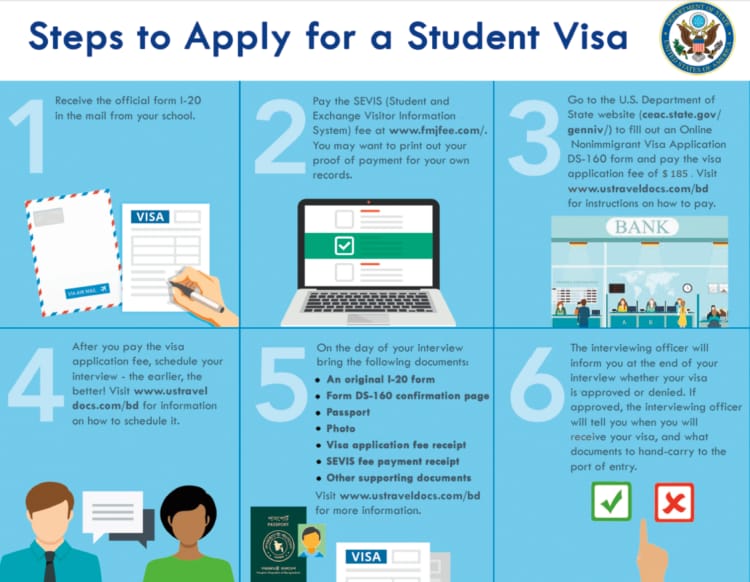
An infographic detailing the six steps to apply for a student visa, including required documents and the interview process
United Kingdom Student Visa Requirements
The UK uses a points-based system with specific documentation requirements.
Essential Documents:
- Confirmation of Acceptance for Studies (CAS) from your institution
- Financial evidence showing £1,483 per month for London or £1,136 per month outside London
- English language test certificate meeting SELT requirements
- Academic Technology Approval Scheme (ATAS) certificate if required for your subject
Additional Requirements:
- Tuberculosis test results if from high-risk countries
- Parental consent documents for applicants under 18
- Financial sponsor consent letter if applicable
Australia Student Visa Requirements
Australia’s student visa system emphasizes genuine temporary entrant criteria and health insurance requirements.
Primary Documents:
- Confirmation of Enrolment (CoE) for all intended courses
- Overseas Student Health Cover (OSHC) for the entire study period
- Genuine Temporary Entrant (GTE) statement explaining your intentions
- Financial capacity evidence showing minimum AUD $29,710 annually
Health and Age Requirements:
- Health examination if from countries with health risks
- Welfare arrangements documentation for students under 18
- Form 1229 parental consent if under 18 and parents not applying
Language Proficiency Requirements
English language proficiency is a critical requirement for most study destinations, with specific score requirements varying by country and academic level.
| Country | Study Level | IELTS Overall | IELTS Each Band | TOEFL iBT | Alternative Tests |
|---|---|---|---|---|---|
| Canada | Undergraduate/Diploma | 6.0 | 5.5 minimum | 80-90 | CELPIP, PTE |
| Canada | Graduate/Masters | 6.5 | 6.0 minimum | 90-100 | CELPIP, PTE |
| Canada | Engineering/Teaching | 7.0 | 7.0 minimum | 100+ | CELPIP, PTE |
| USA | Varies by University | 6.0-7.0 | Varies | 80-100 | Duolingo accepted by some |
| USA | Top Universities | 7.0+ | 6.5+ each | 100+ | GRE/GMAT may substitute |
| UK | Below Degree Level | 5.5-6.0 | 5.5 minimum | 72-87 | PTE, Cambridge SELT |
| UK | Degree Level | 6.0-6.5 | 6.0 minimum | 87-94 | PTE, Cambridge SELT |
| UK | Competitive Programs | 7.0+ | 6.5+ each | 100+ | PTE, Cambridge SELT |
| Australia | Most Programs | 6.0-6.5 | 6.0 minimum | 79-94 | PTE, Cambridge CAE |
| Australia | Competitive Programs | 7.0+ | 6.5+ each | 94+ | PTE, Cambridge CAE |
Most countries accept multiple English proficiency tests, but requirements differ significantly.
For Canada, undergraduate programs typically require IELTS 6.0 overall with 5.5 in each band, while graduate programs need 6.5 overall with 6.0 minimum in each section. The United States varies by institution, but top universities often require IELTS 7.0+ or TOEFL 100+.
The UK uses the Common European Framework of Reference (CEFR) scale, requiring B1 level for below-degree programs and B2 for degree-level studies. Australia generally requires IELTS 6.0-6.5 for most programs, with competitive programs demanding higher scores.
Application Process and Timeline
Understanding the application timeline is crucial for successful study permit applications. The process typically involves several sequential stages, each with specific timeframes and requirements.

The study permit application process follows a structured sequence that begins months before your intended start date. Document preparation typically takes 2-4 weeks, requiring careful gathering and organization of all required materials. Application submission methods vary by country, with most now using online platforms such as Canada’s IRCC secure account, the US DS-160 system, UK’s gov.uk portal, and Australia’s ImmiAccount.
Following submission, biometrics appointments are usually scheduled within 1-2 weeks. This process involves fingerprinting and photographing for identity verification and security purposes.
Processing times vary significantly by destination, with Canada averaging 6 weeks, the US taking 2-8 weeks, the UK processing applications in 3-4 weeks, and Australia requiring 16-49 days.
| Stage | Canada | USA (F-1) | UK | Australia |
|---|---|---|---|---|
| Document Preparation | 2-4 weeks | 3-6 weeks | 2-4 weeks | 2-4 weeks |
| Application Submission | Online submission | Online DS-160 + scheduling | Online application | Online ImmiAccount |
| Biometrics Appointment | 1-2 weeks after submission | 1-2 weeks after payment | 1-2 weeks after submission | 1-2 weeks after submission |
| Processing Time | 6-60 days (avg 6 weeks) | 2-8 weeks | 3-4 weeks | 16-49 days (avg 4-5 weeks) |
| Interview (if required) | Rarely required | Always required | Sometimes required | Rarely required |
| Decision & Visa Issuance | 1-2 weeks after approval | 3-5 days after approval | 1-2 weeks after approval | 1-2 weeks after approval |
Processing Times and Costs
Study permit applications involve various costs and processing timeframes that prospective students must plan for carefully.

Study Permit Processing Times and Application Fees Comparison
Application fees vary considerably across destinations. Canada charges CAD $150 (approximately USD $110) for study permit applications. The United States requires USD $160 for the visa application plus USD $350 for the mandatory SEVIS fee, totaling USD $510.
The United Kingdom charges GBP £490 (approximately USD $600) for student visa applications. Australia has the highest fees, ranging from AUD $710 to $1,600 (USD $500-$1,200) depending on the applicant’s circumstances.
Processing times reflect the complexity and volume of applications each country receives. Canada’s processing time ranges from 6-60 days, with an average of 6 weeks for most applications. The United States typically processes F-1 visas within 2-8 weeks, though interview scheduling can add additional time.
The UK offers relatively fast processing at 3-4 weeks for most applications. Australia’s processing time of 16-49 days reflects their thorough assessment procedures.
Common Mistakes to Avoid
Understanding frequent application errors can significantly improve your chances of approval. The most common mistake is incomplete or incorrect documentation, which accounts for a significant percentage of study permit refusals. Applicants often fail to provide proper proof of acceptance, identity documentation, or financial capability.
Weak proof of financial support represents another major pitfall. Immigration officers need clear evidence that applicants can afford tuition fees, living expenses, and return travel. Submitting inconsistent financial documents or failing to show sufficient funds beyond minimum requirements often results in rejection.
A poorly written Statement of Purpose (SOP) can undermine an otherwise strong application. Generic, unclear, or unconvincing statements about educational goals and career plans raise concerns about the applicant’s genuine intentions. The SOP should clearly explain why you chose the specific program, how it connects to your background, and your long-term career objectives.
Failing to demonstrate ties to your home country is particularly problematic for temporary visa applications. Immigration officers need assurance that you will return home after completing your studies. Strong ties include property ownership, job offers, family connections, or other compelling reasons to return.
Delayed application submission creates unnecessary stress and reduces flexibility for corrections or additional requirements. Applying too close to program start dates leaves little room for processing delays or document resubmission.
Health and Medical Requirements
Many countries require medical examinations or specific health documentation as part of the study permit process. These requirements typically depend on your country of origin, intended length of stay, and field of study.
Canada requires medical examinations for students from certain countries or those planning to study for more than six months. The examination must be conducted by an approved panel physician and includes general health assessment, chest X-rays, and blood tests if necessary. Students in healthcare fields or those working closely with children or elderly populations may face additional requirements.
The United States occasionally requires medical examinations, particularly for students from countries with specific health risks. The US embassy or consulate will inform applicants if a medical exam is required and provide a list of authorized physicians.
The United Kingdom requires tuberculosis testing for students from high-risk countries who plan to stay longer than six months. The test must be conducted at an approved clinic and results must be provided with the visa application. Students who have lived in the UK for less than six months but are resident in TB-risk countries still require testing.
Australia mandates health examinations for students from countries with health risks or those applying for extended stays. The examination includes general health assessment and chest X-rays, with additional tests based on individual circumstances and country of origin.
Tips for a Successful Application
Maximizing your chances of study permit approval requires careful preparation and attention to detail. Start your application process 4-6 months before your intended program start date to allow adequate time for document gathering, processing, and potential complications.
Organize your documents meticulously, following the exact order specified by immigration authorities. Create both physical and digital copies of all documents, ensuring translations are certified and meet official requirements. Financial documentation should show amounts significantly above minimum requirements to demonstrate financial stability.
Your Statement of Purpose should be personalized, clear, and compelling. Avoid generic templates and instead focus on your specific academic goals, career aspirations, and reasons for choosing your particular program and institution. Demonstrate thorough research about your chosen field and explain how the program aligns with your background and future plans.
Maintain consistency across all documents and application forms. Any discrepancies in dates, names, or other details can raise red flags and delay processing. Double-check all information before submission and ensure photographs meet exact specifications.
Consider professional assistance if you’re unsure about any aspect of the application process. Immigration consultants or education agents can provide valuable guidance, though be cautious of unauthorized representatives making unrealistic promises.
Study Permit Document Checklist
To ensure you have all necessary documents, use this comprehensive checklist tailored to your destination country.
✅ UNIVERSAL DOCUMENTS (Required by All Countries)
Essential Documents
- Valid Passport (minimum 6 months validity beyond intended stay)
- Passport-size photographs (as per country specifications)
- Letter of Acceptance/Admission from recognized educational institution
- Completed visa application form (country-specific)
- Proof of application fee payment
Financial Documents
- Bank statements (last 3-6 months)
- Proof of tuition fee payment or fee receipt
- Scholarship letter (if applicable)
- Loan approval letter (if education loan taken)
- Sponsor’s financial documents (if sponsored)
- Tax returns (applicant or sponsor)
- Employment letter and salary slips (if applicable)
Academic Documents
- Official transcripts from previous education
- Degree certificates/diplomas
- Standardized test scores (IELTS, TOEFL, GRE, GMAT, SAT, etc.)
- Language proficiency certificate
- Academic recommendation letters
Additional Requirements
- Statement of Purpose (SOP) or Letter of Explanation
- Study plan or course outline
- Travel itinerary (if available)
- Accommodation proof (if arranged)
🇨🇦 CANADA-SPECIFIC REQUIREMENTS
Mandatory Documents
- Provincial Attestation Letter (PAL) – Required from 2024
- Letter of Acceptance from Designated Learning Institution (DLI)
- Proof of financial support ($10,000 CAD + tuition fees)
- Identity and civil status documents
- Family Information Form (IMM 5707)
Conditional Documents
- Police clearance certificate (if required)
- Medical exam results (if from certain countries or studying >6 months)
- Custodian declaration (if under 18)
- Québec Acceptance Certificate (CAQ) (if studying in Quebec)
🇺🇸 USA-SPECIFIC REQUIREMENTS (F-1 Visa)
Core Documents
- Form I-20 from SEVP-certified institution
- DS-160 confirmation page with barcode
- SEVIS fee payment receipt (I-901)
- Visa interview appointment letter
Supporting Documents
- Financial evidence covering I-20 stated amount
- Form I-134 (Affidavit of Support, if sponsored)
- All previous passports
- University acceptance and rejection letters
🇬🇧 UK-SPECIFIC REQUIREMENTS
Essential Documents
- Confirmation of Acceptance for Studies (CAS)
- Academic Technology Approval Scheme (ATAS) certificate (if required)
- Financial evidence (£1,483/month for London, £1,136/month outside London)
- English language test certificate (IELTS SELT or equivalent)
Additional Requirements
- Tuberculosis test results (if from high-risk countries)
- Parental consent (if under 18)
- Relationship documents (birth certificate if under 18)
- Financial sponsor consent letter (if applicable)
🇦🇺 AUSTRALIA-SPECIFIC REQUIREMENTS
Primary Documents
- Confirmation of Enrolment (CoE) for all courses
- Overseas Student Health Cover (OSHC) proof
- Genuine Temporary Entrant (GTE) statement
- Financial capacity evidence (minimum AUD $29,710)
Age-Specific Requirements
- Welfare arrangements evidence (if under 18)
- Form 1229 – parental consent (if under 18 and parents not applying)
Health Requirements
- Health examination (if from high-risk countries)
- Medical insurance details (provider, dates, policy number)
💡 PRO TIPS
Document Preparation
- Make certified copies of all original documents
- Translate documents to English/French (Canada) if in other languages
- Organize documents in the order specified by immigration authorities
- Keep digital copies of all documents as backup
Quality Checks
- Verify all information is accurate and consistent across documents
- Check photo specifications meet country requirements
- Ensure financial amounts meet minimum requirements with buffer
- Confirm document validity periods and expiration dates
Timeline Management
- Apply early (4-6 months before program start)
- Track processing times for your country of application
- Schedule biometrics appointment promptly after application
- Book visa interview (if required) as soon as eligible
⚠️ COMMON MISTAKES TO AVOID
- Incomplete financial documentation
- Generic or weak Statement of Purpose
- Missing country-specific requirements
- Applying too close to program start date
- Inconsistent information across documents
- Poor quality or incorrect photo specifications
- Not showing ties to home country
- Insufficient funds (always show more than minimum required)
📞 NEXT STEPS
After gathering all documents:
- Double-check completeness using official government checklists
- Submit application through official channels only
- Pay biometrics fee and schedule appointment
- Attend visa interview if required
- Track application status regularly
- Prepare for travel once visa is approved
This checklist is for guidance only. Always refer to official government sources for the most current requirements.
Conclusion
Successfully obtaining a study permit requires careful planning, thorough preparation, and attention to detail. By understanding the universal requirements, country-specific documentation, and application processes outlined in this guide, you’re well-equipped to navigate the complex world of international student visas.
Remember that study permit applications are significant investments in your future, requiring both time and financial resources. Starting early, maintaining organized documentation, and seeking clarification when needed will significantly improve your chances of approval. The effort invested in a well-prepared application pays dividends through faster processing, reduced stress, and successful approval for your educational journey abroad.
Your dream of international education is achievable with proper preparation and the right guidance. Use this comprehensive guide as your roadmap to success, and take the first step toward your global academic adventure with confidence.
Related reading: How to Apply — a closer look at this topic.