
Provincial Attestation Letter (PAL): Requirements by Province

As of January 2024, most international students planning to study in Canada need to obtain a Provincial Attestation Letter (PAL) or Territorial Attestation Letter (TAL) as part of their study permit application process . This new requirement was implemented by Immigration, Refugees and Citizenship Canada (IRCC) to manage the growing number of international students and ensure fair distribution across provinces and territories .
Quick answer: Since January 22, 2024, most new post-secondary international students at the college or undergraduate level must provide a provincial attestation letter (PAL) from a province or territory with their study permit application. IRCC will return any application without a PAL unless exempt. Quebec applicants need a Quebec Acceptance Certificate instead.
As of January 2024, most international students planning to study in Canada need to obtain a Provincial Attestation Letter (PAL) or Territorial Attestation Letter (TAL) as part of their study permit application process .
This new requirement was implemented by Immigration, Refugees and Citizenship Canada (IRCC) to manage the growing number of international students and ensure fair distribution across provinces and territories .
What is a Provincial Attestation Letter (PAL)?
A Provincial Attestation Letter (PAL) is an official document issued by a Canadian provincial or territorial government that confirms an international student has been allocated one of the available spaces to study in that region .
The PAL serves as verification that the student’s enrollment aligns with the established quota for international students within the province or territory . This document must be submitted along with a study permit application to Immigration, Refugees and Citizenship Canada (IRCC) .
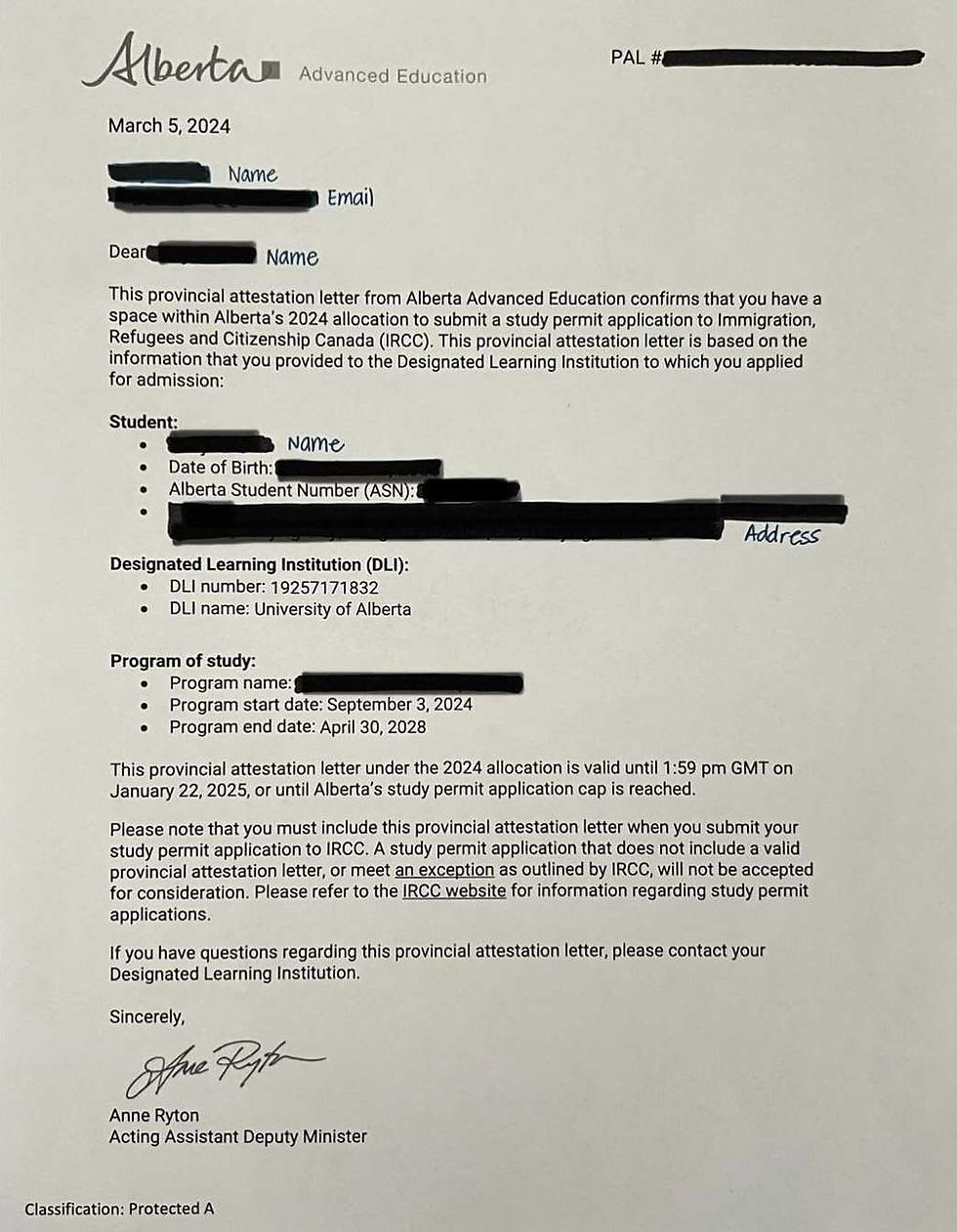

An example of a Provincial Attestation Letter (PAL) from Alberta Advanced Education, detailing student and program information
The introduction of PALs is part of a broader policy by the Canadian government that established an intake cap on the number of international students allowed to study in Canada . For 2024, this cap limits the number of study permit applications to 360,000, which represents a 35% reduction compared to 2023 . Each province and territory has been allocated a specific number of study permits based on their population size .

Provincial Study Permit Allocations for International Students in Canada (2024)
Who Needs a Provincial Attestation Letter?
Most international students applying for a study permit to attend a Canadian post-secondary institution require a PAL . This includes:
- Undergraduate university and college students
- Students in non-degree-granting graduate programs (certificate programs and graduate diplomas)
- Students applying for prerequisite courses or programs, including language courses
- Each applicant in a family applying together
Who Doesn’t Need a PAL?
Certain groups are exempt from the PAL requirement :
- Primary and secondary school students (kindergarten to grade 12)
- Master’s and doctoral degree students (exemption valid until December 2024)
- Current students in Canada applying for a study permit extension at the same Designated Learning Institution (DLI)
- Visiting or exchange students
- Family members of study or work permit holders currently in Canada
- Students taking programs shorter than six months
- Holders of a work permit applying from within Canada
The PAL Application Process
Obtaining a PAL requires several steps that must be completed in sequence . The process generally follows the same pattern across provinces, though specific requirements may vary .
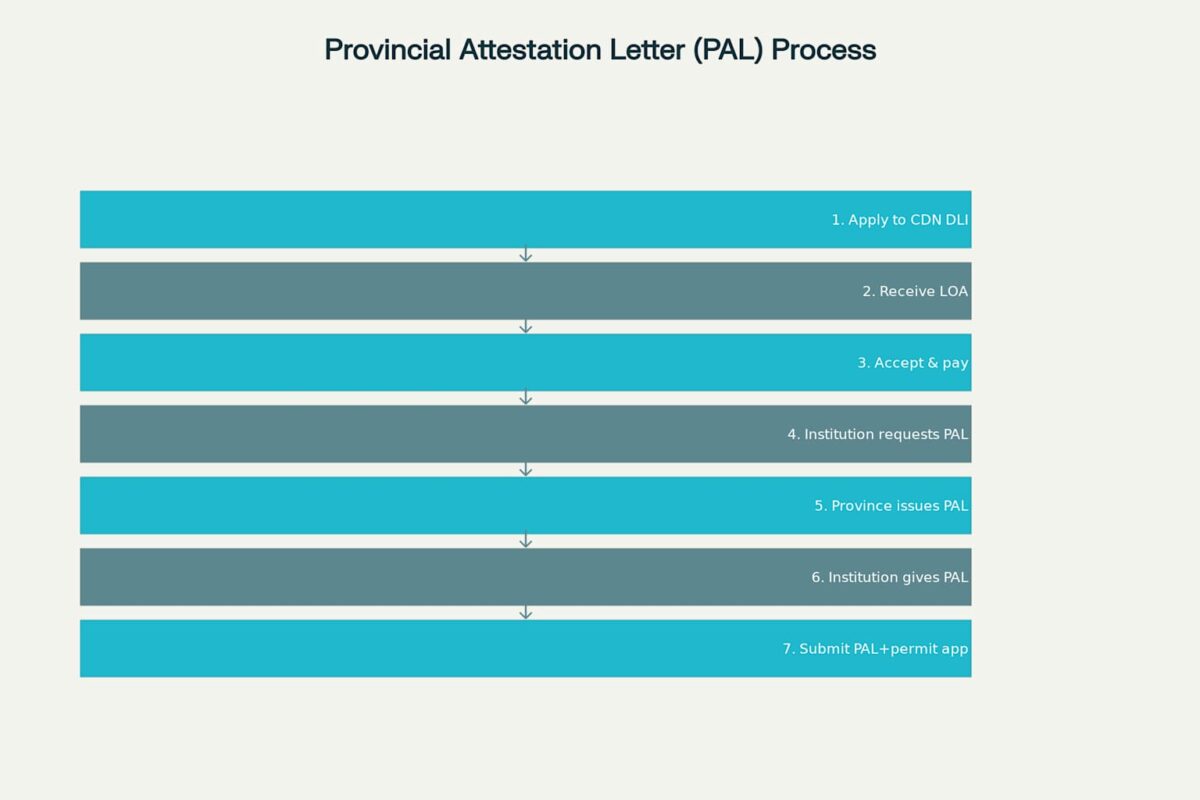
Provincial Attestation Letter (PAL) Application Process for International Students
Step-by-Step PAL Application Process:
- Apply to a Canadian Designated Learning Institution (DLI) – Start by applying to your chosen post-secondary institution in Canada .
- Receive a Letter of Acceptance (LOA) – Once accepted, you’ll receive an official acceptance letter from the institution .
- Confirm your acceptance – Accept your offer and pay any required deposit to secure your spot .
- Institution requests PAL – In most provinces, your institution will request the PAL from the provincial government on your behalf .
- Provincial review – The province will review the request and issue the PAL if it falls within their allocation .
- Receive your PAL – Your institution will provide you with the PAL once issued by the province .
- Submit with study permit application – Include the PAL with your study permit application to IRCC .
PAL Validity Period
Unless specified otherwise, PALs issued between January 22, 2024, and January 21, 2025, are valid until January 21, 2025 . For the 2025 study permit cap year, PALs issued between January 22, 2025, and December 31, 2025, are valid until December 31, 2025 . Your PAL must be valid when you submit your study permit application .
Provincial Requirements for PAL
Each Canadian province and territory has established its own process for issuing PALs . Below are the specific requirements by province:
| Province/Territory | Provincial System | Key Requirements | Who Applies | Implementation Date |
|---|---|---|---|---|
| Ontario | Operational | Contact DLI; DLI applies on student behalf | DLI on behalf of student | January 22, 2024 |
| Quebec | Operational (CAQ) | CAQ (Quebec Acceptance Certificate) with attestation line | Student through CAQ process | January 22, 2024 |
| British Columbia | Operational | Issued to DLIs; 53% to public institutions, 47% to private institutions | DLI on behalf of student | March 4, 2024 |
| Alberta | Operational | Contact DLI; DLI applies on student behalf | DLI on behalf of student | March 2024 |
| Manitoba | Operational | Contact specific Manitoba DLI for PAL process | DLI on behalf of student | March 4, 2024 |
| Saskatchewan | Operational | Contact DLI; varies by institution | DLI on behalf of student | March 13, 2024 |
| Nova Scotia | Operational | Payment of $6,000 CAD confirmation deposit; expires in 10 weeks | DLI on behalf of student | March 28, 2024 |
| New Brunswick | Operational | Log in to student account; pay non-refundable deposit | DLI on behalf of student | March 18, 2024 |
| Prince Edward Island | Operational | Valid only for public institutions; 2,000 PALs allocation | DLI on behalf of student | March 2024 |
| Newfoundland and Labrador | Operational | Contact DLI; DLI applies on student behalf | DLI on behalf of student | March 19, 2024 |
| Northwest Territories | Operational | Contact NWT education authorities | DLI on behalf of student | March 31, 2024 |
| Yukon | Operational | Contact Yukon University Admissions | DLI on behalf of student | March 2024 |
| Nunavut | Operational | Limited information available; contact Nunavut authorities | DLI on behalf of student | March 31, 2024 |
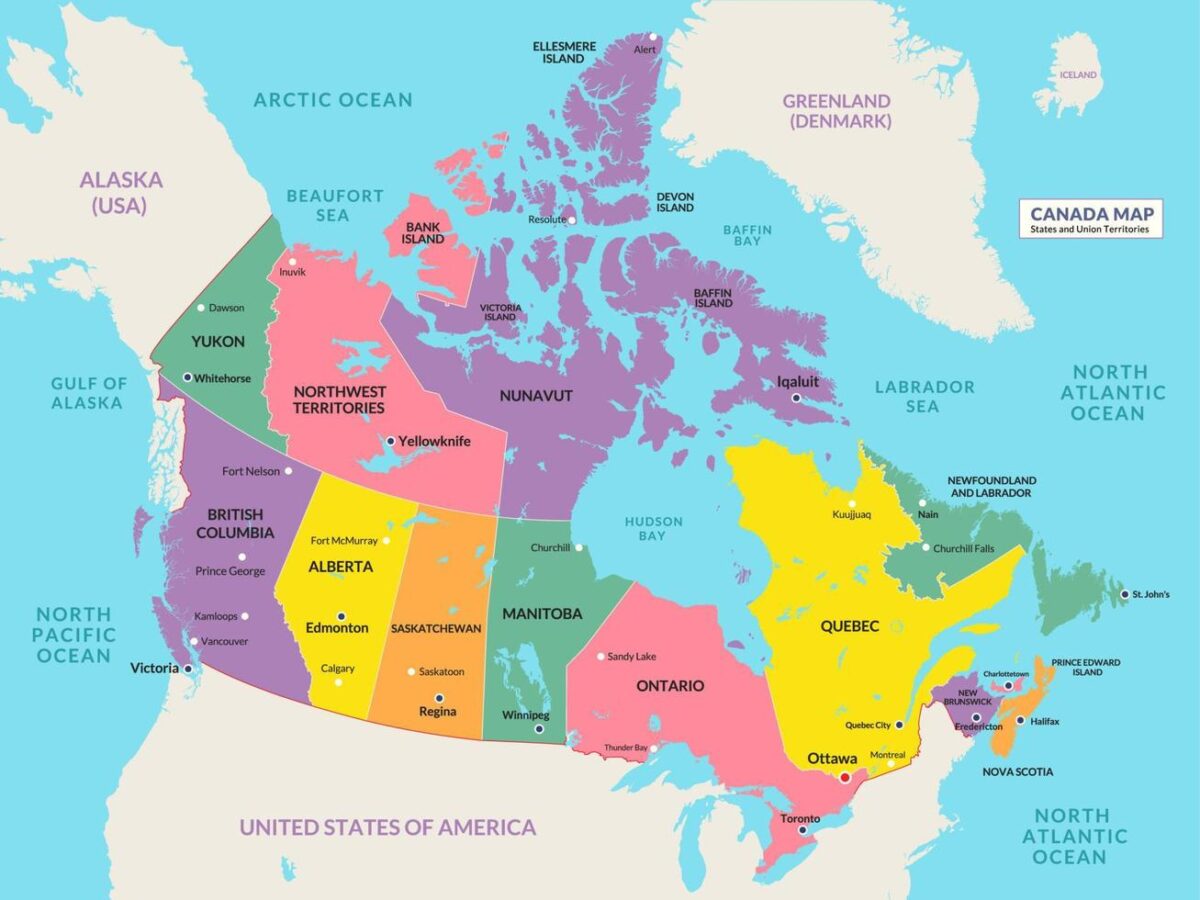
A political map of Canada showing all provinces and territories with their major cities and surrounding geographical features
Ontario
Ontario has been issuing PALs since January 22, 2024 . The process involves the post-secondary institution submitting a PAL request to the Ministry of Colleges, Universities, Research Excellence and Security (MCURES) on behalf of the student . Once approved, the PAL is shared with the student through the institution . Ontario has the largest allocation with 125,000 study permit spaces for 2024 .
Quebec
Quebec has a unique system that utilizes the Quebec Acceptance Certificate (CAQ) instead of a standard PAL . For a CAQ to function as a PAL, it needs to include the following statement: “This attestation letter confirms that the applicant has a place in Quebec’s share of the distribution of study permit applications or is exempt from it” . Quebec has been allocated 49,000 study permit spaces for 2024 .
British Columbia
British Columbia implemented its PAL system on March 4, 2024 . The B.C. government issues PALs to institutions, which then forward them to international students . The province has received an allocation of 83,000 undergraduate study permit applications, with 53% going to public post-secondary institutions and 47% to private institutions .
Alberta
Alberta’s PAL system became operational in March 2024 . International students must contact their Designated Learning Institution, which will request a PAL from the provincial government on their behalf . Alberta has been allocated 40,000 study permit spaces for 2024 .
Manitoba
Manitoba implemented its PAL system on March 4, 2024 . Prospective international students need to connect with the university, college, or private institution they want to attend, which will provide the PAL on behalf of the Ministry . Manitoba has 17,000 study permit spaces for 2024 .
Saskatchewan
Saskatchewan’s PAL system was introduced on March 13, 2024 . The requirements vary by institution, so students should contact their specific DLI for details .
Nova Scotia
Nova Scotia began issuing PALs on March 28, 2024 . The province requires students to pay a $6,000 CAD confirmation deposit and provide consent for the university to allow Nova Scotia to issue the PAL . PALs issued in Nova Scotia expire ten weeks from their issue date . Nova Scotia has 12,900 study permit spaces for 2024 .
New Brunswick
New Brunswick’s PAL system has been operational since March 18, 2024 . Students accepted into New Brunswick institutions must log into their student account, pay a non-refundable deposit, and the school will then request the PAL on their behalf . Processing takes approximately two weeks . New Brunswick has 8,000 study permit spaces for 2024 .
Prince Edward Island
Prince Edward Island implemented its PAL system in March 2024 . The province has allocated its 2,000 study permit applications to three public post-secondary institutions: College de l’Ile (105), Holland College (710), and the University of Prince Edward Island (1,185) . Private institutions are not eligible to receive PALs in PEI .
Newfoundland and Labrador
Newfoundland and Labrador’s PAL system was implemented on March 19, 2024 . Like other provinces, students need to contact their DLI, which will request the PAL from the provincial government . Newfoundland and Labrador has 1,500 study permit spaces for 2024 .
The territories also have PAL systems in place, though specific information is more limited . For the Northwest Territories, students should contact NWT education authorities directly . In Yukon, contact Yukon University Admissions .
For Nunavut, limited information is available, but students should contact Nunavut authorities directly . Each territory has been allocated fewer study permit spaces, with the Northwest Territories and Yukon receiving 150 each, and Nunavut receiving 50 for 2024 .
What Information is Included in a PAL?
A Provincial Attestation Letter typically contains the following information :
- Full name of the applicant
- Date of birth of the applicant
- Address of the applicant
- Confirmation that the student has a space within the provincial allocation
- Date the letter was issued
- Allocation year and PAL expiry date
- Information about the study program
- Level of study
- Designated Learning Institution (DLI) name and number
- Program name
- Program start and end dates
- A unique identifier (PAL number)

A Canadian study permit document issued by Immigration, Refugees and Citizenship Canada
Todo Checklist for International Students
To help you navigate the PAL application process, follow this checklist :
- Research and select Designated Learning Institutions (DLIs) in your preferred province
- Submit your application to the chosen institution(s)
- Accept your offer of admission once received
- Pay any required confirmation deposit as specified by your institution
- Complete any institution-specific PAL questionnaire or form if required
- Confirm with your institution that they have submitted your PAL request to the province
- Check your email regularly for PAL updates from your institution
- Obtain your PAL from your institution (typically via email or student portal)
- Verify all information on your PAL is correct
- Include your PAL with your study permit application to IRCC
- Submit your study permit application before your PAL expires
- Keep a copy of your PAL for your records
Tips for a Successful PAL Application
- Start early: Begin your application process well in advance as PAL processing times vary by province .
- Stay in touch with your institution: Maintain regular contact with your DLI regarding the PAL process .
- Pay deposits on time: Failure to pay deposits by the required deadline may delay or prevent your PAL issuance .
- Check expiry dates: Be aware of your PAL’s expiry date and submit your study permit application before it expires .
- Be prepared with alternatives: Due to limited allocations, have backup options in case your preferred province reaches its cap .
Conclusion
The Provincial Attestation Letter (PAL) has become a crucial document for international students planning to study in Canada . While the requirements vary by province, the general process involves working closely with your Designated Learning Institution to obtain this document .
By understanding the specific requirements of your chosen province and following the steps outlined in this guide, you’ll be better prepared to navigate this new aspect of the Canadian study permit application process .
Remember that the PAL system was implemented to manage international student enrollments across Canada, ensuring a more balanced distribution and sustainable growth in the international education sector .
With the 2024 cap set at 360,000 study permits, it’s more important than ever to start your application process early and be well-informed about the requirements specific to your situation .
Related reading: Express Entry Language Requirements: IELTS vs CELPIP vs — a closer look at this topic.
Quick answers from official sources
Who needs a provincial attestation letter?
Most new post-secondary international students at the college or undergraduate level, per IRCC.
What happens if I apply without a PAL?
IRCC will return any application received that does not include a PAL, unless the applicant is exempt.
Do I need a PAL to study in Quebec?
No. IRCC says you need a Quebec Acceptance Certificate instead of a PAL/TAL.
Sources (checked October 27, 2026):