Choosing a DLI: How to Pick the Right School in Canada
Choosing the right Designated Learning Institution (DLI) in Canada is one of the most important decisions you’ll make as an international student. With over 1,500 approved institutions across the country, finding the perfect fit for your academic goals, budget, and career aspirations can feel overwhelming. This comprehensive guide will walk you through everything you need to know to make an informed decision that sets you up for success in Canada and beyond.
Canada welcomed nearly 1 million international students in 2024, making it one of the world’s top study destinations. However, with new study permit caps introduced in 2025, competition for spots has intensified, making it more crucial than ever to choose wisely.
What is a Designated Learning Institution (DLI)?
A Designated Learning Institution (DLI) is a school approved by a provincial or territorial government to host international students. These institutions must meet specific quality standards and maintain compliance with Canadian immigration regulations to retain their designation.
Key DLI Facts You Need to Know
All primary and secondary schools in Canada are automatically designated learning institutions. However, if you’re planning to attend a post-secondary institution, you must verify it appears on the official DLI list.
Every DLI has a unique identification number that starts with the letter “O” followed by additional digits. This number is essential for your study permit application and helps verify the institution’s legitimacy.
| Aspect | Details | Key Considerations |
|---|---|---|
| Total DLIs in Canada | 1,500+ institutions | Choose from extensive options |
| Primary & Secondary Schools | All automatically designated (not listed separately) | No DLI verification needed for K-12 |
| Post-Secondary DLIs | Universities, colleges, institutes, academies | Must verify PGWP eligibility |
| DLI Number Format | Starts with ‘O’ + unique number | Essential for study permit application |
| PGWP Eligibility | Not all DLIs/programs qualify | Critical for post-graduation work opportunities |
| Provincial Approval | Must be approved by provincial/territorial government | Ensures quality and legitimacy |
| International Students (2024) | 997,820 students | Competitive admission environment |
| Top Source Countries | India, China, Philippines, Nigeria, France | Consider visa approval rates by country |
| Study Permit Cap (2025) | 316,276 permits allocated across provinces | Apply early due to limited spots |
| Language Requirements | IELTS, TOEFL, CAEL, or institutional tests | Meet minimum scores before applying |
| Financial Proof Required | CAD $10,000+ per year typically required | Prepare comprehensive financial documentation |
| Processing Time | 4-16 weeks (varies by country) | Apply well before intended start date |
Types of DLIs Available
Canada offers diverse educational opportunities through various types of institutions. Each type serves different educational goals and career paths, making it important to understand your options before making a decision.
| Institution Type | PGWP Eligible | Typical Duration | Average Annual Cost | Best For |
|---|---|---|---|---|
| Universities | Yes (most programs) | 3-4 years (Bachelor), 1-2 years (Master) | CAD $30,000 – $60,000 | Comprehensive education, research opportunities |
| Public Colleges | Yes (most programs) | 1-3 years (Diploma/Certificate) | CAD $15,000 – $35,000 | Practical skills, career-focused programs |
| Private Colleges | Limited programs | 1-2 years (Diploma/Certificate) | CAD $20,000 – $45,000 | Specialized programs, flexible schedules |
| Language Schools | Usually No | Few weeks to 1 year | CAD $8,000 – $15,000 | Language improvement before main studies |
| Flight Training Schools | Yes (specific programs) | 6 months – 2 years | CAD $25,000 – $50,000 | Aviation career preparation |
| Art & Design Schools | Limited programs | 1-4 years | CAD $20,000 – $40,000 | Creative and artistic careers |
| Trade & Technical Schools | Yes (most programs) | 6 months – 2 years | CAD $15,000 – $30,000 | Skilled trades and technical careers |
Why Choosing the Right DLI Matters
Your choice of DLI impacts far more than just your education. It affects your eligibility for work permits, permanent residence pathways, and overall experience in Canada.
Post-Graduation Work Permit (PGWP) Eligibility
Not all DLIs or programs qualify graduates for a Post-Graduation Work Permit. Recent policy changes effective November 1, 2024, have made PGWP eligibility more restrictive, requiring specific program types and meeting new field-of-study requirements.
Critical PGWP Changes:
- Programs must meet Classification of Instructional Programs (CIP) code requirements
- Language proficiency requirements now apply to certain applicants
- Public-private partnership institutions face new restrictions
Career and Immigration Opportunities
Graduating from a PGWP-eligible DLI opens doors to Canadian work experience, which is crucial for permanent residence applications. Approximately 57% of international students plan to apply for permanent residence in Canada, making this consideration vital.
The Complete DLI Selection Process
Selecting the right DLI requires a systematic approach to ensure you make an informed decision. Follow this comprehensive process to identify institutions that align with your goals and requirements.
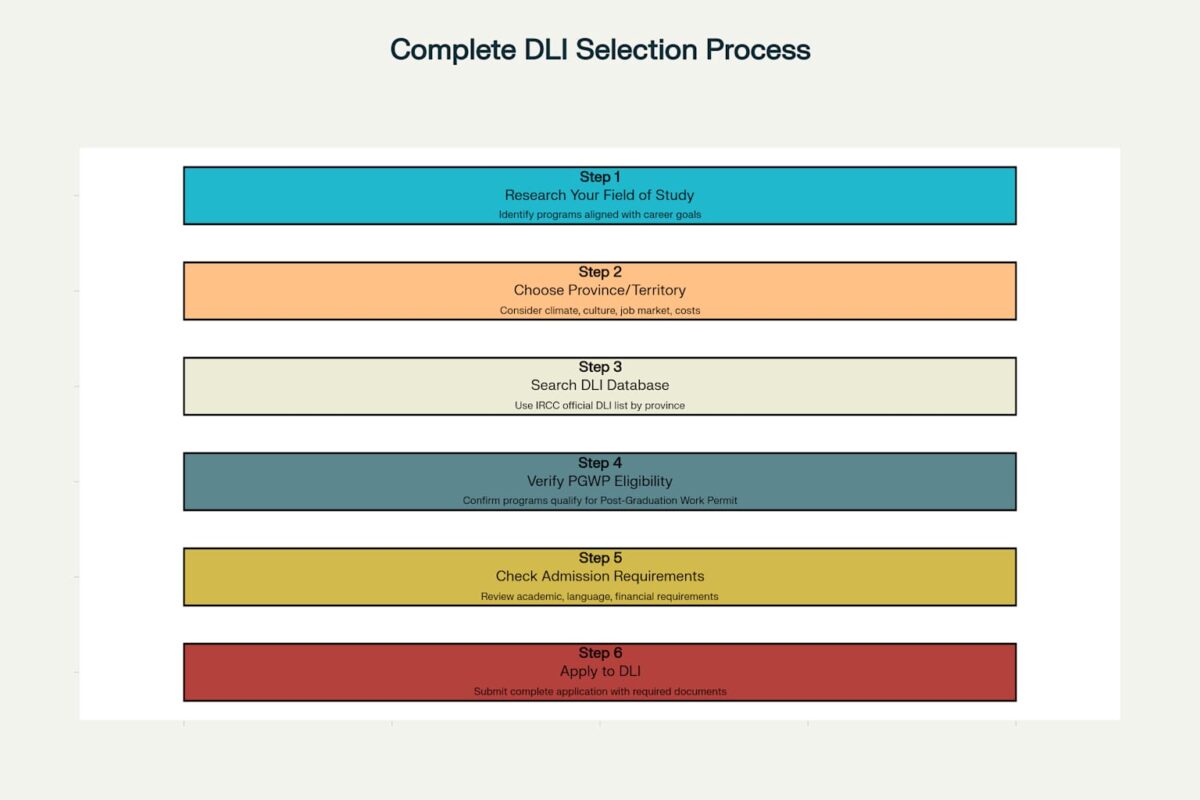

Step-by-step flowchart guide for selecting the right DLI in Canada
Step 1: Research Your Field of Study
Begin by clearly defining your career goals and identifying programs that align with your aspirations. Consider both current job market demands and future growth prospects in your chosen field.
Popular Programs Among International Students:
- Business & Management (most popular)
- Computer Science & IT
- Engineering
- Healthcare & Medicine
- Hospitality & Tourism
| Program Field | Popularity Rank | Average Starting Salary (CAD) | PGWP Eligible |
|---|---|---|---|
| Business & Management | 1 | 55000 | Yes |
| Computer Science & IT | 2 | 70000 | Yes |
| Engineering | 3 | 68000 | Yes |
| Healthcare & Medicine | 4 | 65000 | Yes |
| Hospitality & Tourism | 5 | 40000 | Limited |
| Accounting & Finance | 6 | 58000 | Yes |
| Arts & Creative Industries | 7 | 45000 | Limited |
| Environmental Studies | 8 | 52000 | Yes |
Step 2: Choose Your Province or Territory
Canada’s provinces and territories offer different advantages, costs, and opportunities. Consider factors such as climate, cost of living, job market, and cultural fit when making your decision.
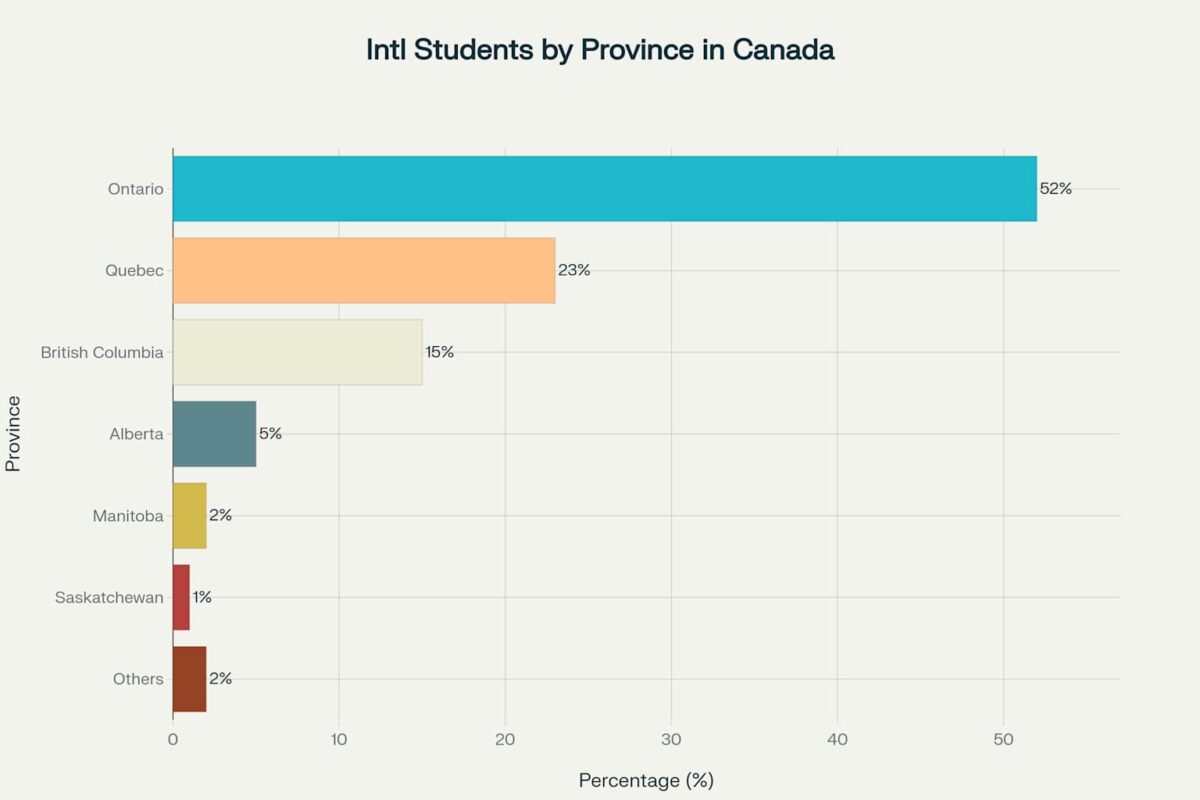
Provincial distribution of international students across Canada, showing Ontario as the leading destination
Provincial Considerations:
- Ontario: Hosts 52% of international students but faces the highest competition
- Quebec: Offers lower tuition fees and unique cultural experiences
- British Columbia: Provides diverse opportunities and mild coastal climate
- Atlantic Provinces: Feature lower costs and easier immigration pathways

Comprehensive cost breakdown showing tuition, living expenses, and total costs by Canadian province
Step 3: Verify DLI Status and PGWP Eligibility
Always verify that your chosen institution appears on the official IRCC DLI list. This step is crucial as studying at a non-DLI institution will result in study permit rejection.
Verification Process:
- Visit the official IRCC DLI list website
- Search by province/territory
- Confirm the institution’s DLI number
- Verify PGWP eligibility for your specific program
| Verification Item | Priority | Description |
|---|---|---|
| Check IRCC Official DLI List | Critical | Ensure institution appears on government list |
| Verify DLI Number | Critical | DLI number starts with ‘O’ and matches official records |
| Confirm PGWP Eligibility | High | Confirm specific programs qualify for work permit |
| Review Program Offerings | High | Verify desired program is available and accredited |
| Check Accreditation Status | Medium | Check provincial/territorial government approval |
| Validate Contact Information | Medium | Verify official contact details match government list |
| Research Institution Reputation | Medium | Research rankings, reviews, and graduate outcomes |
| Compare Tuition Fees | Low | Compare costs with similar institutions |
Key Factors to Consider
Academic Quality and Reputation
Research the institution’s academic reputation, faculty qualifications, and graduate outcomes. Look for accreditation by relevant professional bodies and recognition in your home country.
Quality Indicators:
- Program curriculum and course structure
- Faculty expertise and research opportunities
- Graduation rates and employment statistics
- Industry partnerships and internship opportunities
Campus Life and Support Services
Consider the overall student experience, including campus facilities, student support services, and extracurricular opportunities. International student services, such as orientation programs and academic support, can significantly impact your success.
Location and Practical Considerations
Evaluate practical factors such as:
- Climate and weather preferences
- Transportation and accessibility
- Healthcare services availability
- Safety and security
- Proximity to work opportunities
Financial Planning and Cost Considerations
Understanding the total cost of your education is crucial for making an informed decision. Costs vary significantly between provinces and institution types, making careful financial planning essential.
Tuition Fee Ranges by Institution Type
Average Annual Costs (2024-2025):
- Universities: CAD $30,000 – $60,000
- Public Colleges: CAD $15,000 – $35,000
- Private Colleges: CAD $20,000 – $45,000
- Language Schools: CAD $8,000 – $15,000
Living Expenses by Province
Consider both tuition and living costs when calculating your total educational investment. Living expenses can vary dramatically between provinces and cities within the same province.
Budget Planning Tips:
- Research accommodation options (on-campus vs. off-campus)
- Factor in health insurance requirements
- Plan for textbooks, supplies, and personal expenses
- Consider currency exchange fluctuations
Common Mistakes to Avoid
Learning from others’ mistakes can save you time, money, and frustration. Here are the most critical errors to avoid when selecting a DLI.
Critical Mistakes That Can Derail Your Plans
Institution-Related Mistakes:
- Choosing an institution not on the official DLI list
- Assuming all DLI programs qualify for PGWP
- Failing to verify recent policy changes
- Ignoring accreditation status
Application-Related Mistakes:
- Missing application deadlines
- Submitting incomplete documentation
- Insufficient financial proof
- Using unauthorized consultants
📋 Ultimate DLI Selection Checklist for International Students
To ensure you don’t miss any crucial steps, use this comprehensive checklist throughout your decision-making process. This systematic approach will help you evaluate all important factors and make an informed choice.
✅ Pre-Research Phase
Personal Assessment
- Define your career goals and preferred field of study
- Assess your academic background and qualifications
- Determine your budget for tuition and living expenses
- Check language proficiency requirements (IELTS/TOEFL scores)
- Research visa requirements for your country of origin
Province/Territory Selection
- Research climate preferences (weather patterns)
- Compare cost of living across provinces
- Investigate job market opportunities in your field
- Consider cultural fit and community preferences
- Review provincial immigration programs (PNP opportunities)
🏫 DLI Verification Process
Official Verification
- Access the official IRCC DLI list website
- Verify institution appears on government database
- Confirm DLI number starts with “O”
- Check if all programs are DLI-eligible
- Verify campus locations and DLI coverage
PGWP Eligibility Check
- Confirm institution offers PGWP-eligible programs
- Verify your specific program qualifies for PGWP
- Check recent policy changes (post-November 2024)
- Review CIP code requirements for your field
- Understand program duration requirements
📚 Academic Program Evaluation
Program Quality
- Research program curriculum and course structure
- Check faculty qualifications and expertise
- Review graduation rates and student outcomes
- Investigate internship and co-op opportunities
- Assess industry partnerships and connections
Accreditation & Recognition
- Verify provincial accreditation status
- Check professional body recognition (if applicable)
- Research international recognition of credentials
- Review transfer credit policies
- Confirm degree/diploma legitimacy
💰 Financial Planning
Cost Analysis
- Calculate total tuition fees for program duration
- Estimate living expenses (housing, food, transportation)
- Research scholarship and bursary opportunities
- Check payment plans and fee structures
- Plan for additional costs (books, health insurance)
Financial Documentation
- Prepare proof of funds documents
- Research student loan options
- Check currency exchange considerations
- Plan for emergency funds
- Understand refund policies
📋 Application Requirements
Academic Documents
- Gather official transcripts
- Obtain degree certificates and diplomas
- Prepare course descriptions/syllabi
- Get academic references/recommendation letters
- Complete credential evaluation (if required)
Language Requirements
- Take required language tests (IELTS/TOEFL/CAEL)
- Meet minimum score requirements
- Check test validity periods
- Consider language support programs
- Prepare for possible language assessments
Application Materials
- Complete application forms accurately
- Write compelling personal statement/essay
- Prepare portfolio (if required for program)
- Collect supporting documents
- Pay application fees
🏠 Practical Considerations
Campus Life
- Research on-campus housing options
- Investigate off-campus accommodation
- Check campus facilities and resources
- Review student support services
- Explore extracurricular activities
Location Factors
- Assess transportation options
- Research healthcare access
- Check proximity to airports/family
- Investigate part-time work opportunities
- Consider safety and security factors
📄 Study Permit Preparation
Documentation
- Obtain Letter of Acceptance (LOA) from DLI
- Secure Provincial Attestation Letter (PAL/TAL)
- Prepare financial support documents
- Complete study permit application
- Gather biometric requirements
Timeline Management
- Apply early to avoid processing delays
- Track application status regularly
- Prepare for possible interview
- Plan arrival timing
- Arrange temporary accommodation
🎯 Post-Arrival Planning
Settlement Preparation
- Research banking options
- Understand tax obligations
- Plan health insurance coverage
- Prepare for cultural adaptation
- Connect with student communities
Career Planning
- Understand work permit regulations
- Research internship opportunities
- Plan for PGWP application timeline
- Explore permanent residence pathways
- Build professional networks
⚠️ Red Flags to Avoid
Institution Warning Signs
- AVOID: Institutions not on official DLI list
- AVOID: Promises of guaranteed admission
- AVOID: Unusually low fees (potential quality issues)
- AVOID: Lack of proper accreditation
- AVOID: Poor communication or unprofessional conduct
Application Pitfalls
- AVOID: Incomplete or inaccurate applications
- AVOID: Missing application deadlines
- AVOID: Insufficient financial documentation
- AVOID: Using unauthorized immigration consultants
- AVOID: Providing false or misleading information
📞 Important Resources
Official Government Sources
- IRCC Website: canada.ca/en/immigration-refugees-citizenship
- DLI List: Search by province on IRCC website
- Provincial Immigration: Check provincial government websites
- Study Permit Information: Official IRCC study permit guide
Support Services
- Educational Consultants: Licensed immigration consultants
- Student Services: Institution-specific support
- Community Organizations: Settlement agencies
- Online Forums: Student communities and groups
📝 Final Verification Steps
Before submitting your application:
- Double-check all information is accurate and complete
- Verify DLI status one final time before submission
- Confirm PGWP eligibility for your chosen program
- Review all financial calculations and documentation
- Ensure you meet all deadlines and requirements
Remember: Choosing the right DLI is crucial for your academic success and future opportunities in Canada. Take time to research thoroughly and make an informed decision.
Last Updated: January 2025
For the most current information, always refer to official government sources.
Understanding the Current Landscape
2025 Study Permit Changes
Recent policy changes have significantly impacted international student admissions. The federal government has implemented caps on study permits, with 316,276 permits allocated across provinces for 2025.
Key Changes:
- Provincial Attestation Letters (PAL) now required
- Study permit caps vary by province
- Master’s and PhD students included in caps
- Enhanced verification processes
Impact on Different Student Populations
The new policies have affected different student populations differently. Students from India, Nigeria, and the Philippines have seen significant decreases in approval rates, while some African countries have experienced growth.
Future Opportunities and Career Pathways
Post-Graduation Work Opportunities
Understanding post-graduation pathways is essential for long-term planning. The PGWP program allows graduates to gain valuable Canadian work experience, which is crucial for permanent residence applications.
PGWP Duration Guidelines:
- Programs 8 months to 2 years: Work permit up to program length
- Programs 2+ years: 3-year work permit
- Master’s programs (8+ months): 3-year work permit
Permanent Residence Pathways
Many international students use their Canadian education as a pathway to permanent residence. Key programs include the Canadian Experience Class, Provincial Nominee Programs, and special pathways for graduates.
Making Your Final Decision
Comparing Your Options
Once you’ve researched multiple institutions, create a comparison matrix including:
- Program quality and reputation
- Total costs and financial aid opportunities
- PGWP eligibility and career prospects
- Location and lifestyle preferences
- Support services and campus culture
Next Steps After Selection
After choosing your DLI:
- Begin the application process immediately
- Prepare all required documents
- Apply for your study permit early
- Plan your arrival and accommodation
- Research settlement services in your destination
Conclusion
Choosing the right DLI in Canada is a complex but crucial decision that will shape your academic journey and future opportunities. By following this comprehensive guide, using the provided checklist, and conducting thorough research, you’ll be well-equipped to make an informed choice that aligns with your goals and sets you up for success.
Remember that the Canadian education landscape is dynamic, with policies and opportunities constantly evolving. Stay informed about changes, verify all information with official sources, and don’t hesitate to seek guidance from licensed educational consultants when needed.
Your journey to studying in Canada begins with choosing the right DLI. Take the time to research thoroughly, plan carefully, and make a decision that will open doors to the bright future you envision in Canada.
Related reading: Student Direct Stream (SDS): Faster Study Permit Processing — a closer look at this topic.