Express Entry CRS Score Calculator: How to Maximize Your Points

Canada’s Express Entry system is your gateway to permanent residence, but success depends heavily on your Comprehensive Ranking System (CRS) score. With over 227,000 candidates currently in the pool competing for limited invitations, understanding how to maximize your CRS points has become more critical than ever.
This comprehensive guide will walk you through everything you need to know about calculating and optimizing your CRS score to increase your chances of receiving an Invitation to Apply (ITA) for Canadian permanent residence.
What is the Comprehensive Ranking System (CRS)?
The Comprehensive Ranking System is a points-based scoring system used by Immigration, Refugees and Citizenship Canada (IRCC) to rank Express Entry candidates. Your CRS score determines your position in the Express Entry pool, with higher scores increasing your likelihood of receiving an invitation during regular draws.
The system evaluates candidates across multiple factors including age, education, language proficiency, work experience, and additional qualifying factors.
Express Entry manages three federal economic immigration programs: the Federal Skilled Worker Program (FSWP), Canadian Experience Class (CEC), and Federal Skilled Trades Program (FSTP). A portion of Provincial Nominee Programs (PNPs) also flow through Express Entry, providing an additional pathway to permanent residence.
Understanding CRS Points Distribution
The CRS awards a maximum of 1,200 points across four main categories. For single applicants, the core human capital factors can earn up to 500 points, while married applicants can earn up to 460 points for themselves plus 40 points for their spouse. Skill transferability factors provide up to 100 additional points, and various additional factors can contribute up to 600 points.
Express Entry CRS Score Optimization Todo List
✅ Immediate Actions (0-1 Month)
Language Testing Preparation
- Book IELTS/CELPIP test date (aim for 4-6 weeks out)
- Download official preparation materials
- Take practice tests to identify weak areas
- Consider prep course if scoring below CLB 8
- Research French language tests (TEF/TCF) if applicable
Educational Credentials
- Submit documents for Educational Credential Assessment (ECA)
- Gather all original diplomas and transcripts
- Choose designated organization (WES, ICAS, etc.)
- Pay ECA fees and submit application
Express Entry Profile Setup
- Create IRCC online account
- Complete eligibility questionnaire
- Determine which programs you qualify for (FSWP, CEC, FSTP)
- Calculate estimated CRS score using official calculator
🎯 Short-Term Goals (1-6 Months)
Language Score Improvement
- Achieve CLB 9+ in all four language abilities
- Retake language tests if needed to maximize points
- Consider French language learning for bonus points
- Aim for NCLC 7+ in French (25-50 bonus points)
Spouse/Partner Optimization
- Have spouse take language tests if beneficial
- Get spouse’s education credentials assessed
- Consider making spouse primary applicant if higher CRS potential
- Calculate both scenarios to determine best approach
Provincial Nominee Program Research
- Research PNP streams that match your profile
- Check province-specific requirements and occupations in demand
- Express interest in provinces through Express Entry profile
- Submit PNP applications if eligible
📈 Medium-Term Strategies (6-12 Months)
Work Experience Enhancement
- Gain Canadian work experience if in Canada
- Document all foreign work experience properly
- Obtain reference letters from previous employers
- Focus on NOC 0, A, or B level positions
Additional Points Opportunities
- Check if you have siblings in Canada (15 points)
- Research Canadian post-secondary education options
- Consider short-term programs if already in Canada
- Monitor Express Entry draw trends
📊 Long-Term Planning (1+ Years)
Education Advancement
- Consider pursuing Master’s degree for additional points
- Research Canadian institutions if in Canada
- Evaluate cost vs. benefit of additional education
- Look into online programs from Canadian universities
Career Development
- Work towards regulated profession credentials if applicable
- Build Canadian work experience
- Network within your industry
- Consider relocation to in-demand provinces
🔄 Ongoing Monitoring
Profile Maintenance
- Update Express Entry profile as credentials improve
- Monitor draw results and cutoff scores
- Keep all documents current and valid
- Track profile expiration date (1 year)
Strategic Adjustments
- Reassess strategy based on draw trends
- Consider alternative immigration programs if needed
- Stay informed about policy changes
- Join Express Entry communities for tips and updates
📋 Document Checklist for ITA
Pre-ITA Preparation
- Language test results (valid for 2 years)
- ECA report (valid for 5 years)
- Passport (valid for travel)
- Work experience reference letters
Post-ITA Documents (60 days to submit)
- Medical exams from panel physicians
- Police certificates from all countries
- Proof of funds (bank statements)
- Birth certificate and family documents
- Photos meeting specifications
- Additional documents specific to your situation
💡 Pro Tips
Language Testing
- Focus on weakest skill areas during preparation
- Consider multiple test attempts to achieve CLB 9+
- French proficiency can provide significant advantage
PNP Strategy
- Provincial nomination adds 600 points (virtually guarantees ITA)
- Research provincial labor market needs
- Consider less popular provinces for better chances
Score Tracking
- Use CRS calculator regularly to track improvements
- Monitor competitor scores in your range
- Set realistic timelines for score improvements
Remember: Express Entry is competitive. Focus on maximizing your CRS score through language improvement, education credentials, and provincial nomination strategies. Stay persistent and keep improving your profile!
Current Express Entry Pool Stats:
- Total candidates: ~227,000
- Competitive range: 450+ points
- Highly competitive: 500+ points
- Virtually guaranteed: 600+ points (with PNP)
CRS Points Breakdown
| Category | Points_With_Spouse | Points_Without_Spouse | Maximum_Points |
|---|---|---|---|
| Age (20-29) | 100 | 110 | Age: 100/110 |
| Age (30) | 95 | 105 | Age: 100/110 |
| Age (31) | 90 | 99 | Age: 100/110 |
| Age (32) | 85 | 94 | Age: 100/110 |
| Age (33) | 80 | 88 | Age: 100/110 |
| Age (34) | 75 | 83 | Age: 100/110 |
| Age (35) | 70 | 77 | Age: 100/110 |
| Age (36) | 65 | 72 | Age: 100/110 |
| Age (37) | 60 | 66 | Age: 100/110 |
| Age (38) | 55 | 61 | Age: 100/110 |
| Age (39) | 50 | 55 | Age: 100/110 |
| Age (40) | 45 | 50 | Age: 100/110 |
| Age (41) | 35 | 39 | Age: 100/110 |
| Age (42) | 25 | 28 | Age: 100/110 |
| Age (43) | 15 | 17 | Age: 100/110 |
| Age (44) | 5 | 6 | Age: 100/110 |
| Age (45+) | 0 | 0 | Age: 100/110 |
| High School | 28 | 30 | Education: 140/150 |
| 1-Year Post-Secondary | 84 | 90 | Education: 140/150 |
| 2-Year Post-Secondary | 91 | 98 | Education: 140/150 |
| Bachelor’s Degree | 112 | 120 | Education: 140/150 |
| Two+ Degrees | 119 | 128 | Education: 140/150 |
| Master’s Degree | 126 | 135 | Education: 140/150 |
| PhD | 140 | 150 | Education: 140/150 |
| CLB 4-5 (First Language) | 24 | 24 | Language: 150/160 |
| CLB 6 (First Language) | 32 | 36 | Language: 150/160 |
| CLB 7 (First Language) | 64 | 68 | Language: 150/160 |
| CLB 8 (First Language) | 88 | 92 | Language: 150/160 |
| CLB 9 (First Language) | 116 | 124 | Language: 150/160 |
| CLB 10+ (First Language) | 128 | 136 | Language: 150/160 |
| CLB 5-6 (Second Language) | 4 | 4 | Language: 22/24 |
| CLB 7-8 (Second Language) | 12 | 12 | Language: 22/24 |
| CLB 9+ (Second Language) | 24 | 24 | Language: 22/24 |
| No Canadian Work Experience | 0 | 0 | Canadian Work: 70/80 |
| 1 Year Canadian Work Experience | 35 | 40 | Canadian Work: 70/80 |
| 2 Years Canadian Work Experience | 46 | 53 | Canadian Work: 70/80 |
| 3 Years Canadian Work Experience | 56 | 64 | Canadian Work: 70/80 |
| 4 Years Canadian Work Experience | 63 | 72 | Canadian Work: 70/80 |
| 5+ Years Canadian Work Experience | 70 | 80 | Canadian Work: 70/80 |
The points breakdown varies significantly based on your marital status, with single applicants generally receiving higher points for core factors. Age points peak between 20-29 years, with maximum points of 110 for single applicants and 100 for married applicants. Education points range from 30 points for high school to 150 points for a PhD, depending on your marital status.
Current Competition in the Express Entry Pool
Understanding where you stand among other candidates is crucial for developing an effective strategy. The current Express Entry pool shows intense competition, with the majority of candidates scoring between 400-500 points.
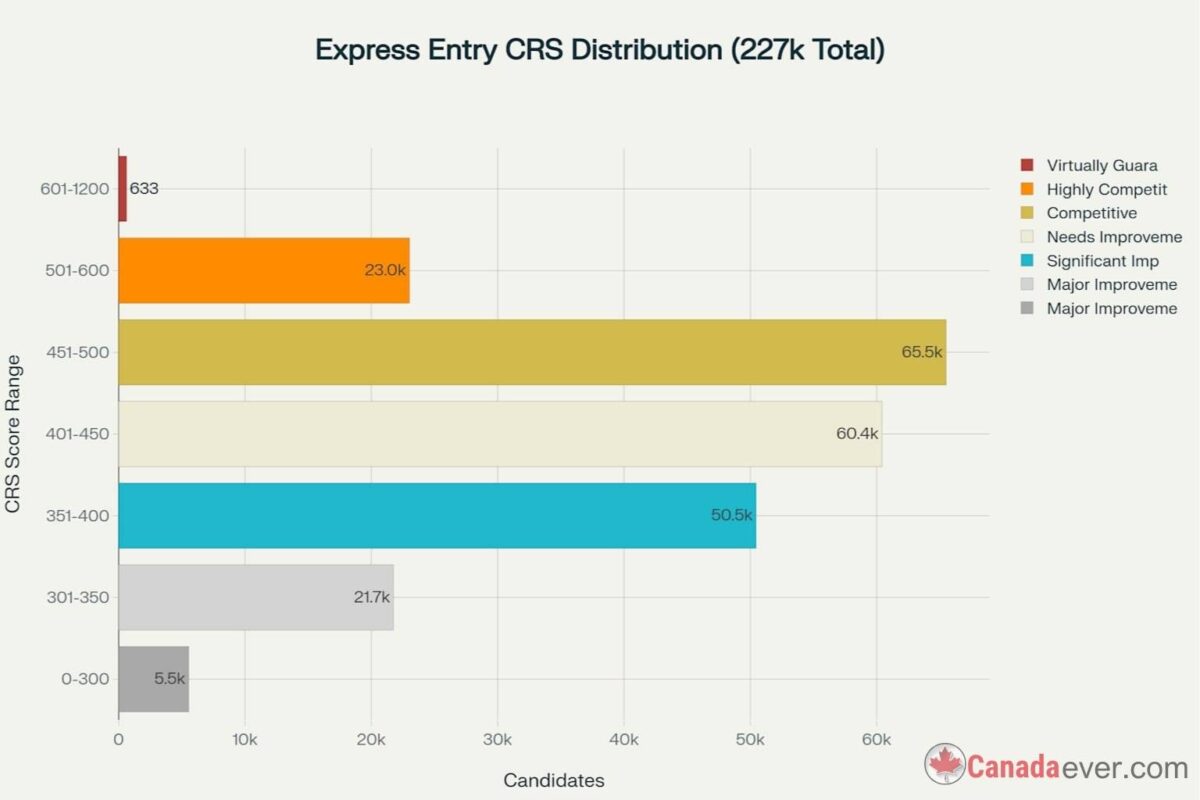

Express Entry Pool CRS Score Distribution showing the number of candidates in each score range and competitiveness levels as of 2025
As of 2025, candidates with scores above 500 points represent the most competitive segment of the pool. Those scoring 451-500 points face significant competition, while candidates below 450 points typically need substantial improvements to become competitive. Provincial nominations remain the most reliable path to receiving an ITA, as they add 600 points and virtually guarantee selection.
Major Changes in 2025: Removal of Job Offer Points
A significant change occurred in March 2025 when IRCC removed all CRS points for arranged employment. Previously, candidates could receive 50 points for most job offers or 200 points for executive positions, but these points are no longer awarded. This change affected over 37,000 candidates who suddenly lost 50-200 points from their profiles.
The removal is described as a temporary measure, though no end date has been announced. Candidates who already received ITAs or submitted permanent residence applications before March 25, 2025, are not affected by this change. However, job offers remain relevant for program eligibility requirements and some Provincial Nominee Program streams.
Strategic Approach to Maximizing Your CRS Score
Maximizing your CRS score requires a strategic approach focusing on the highest-impact improvements. Language proficiency offers the most immediate and substantial gains, with the potential to earn up to 160 points for single applicants.
CRS Maximization Checklist
| Priority | Action_Item | Potential_Points_Gain | Time_Investment |
|---|---|---|---|
| High | Take language tests (IELTS/CELPIP for English, TEF/TCF for French) | Up to 136 points (single) / 128 points (married) | 2-4 weeks preparation + test dates |
| High | Aim for CLB 9+ in all language abilities | Additional 20-30 points over CLB 7 | 3-6 months intensive study |
| High | Complete Educational Credential Assessment (ECA) | Up to 150 points (single) / 140 points (married) | 2-4 weeks processing time |
| High | Research and apply for Provincial Nominee Programs (PNP) | 600 points (virtually guarantees ITA) | 6-12 months application process |
| High | Gain Canadian work experience (if possible) | Up to 80 points (single) / 70 points (married) | 1+ years |
| Medium | Consider spouse as primary applicant (if higher CRS potential) | Variable – could be significant | Immediate decision |
| Medium | Improve spouse’s language scores and education | Up to 40 points total for spouse factors | 2-6 months |
| Medium | Learn French to CLB 7+ level for bonus points | 25-50 additional points | 6-12 months learning |
| Medium | Pursue additional education (Master’s/PhD) | 15-30 additional points | 1-3 years |
| Low | Check if you have siblings in Canada | 15 points | Immediate check |
| Low | Consider Canadian post-secondary education | 15-30 points | 1-4 years study |
| Low | Stay updated on Express Entry draw trends | Strategic advantage | Ongoing monitoring |
The most effective strategy involves targeting CLB 9 or higher in all language abilities, as this can add 20-30 points beyond the minimum CLB 7 requirement.
French language proficiency provides significant bonus points, with 50 additional points available for candidates who achieve NCLC 7+ in French while maintaining CLB 5+ in English. Even candidates with lower English scores can earn 25 bonus points for strong French proficiency.
Language Requirements and Testing Strategy
Language testing represents the foundation of your CRS score and often the most controllable factor. Each Express Entry program has specific minimum language requirements that must be met for eligibility.
For optimal CRS scores, candidates should aim well beyond minimum requirements. Achieving CLB 9 in all four abilities (reading, writing, speaking, listening) can significantly boost your competitive position. Test preparation typically requires 2-4 weeks, though reaching CLB 9 may require 3-6 months of intensive study.
French language proficiency offers substantial advantages in the current system. Candidates who achieve NCLC 7 in all French language abilities while maintaining strong English scores receive the maximum 50 bonus points. This bilingual advantage has become increasingly valuable as competition intensifies.
| Program | Minimum CLB Required | English Tests Accepted | French Tests Accepted |
|---|---|---|---|
| Federal Skilled Worker (FSWP) | CLB 7 all skills | IELTS, CELPIP | TEF Canada, TCF Canada |
| Canadian Experience Class (CEC) – NOC 0/A | CLB 7 all skills | IELTS, CELPIP | TEF Canada, TCF Canada |
| Canadian Experience Class (CEC) – NOC B | CLB 5 all skills | IELTS, CELPIP | TEF Canada, TCF Canada |
| Federal Skilled Trades (FSTP) – Speaking/Listening | CLB 5 | IELTS, CELPIP | TEF Canada, TCF Canada |
| Federal Skilled Trades (FSTP) – Reading/Writing | CLB 4 | IELTS, CELPIP | TEF Canada, TCF Canada |
Additional Points Opportunities
Beyond core human capital factors, several additional point categories can significantly impact your CRS score. Provincial nominations provide the largest single boost, adding 600 points and virtually guaranteeing an ITA.
Canadian education credentials offer 15-30 additional points depending on program length. Having a sibling who is a Canadian citizen or permanent resident aged 18 or older provides 15 points. These additional factors, while smaller individually, can make the difference between receiving an ITA and waiting in the pool.
| Additional Points Category | Points Awarded | Requirements |
|---|---|---|
| Provincial Nomination (PNP) | 600 | Valid provincial nomination certificate |
| French Language Proficiency (CLB 7+ French + CLB 5+ English) | 50 | NCLC 7+ in all French skills + CLB 5+ in all English skills |
| French Language Proficiency (CLB 7+ French + Below CLB 5 English) | 25 | NCLC 7+ in all French skills + CLB 4 or lower in English |
| Canadian Post-Secondary Education (1-2 years) | 15 | Completed 1-2 year program at Canadian institution |
| Canadian Post-Secondary Education (3+ years) | 30 | Completed 3+ year program at Canadian institution |
| Sibling in Canada (Citizen/PR, 18+ years old) | 15 | Brother/sister who is Canadian citizen or PR, age 18+ |
Recent Express Entry Draw Trends
Understanding recent draw patterns helps inform your strategy and timeline expectations. Draw frequencies, CRS cutoff scores, and invitation numbers vary significantly based on immigration targets and candidate pool composition.

express entry draw CRS cutoff score trends showing the variation in minimum scores across different draw types from May to June 2025
Recent draws show clear patterns: Provincial Nominee draws consistently require the highest CRS scores (700-800+), while category-based draws for specific occupations often have lower requirements. Canadian Experience Class draws typically fall in the middle range (520-550), making them accessible to well-prepared candidates without provincial nominations.
Step-by-Step Express Entry Process
Navigating the Express Entry process requires careful planning and execution across multiple stages. The journey begins with eligibility assessment and profile creation, followed by pool entry and optimization.

The process typically takes 6-12 months from initial preparation to receiving permanent residence, though this varies significantly based on your starting CRS score and improvement strategy. Candidates must maintain valid profiles and update information as circumstances change.
Essential Document Preparation
Proper documentation is crucial for both profile creation and post-ITA application submission. Some documents must be prepared before creating your Express Entry profile, while others are only required after receiving an ITA.
Language test results and Educational Credential Assessment (ECA) reports must be obtained before profile creation. These documents have specific validity periods: language tests are valid for two years, while ECA reports last five years. Medical examinations, police certificates, and proof of funds are only required after receiving an ITA, with 60 days to submit your complete application.
| Document Category | Required Documents | Validity Period | When to Prepare |
|---|---|---|---|
| Language Test Results | IELTS/CELPIP results (English), TEF/TCF results (French) | 2 years from test date | Before creating Express Entry profile |
| Educational Credentials | ECA report, Original degrees/diplomas, Transcripts | 5 years from ECA date | Before creating Express Entry profile |
| Work Experience | Reference letters, Employment contracts, Pay stubs | Must be current/recent | Before creating Express Entry profile |
| Proof of Funds | Bank statements, Investment statements, Gift deed | Must be current (within 6 months) | After receiving ITA |
| Medical Examinations | Medical exams from panel physicians | 1 year from exam date | After receiving ITA |
| Police Certificates | Police clearance from all countries lived 6+ months | 1 year from issue date | After receiving ITA |
| Photographs | Passport-style photos meeting specifications | 6 months from photo date | After receiving ITA |
| Job Offer Documents | Job offer letter, LMIA (if applicable) | Must be current and valid | If applicable – before profile creation |
| Provincial Nomination | Provincial nomination certificate | Valid until expiry date | If applicable – before profile creation |
| Family Information | Birth certificates, Marriage certificate, Divorce papers | No expiry (certified copies) | After receiving ITA |
Your Action Plan for CRS Optimization
Success in Express Entry requires a systematic approach with clear priorities and timelines. Immediate actions should focus on language testing and credential assessment, as these form the foundation of your CRS score.
High-priority actions include booking language tests, submitting ECA applications, and researching Provincial Nominee Programs. Medium-term strategies involve French language learning, spouse optimization, and work experience enhancement. Long-term planning may include additional education or career development to strengthen your profile.
Conclusion
Maximizing your Express Entry CRS score requires strategic planning, focused effort, and patience. With the removal of job offer points in 2025, traditional pathways have become more competitive, making it essential to optimize every available point source. Language proficiency improvements and Provincial Nominee Programs represent the most impactful strategies for most candidates.
The current Express Entry landscape favors well-prepared candidates who understand the system and execute comprehensive optimization strategies. By focusing on high-impact improvements like language scores, educational credentials, and provincial nominations, you can significantly increase your chances of receiving an ITA and achieving your goal of Canadian permanent residence. Remember that Express Entry profiles are valid for one year, providing ongoing opportunities to improve your score and position yourself for success.
Related reading: How to Create Your Express Entry Profile: Complete — a closer look at this topic.