How to Create Your Express Entry Profile: Complete Walkthrough

Creating your Express Entry profile is your first crucial step toward obtaining Canadian permanent residence. This comprehensive guide will walk you through every aspect of the process, from understanding what Express Entry is to successfully submitting your profile and preparing for the next steps.
Quick answer: To create an Express Entry profile, you sign in to your IRCC secure account and enter your personal details. Gather your documents first: IRCC lists a passport or travel document, language test results, proof of work experience and, if you have one, a written job offer. Entering the pool doesn’t guarantee an invitation to apply.
What is Express Entry?
Express Entry is Canada’s online immigration system that manages applications for three federal economic immigration programs: the Federal Skilled Worker Program (FSWP), Canadian Experience Class (CEC), and Federal Skilled Trades Program (FSTP). Rather than being an immigration program itself, Express Entry serves as an application management system that ranks candidates using the Comprehensive Ranking System (CRS) and invites the highest-scoring applicants to apply for permanent residence.
The system operates on a points-based ranking where candidates with the strongest profiles receive Invitations to Apply (ITAs) during regular draws conducted by Immigration, Refugees and Citizenship Canada (IRCC). In 2025, Canada has shifted toward more targeted draws, focusing on candidates with French language skills, Canadian experience, provincial nominations, and specific occupations in healthcare, trades, and education.
Understanding the Three Express Entry Programs
Federal Skilled Worker Program (FSWP)
The FSWP targets skilled workers with foreign work experience who want to immigrate to Canad. To qualify, you must have at least one year of continuous full-time work experience (or equivalent part-time) in a skilled occupation classified under NOC TEER categories 0, 1, 2, or 3.
You need a minimum Canadian Language Benchmark (CLB) of 7 in English or French, which translates to IELTS 6.0 in all sections. Additionally, you must score at least 67 points out of 100 on the FSWP selection factors, which include age, education, language skills, work experience, arranged employment, and adaptability.
Canadian Experience Class (CEC)
The CEC is designed for skilled workers who already have Canadian work experience. You need at least one year of skilled work experience in Canada within the last three years in NOC TEER 0, 1, 2, or 3 occupations. Language requirements vary by job level: CLB 7 for TEER 0 and 1 positions, and CLB 5 for TEER 2 and 3 positions. No education requirement exists for CEC, but having credentials assessed can boost your CRS score.


Federal Skilled Trades Program (FSTP)
The FSTP caters to skilled tradespeople with work experience in specific trades. You need at least two years of full-time work experience in a skilled trade within the last five years, plus either a valid job offer for at least one year or a certificate of qualification from a Canadian province or territory. Language requirements are lower than other programs: CLB 5 for speaking and listening, and CLB 4 for reading and writing.
Express Entry Profile Creation Checklist
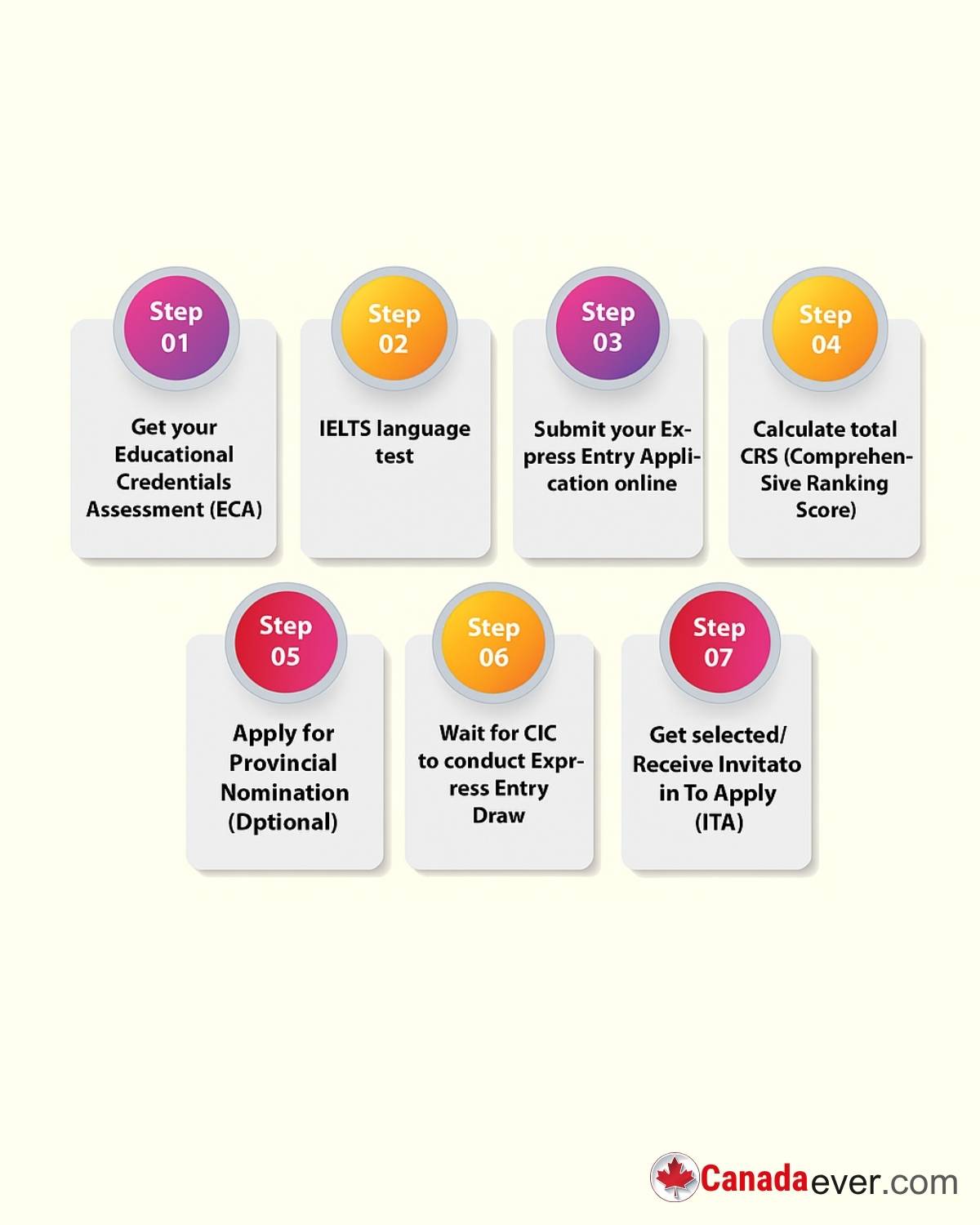
Pre-Application Checklist
✅ Eligibility Assessment
- Check eligibility for at least one Express Entry program:
- Federal Skilled Worker Program (FSWP)
- Canadian Experience Class (CEC)
- Federal Skilled Trades Program (FSTP)
- Age: 18+ years old
- Meet minimum work experience requirements
- Meet minimum language requirements
✅ Required Documents Before Profile Creation
- Valid Passport or Travel Document
- Must be valid for profile creation
- Scan copy ready for upload
- Language Test Results (Valid for 2 years)
- IELTS General Training
- CELPIP General
- PTE Core
- TEF Canada (French)
- TCF Canada (French)
- Educational Credential Assessment (ECA)
- WES Report
- ICAS Report
- CES Report
- IQAS Report
- ICES Report
- Reference number ready
- Work Experience Documentation
- Employment reference letters
- Job descriptions
- Pay stubs/salary certificates
- Employment contracts
- Proof of Funds
- Bank statements (6 months)
- Fixed deposits
- Investment certificates
- Gift deed (if applicable)
✅ Additional Documents (If Applicable)
- Provincial Nomination Certificate
- Valid Job Offer from Canadian Employer
- Canadian Education Credentials
- Certificate of Qualification (for trades)
- Spouse/Partner Documents (if accompanying)
Profile Creation Checklist
✅ IRCC Account Setup
- Create IRCC secure account
- Verify email address
- Set up security questions
✅ Profile Information Entry
- Personal details (name, date of birth, etc.)
- Contact information
- Passport/travel document details
- Language test results and reference numbers
- Education details and ECA reference number
- Work experience details (last 10 years)
- Funds declaration
- Provincial nomination details (if applicable)
- Job offer details (if applicable)
✅ Final Review
- Double-check all information for accuracy
- Verify all reference numbers
- Ensure consistency across all sections
- Review CRS score calculation
- Submit profile to Express Entry pool
Post-Submission Checklist
✅ Profile Management
- Keep profile updated with any changes
- Monitor email for draw notifications
- Check IRCC account regularly
- Maintain document validity (renew if needed)
✅ ITA Preparation (While Waiting)
- Prepare complete document set for ITA
- Obtain police clearance certificates
- Complete medical examination
- Gather additional supporting documents
Common Mistakes to Avoid
❌ Don’t Do These:
- Don’t use estimated language test scores
- Don’t submit profile with expired documents
- Don’t forget to include spouse information
- Don’t claim points for ineligible work experience
- Don’t submit multiple profiles simultaneously
- Don’t provide false information
- Don’t ignore profile updates when circumstances change
✅ Best Practices:
- Always use official test results
- Keep all documents updated and valid
- Be honest and accurate in all information
- Regularly update profile for score improvements
- Maintain proper document backups
- Seek professional help if unsure
Important Reminders
📅 Timeline Reminders:
- Express Entry profile valid for 12 months
- Language test results valid for 2 years
- ECA report valid for 5 years
- 60 days to submit application after ITA
💰 Budget Planning:
- Language test: CAD 300-400
- ECA assessment: CAD 200-300
- Application fees: CAD 1,525 per adult
- Medical exams: CAD 300-500 per person
- Police certificates: Varies by country
📞 Emergency Contacts:
- IRCC Client Support Centre: 1-888-242-2100
- Technical support for online applications
- Licensed immigration consultant (if using)
Note: This checklist is for reference purposes. Always refer to the official IRCC website for the most current requirements and procedures.
Pre-Application Requirements and Eligibility
Before creating your Express Entry profile, you must ensure eligibility for at least one of the three programs. Start by determining your National Occupational Classification (NOC) code, as this affects which programs you qualify for. Your work experience must be in skilled occupations, and you must meet minimum language proficiency requirements.
Essential eligibility criteria include being at least 18 years old, having the required work experience in skilled occupations, meeting language requirements, and having sufficient funds to support yourself and your family in Canada. For 2025, the proof of funds requirements range from CAD $14,463 for a single applicant to CAD $38,156 for a family of seven.
| Family Size | Required Funds (CAD) | USD Equivalent (Approx) | Notes |
|---|---|---|---|
| 1 | 14463 | 10800 | Single applicant |
| 2 | 17965 | 13400 | Couple or single parent with 1 child |
| 3 | 22094 | 16500 | Family of 3 |
| 4 | 26833 | 20000 | Family of 4 |
| 5 | 30439 | 22700 | Family of 5 |
| 6 | 34309 | 25600 | Family of 6 |
| 7 | 38156 | 28500 | Each additional member: +$3,847 |
Essential Documents You Need
Gathering the correct documents before starting your profile creation is crucial for a smooth process. The documents you need fall into several categories, and some are required for profile creation while others are needed only after receiving an ITA.
| Document Category | Document Type | Required For Profile | Required After ITA | Validity Period | Notes |
|---|---|---|---|---|---|
| Identity Documents | Valid Passport/Travel Document | Yes | Yes | Valid throughout process | Must be machine-readable |
| Identity Documents | Birth Certificate | No | Yes | No expiry | Required for identity verification |
| Identity Documents | Marriage Certificate (if applicable) | No | Yes | No expiry | Or common-law partnership proof |
| Language Proficiency | IELTS General Training Results | Yes | Yes | 2 years from test date | CLB 7 minimum for FSW |
| Language Proficiency | CELPIP General Results | Yes | Yes | 2 years from test date | Alternative to IELTS |
| Language Proficiency | PTE Core Results | Yes | Yes | 2 years from test date | Newest accepted test |
| Language Proficiency | TEF/TCF Canada (French) | Yes | Yes | 2 years from test date | For French language points |
| Education | Educational Credential Assessment (ECA) | Yes | Yes | 5 years from issue date | From IRCC-designated organization |
| Education | Diplomas/Degrees/Certificates | Yes | Yes | No expiry | Original language acceptable |
| Work Experience | Employment Reference Letters | Yes | Yes | Valid throughout process | Must detail duties and hours |
| Work Experience | Job Offer Letter (if applicable) | No | Yes | Valid throughout process | LMIA-approved preferred |
| Work Experience | NOC Code Documentation | Yes | Yes | Valid throughout process | Must match job duties exactly |
| Financial | Proof of Funds | Yes | Yes | Valid throughout process | Based on family size |
| Financial | Bank Statements (6 months) | Yes | Yes | 6 months old max | Show consistent balance |
| Additional (If Applicable) | Provincial Nomination Certificate | If applicable | If applicable | Valid throughout process | Must be valid PNP certificate |
| Additional (If Applicable) | Canadian Work Permit | If applicable | If applicable | Valid throughout process | Shows Canadian experience |
| Additional (If Applicable) | Spouse/Partner Documents | If applicable | If applicable | Valid throughout process | If accompanying family |
| Post-ITA Only | Police Clearance Certificates | No | Yes | 1 year from issue date | From all countries lived 6+ months |
Language Test Requirements
Language proficiency is a critical factor in Express Entry, and you must take an approved language test to demonstrate your abilities. For English, accepted tests include IELTS General Training, CELPIP General, and PTE Core. For French, you can take TEF Canada or TCF Canada. Your test results must be less than two years old when you create your profile and submit your application.
| CLB Level | IELTS Reading | IELTS Writing | IELTS Listening | IELTS Speaking | CELPIP All Skills | Program Requirements |
|---|---|---|---|---|---|---|
| 4 | 3.5 | 4.0 | 4.5 | 4.0 | 4 | Below minimum |
| 5 | 4.0 | 5.0 | 5.0 | 5.0 | 5 | FSTP minimum (some skills) |
| 6 | 5.0 | 5.5 | 5.5 | 6.0 | 6 | Below FSW minimum |
| 7 | 6.0 | 6.0 | 6.0 | 6.0 | 7 | FSW/CEC minimum |
| 8 | 6.5 | 6.5 | 7.5 | 6.5 | 8 | Strong proficiency |
| 9 | 7.0 | 7.0 | 8.0 | 7.0 | 9 | High proficiency |
| 10 | 8.0 | 7.5 | 8.5 | 7.5 | 10 | Very high proficiency |
| 11 | 8.5 | 8.0 | 9.0 | 8.0 | 11 | Near native level |
| 12 | 9.0 | 8.5 | 9.5 | 8.5 | 12 | Native level |
Educational Credential Assessment (ECA)
If you completed your education outside Canada, you need an Educational Credential Assessment from an IRCC-designated organization. The most popular choice is World Education Services (WES), though you can also use ICAS, CES, IQAS, or ICES.
In most cases, you only need to submit your highest credential for assessment. The ECA report is valid for five years and helps IRCC determine the Canadian equivalency of your foreign education.
Step-by-Step Profile Creation Process
Step 1: Create Your IRCC Secure Account
Begin by visiting the official IRCC website and creating a secure online account. This account will be your gateway to managing your Express Entry profile and, later, your permanent residence application. Ensure you provide accurate contact information and set up strong security questions, as you’ll use this account throughout your immigration journey.
Step 2: Gather and Enter Your Information
Once your account is ready, start entering your personal information systematically315. Begin with basic details like your name, date of birth, country of birth, and current country of residence3. Enter your passport or travel document information, ensuring all details match exactly what appears on your documents.
Next, input your language test results, including the test type, test date, and your scores for each skill (reading, writing, listening, speaking). Include your test reference number or unique identifier as required. For education, enter details about your highest level of education and include your ECA reference number if you have foreign credentials.
Step 3: Work Experience Entry
Document your work experience for the last 10 years, focusing on skilled positions that qualify under your chosen Express Entry program. For each position, provide the job title, company name, start and end dates, number of hours worked per week, and your main duties and responsibilities. Ensure your job descriptions align with the NOC code you’re claiming, as mismatches can lead to point deductions or application refusal.
Step 4: Additional Information
Include information about any provincial nominations, valid job offers, or Canadian education credentials you may have. If you have a spouse or common-law partner who will accompany you to Canada, include their information as well, as their credentials can contribute additional CRS points.
Step 5: Review and Submit
Before submitting your profile, carefully review all information for accuracy and completeness. Check that all reference numbers are correct and that your information is consistent across all sections. Pay particular attention to dates, NOC codes, and language test scores, as errors in these areas commonly cause problems.
Understanding Your CRS Score
The Comprehensive Ranking System determines your ranking in the Express Entry pool. Your CRS score is calculated based on core human capital factors (age, education, language proficiency, work experience), spouse factors (if applicable), skill transferability factors, and additional factors like provincial nominations or job offers.
Age is a significant factor, with candidates aged 25-29 receiving maximum points. Education level also plays a crucial role, with higher degrees earning more points. Language proficiency can significantly boost your score, especially if you achieve CLB 9 or higher. Canadian work experience and provincial nominations provide substantial point boosts.
CRS Score Breakdown
| Factor | Maximum Points (Single) | Maximum Points (With Spouse) | Notes |
|---|---|---|---|
| Age (25-29 years) | 110 | 100 | Peak age range for maximum points |
| Age (30-34 years) | 105 | 95 | Still high scoring age range |
| Age (35-39 years) | 95 | 85 | Points decrease with age |
| Education (Bachelor’s degree) | 112 | 112 | Good education points |
| Education (Master’s degree) | 126 | 126 | Higher education bonus |
| Education (PhD) | 135 | 135 | Highest education points |
| Language (First Official – CLB 9) | 136 | 128 | Maximum language points |
| Language (First Official – CLB 8) | 124 | 116 | High language proficiency |
| Language (First Official – CLB 7) | 68 | 64 | Minimum for most programs |
| Language (Second Official – CLB 7+) | 22 | 22 | Bonus for bilingualism |
| Canadian Work Experience (1 year) | 40 | 40 | Valuable Canadian experience |
| Canadian Work Experience (3+ years) | 80 | 80 | Maximum Canadian experience |
| Foreign Work Experience (3+ years) | 25 | 25 | International experience valued |
| Provincial Nomination | 600 | 600 | Biggest point boost available |
| Valid Job Offer (NOC 0, A, B) | 200 | 200 | Significant advantage |
| Canadian Education (2+ year program) | 30 | 30 | Additional education points |
| Spouse Language (CLB 7+) | N/A | 20 | Spouse can contribute points |
| Spouse Education (Bachelor’s+) | N/A | 10 | Spouse education matters |
| Spouse Work Experience | N/A | 10 | Spouse experience counts |
Common Mistakes to Avoid
Several common errors can harm your Express Entry profile or delay your application. Never use estimated language test scores when creating your profile – always use official results from approved testing organizations. Avoid selecting incorrect NOC codes, as this can lead to ineligibility or point reductions.
Don’t submit multiple Express Entry profiles simultaneously, as this violates IRCC rules. Ensure all your documents are valid and up-to-date before submitting your profile. Never provide false information, as misrepresentation can result in a five-year ban from applying.
Keep your profile updated with any changes in circumstances, such as new work experience, improved language scores, or changes in marital status. These updates can potentially improve your CRS score and increase your chances of receiving an ITA.
What Happens After Profile Submission
Once you submit your Express Entry profile, you enter the pool of candidates and receive a CRS score. IRCC conducts draws approximately every two weeks, though the frequency and focus of draws can vary based on immigration targets and priorities. In 2025, most draws have been program-specific, targeting candidates with provincial nominations, Canadian experience, French language skills, or experience in priority occupations.
Your profile remains valid for 12 months. If you don’t receive an ITA within this period, your profile expires and you must create a new one. However, you can update your profile at any time to reflect changes that might improve your score.
Preparing for Your ITA
While waiting in the Express Entry pool, start preparing the comprehensive document package you’ll need if you receive an ITA. You’ll have only 60 days to submit your complete application after receiving an invitation. Essential documents for the post-ITA stage include police clearance certificates from all countries where you’ve lived for six months or more since age 18, medical examinations from IRCC-approved panel physicians, and updated proof of funds.
Processing Times and Fees
Current Express Entry Processing times are approximately 5-8 months from the date IRCC receives your complete application. However, this doesn’t include the time spent in the Express Entry pool waiting for an ITA. Processing times can vary based on your specific program stream and individual circumstances.
The cost of applying through Express Entry includes several components beyond the government application fees. Language tests typically cost CAD $300-400, ECA assessments range from CAD $200-300, and the main application fee is CAD $1,525 per adult applicant plus CAD $260 per dependent child. Additional costs include medical examinations (CAD $300-500 per person) and police clearance certificates (varies by country).
Looking Ahead: 2025 Express Entry Trends
Express Entry continues evolving in 2025 with increased focus on targeted immigration. The federal government is prioritizing candidates with French language proficiency, Canadian work experience, and skills in healthcare, education, and skilled trades. Provincial Nominee Programs remain important, though allocations have been reduced to give the federal government more control over immigration levels.
The overall immigration targets for 2025 include 124,590 admissions under Federal Economic Programs, representing an increase from 2024 despite reduced overall immigration targets. This shift emphasizes the importance of Express Entry in Canada’s immigration strategy.
Creating a successful Express Entry profile requires careful preparation, attention to detail, and ongoing maintenance. By following this comprehensive walkthrough and utilizing the provided checklists and reference materials, you’ll be well-positioned to navigate the Express Entry system effectively and move closer to achieving your goal of Canadian permanent residence.
Remember to stay informed about program changes and maintain realistic expectations while working to strengthen your profile for the best possible outcome.
Related reading: Express Entry Complete Guide — a closer look at this topic.
Quick answers from official sources
What documents might I need to create an Express Entry profile?
You may need a passport or travel document, language test results, an educational credential assessment report in some cases, proof of work experience and a written job offer if you have one.
When should I renew my passport for Express Entry?
IRCC says to renew your passport if it expires within 6 months from the day you apply, then update the passport information in your application.
Does creating a profile mean I will be invited?
No. Creating a profile and entering the pool doesn’t guarantee an invitation to apply.
Sources (checked October 27, 2026):