Express Entry Complete Guide 2026: Step-by-Step Application Process

Canada’s Express Entry system remains the fastest pathway for skilled workers to obtain permanent residence, processing applications in approximately 5-8 months from submission. This comprehensive guide provides everything you need to know about navigating the Express Entry process in 2025, including recent program changes, detailed step-by-step instructions, and essential requirements for successful application.
Quick answer: Express Entry is IRCC’s online system for the Federal Skilled Worker Program, Canadian Experience Class and Federal Skilled Trades Program. You create a profile and enter the pool, but entering it doesn’t guarantee an invitation to apply. If you are invited, your invitation to apply is valid for 60 days only.
Want the newest invitation rounds and CRS cut-offs? See our Express Entry draws tracker.
Canada’s Express Entry system remains the fastest pathway for skilled workers to obtain permanent residence, processing applications in approximately 5-8 months from submission.
Understanding Express Entry
What is Express Entry?
Express Entry is Canada’s electronic immigration management system that facilitates applications for three federal economic programs: the Federal Skilled Worker Program (FSWP), Canadian Experience Class (CEC), and Federal Skilled Trades Program (FSTP).
Unlike individual immigration programs, Express Entry operates as a competitive pool where candidates are ranked using the Comprehensive Ranking System (CRS) and invited to apply based on their scores.
The system uses an “expression of interest” model, meaning candidates submit profiles indicating their desire to immigrate to Canada. Those meeting minimum eligibility requirements enter a pool where they compete for Invitations to Apply (ITAs) issued during regular draws.
Key Changes in 2025
The Express Entry landscape has shifted significantly in 2025, with the government moving away from general draws to targeted category-based selections. From January to May 2025, Immigration, Refugees and Citizenship Canada (IRCC) conducted no all-program draws, instead focusing on candidates with specific qualifications such as French language proficiency, Canadian work experience, or occupations in high-demand sectors.
This strategic shift aligns with Canada’s updated immigration plan for 2024-2026, which reduces new permanent residents to 395,000 in 2025—a decrease of 90,000 from the previous year9. The change reflects concerns about housing, healthcare, and infrastructure capacity while prioritizing quality over quantity in immigrant selection.
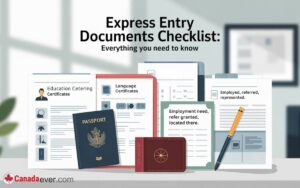
Express Entry Document Checklist 2025
✅ Pre-Application Documents
Language Test Results
- English Test Results (Choose one):
- IELTS General Training (valid for 2 years)
- CELPIP General (valid for 2 years)
- PTE Core (valid for 2 years)
- French Test Results (Optional but recommended):
- TEF Canada (valid for 2 years)
- TCF Canada (valid for 2 years)
Educational Credential Assessment (ECA)
- ECA Report from designated organization:
- WES (World Education Services)
- ICAS (International Credential Assessment Service)
- CES (Comparative Education Service)
- IQAS (International Qualifications Assessment Service)
- PEBC (Pharmacy Examining Board of Canada)
Work Experience Documentation
- Reference Letters from all employers (last 10 years)
- Employment Contracts or offer letters
- Pay Stubs or salary certificates
- Tax Documents (if available)
- Job Descriptions matching NOC codes
✅ Post-ITA Documents (Required within 60 days)
Identity and Civil Status
- Passport (biographical pages)
- Birth Certificate
- Marriage Certificate (if married)
- Divorce Certificate (if divorced)
- Death Certificate of spouse (if widowed)
- Common-law Union Form (IMM 5409) if applicable
Police Certificates
- Police Certificate from country of residence
- Police Certificate from all countries lived in for 6+ months since age 18
- FBI Certificate (if lived in USA)
Proof of Funds
- Bank Statements (last 6 months)
- Bank Letter confirming account details and balance
- Investment Statements (if applicable)
- Gift Deed (if funds are gifted)
Medical Examination
- Upfront Medical Exam (optional but recommended)
- Medical Forms from panel physician
Additional Documents (if applicable)
- Provincial Nomination Certificate
- Job Offer Letter with LMIA
- Proof of Canadian Work Experience
- Digital Photo specifications per IRCC requirements
✅ Family Members (Spouse/Children)
For Spouse/Partner
- Passport (biographical pages)
- Birth Certificate
- Language Test Results (if claiming points)
- Educational Credentials (if claiming points)
- Police Certificates
- Medical Examination
For Dependent Children
- Passport or travel document
- Birth Certificate
- Adoption Certificate (if adopted)
- Custody Agreement (if not both parents immigrating)
- Police Certificate (if 18+ years old)
- Medical Examination
📋 Important Notes
- All documents must be in English or French, or accompanied by certified translations
- Documents must be clear, complete, and legible
- Some documents may require notarization or certification
- Keep originals and copies of all documents
- Submit documents as PDF files through your online account
- File size limit: 4MB per document
⏰ Timeline Reminders
- Language Tests: Valid for 2 years from test date
- ECA Report: Valid for 5 years from issue date
- Police Certificates: Generally valid for 1 year
- Medical Exam: Valid for 1 year
- Post-ITA Submission: Must submit within 60 calendar days
🔍 Document Quality Tips
- Scan at high resolution (minimum 300 DPI)
- Ensure all text is readable and images are clear
- Check file sizes (max 4MB per document)
- Name files clearly (e.g., “Passport_MainApplicant.pdf”)
- Verify all pages are included and in correct order
- Use PDF format for all documents when possible
Express Entry Timeline
| Phase | Duration | Notes |
|---|---|---|
| Language Test Results | 7-13 business days | IELTS, CELPIP, or TEF results |
| Educational Credential Assessment | 20-25 business days | From designated organizations |
| Create Express Entry Profile | 1-2 hours | If eligible for program |
| Wait in Pool for ITA | Varies (instant to 12+ months) | Depends on CRS score & draws |
| Submit Complete Application | 60 days after ITA | Must submit within 60 days |
| Medical Examination | 1-4 weeks to get appointment | From IRCC panel physician |
| Police Clearance Certificate | 2-16 weeks | From all countries lived 6+ months |
| Application Processing | 6-8 months after submission | Target: 80% in 6 months |
| Final Decision & COPR | Same day as approval | Confirmation of PR document |
| Landing in Canada | Within 1 year of COPR | Must land before expiry |
This checklist is based on IRCC requirements as of 2025. Always verify current requirements on the official IRCC website before submitting your application.
Complete Step-by-Step Process


The Express Entry process involves twelve distinct phases, from initial eligibility assessment through landing in Canada as a permanent resident. Understanding each step helps ensure proper preparation and successful application completion.
Phase 1: Eligibility Assessment
Before creating an Express Entry profile, candidates must determine their eligibility for at least one of the three federal programs. Each program has specific requirements:
Federal Skilled Worker Program (FSWP) requires a minimum of CLB 7 in all four language abilities, one year of continuous skilled work experience (NOC TEER 0, 1, 2, or 3), and completion of secondary education. Candidates must also score at least 67 points on the FSW points grid, which evaluates factors including age, education, work experience, language ability, arranged employment, and adaptability.
Canadian Experience Class (CEC) targets individuals with Canadian work experience, requiring at least 12 months of skilled work experience in Canada within the past 36 months. Language requirements vary by NOC TEER level: CLB 7 for TEER 0 and 1 occupations, and CLB 5 for TEER 2 and 3 positions. Importantly, work experience gained while studying full-time does not count toward CEC eligibility.
Federal Skilled Trades Program (FSTP) requires CLB 5 for speaking and listening, CLB 4 for reading and writing, plus either a valid job offer or certificate of qualification from a Canadian province or territory.
Phase 2: Language Testing
Language proficiency serves as a cornerstone of Express Entry eligibility, with test results valid for two years from the test date. For English, candidates can choose from IELTS General Training, CELPIP General, or PTE Core. French testing options include TEF Canada and TCF Canada.
Higher language scores significantly impact CRS rankings, making language improvement one of the most effective strategies for increasing competitiveness. Candidates claiming proficiency in both official languages can earn additional CRS points, particularly valuable given 2025’s emphasis on French-speaking candidates.
Phase 3: Educational Credential Assessment
Foreign-educated candidates must obtain an Educational Credential Assessment (ECA) from a designated organization to verify their education meets Canadian standard. The ECA report remains valid for five years and is mandatory for claiming education points in the CRS calculation.
Designated organizations include World Education Services (WES), International Credential Assessment Service (ICAS), Comparative Education Service (CES), International Qualifications Assessment Service (IQAS), and the Pharmacy Examining Board of Canada (PEBC) for pharmacy professionals.
Phase 4: Profile Creation and Pool Entry
Candidates create their Express Entry profile online through the IRCC secure portal, providing detailed information about their background, education, work experience, and language abilities. The system automatically determines program eligibility and calculates the CRS score based on submitted information.
Registration with Job Bank, previously mandatory for candidates without job offers or provincial nominations, became optional in June 2017. While no longer required, Job Bank registration can still provide valuable networking opportunities and potential employer connections.
Phase 5: Comprehensive Ranking System Scoring
The CRS evaluates candidates across multiple factors, awarding up to 1,200 points total. Core factors including age, education, language ability, and work experience can earn up to 600 points, while additional factors such as Canadian education, work experience, job offers, or provincial nominations provide the remaining 600 points.
CRS Score Breakdown
| Factor | Points Available | Details |
|---|---|---|
| Age (maximum) | 110 | Peak at 20-29 years old |
| Education (maximum) | 150 | PhD gets maximum points |
| Official language proficiency (maximum) | 160 | CLB 10+ in first language |
| Canadian work experience (maximum) | 80 | 5+ years gets maximum |
| Arranged employment (maximum) | 200 | LMIA or PNP job offer |
| Spouse factors (maximum) | 40 | Education, language, Canadian experience |
| Additional factors – Skills transferability | 100 | Combinations of education, language, experience |
| Additional factors – Provincial nomination | 600 | Automatic 600 points |
| Additional factors – French proficiency | 50 | TEF B2+ with CLB 7+ English |
| Additional factors – Canadian education | 30 | Canadian post-secondary credential |
| Additional factors – Sibling in Canada | 15 | Canadian citizen/PR sibling |
Recent trends show increasing CRS cut-off scores, making strategic score improvement essential for competitiveness. Common enhancement strategies include improving language test scores, obtaining additional education, gaining Canadian work experience, or securing provincial nominations.
Phase 6: Receiving an Invitation to Apply
ITAs are issued during regular draws from the Express Entry pool, typically every two weeks. In 2025, draws have become highly targeted, focusing on specific categories rather than general all-program selections. French-speaking candidates, those with Canadian experience, and individuals in high-demand occupations receive priority.
Upon receiving an ITA, candidates have exactly 60 calendar days to submit a complete application for permanent residence. This deadline is strictly enforced, with no extensions available for late submissions.
Phase 7: Document Preparation and Submission
The post-ITA phase requires extensive documentation to support all claims made in the Express Entry profile. Required documents include identity papers, language test results, educational credentials, work experience proof, police certificates, medical examinations, and proof of funds.
Document quality and completeness significantly impact processing times and approval rates. All documents must be in English or French, or accompanied by certified translations from approved translators. Digital submission through the online portal requires PDF format with maximum file sizes of 4MB per document.
Phase 8: Medical Examinations and Background Checks
Medical examinations must be conducted by IRCC-approved panel physicians, with results valid for one year. As of October 2023, upfront medical examinations are no longer required before application submission, though they can expedite processing if completed proactively.
Police certificates are required from all countries where candidates have lived for six months or more since age 18. These certificates typically remain valid for one year and must be obtained from appropriate authorities in each jurisdiction.
Phase 9: Settlement Funds Verification
Applicants under FSWP and FSTP must demonstrate sufficient settlement funds to support themselves and their families upon arrival in Canada. CEC applicants are exempt from this requirement.
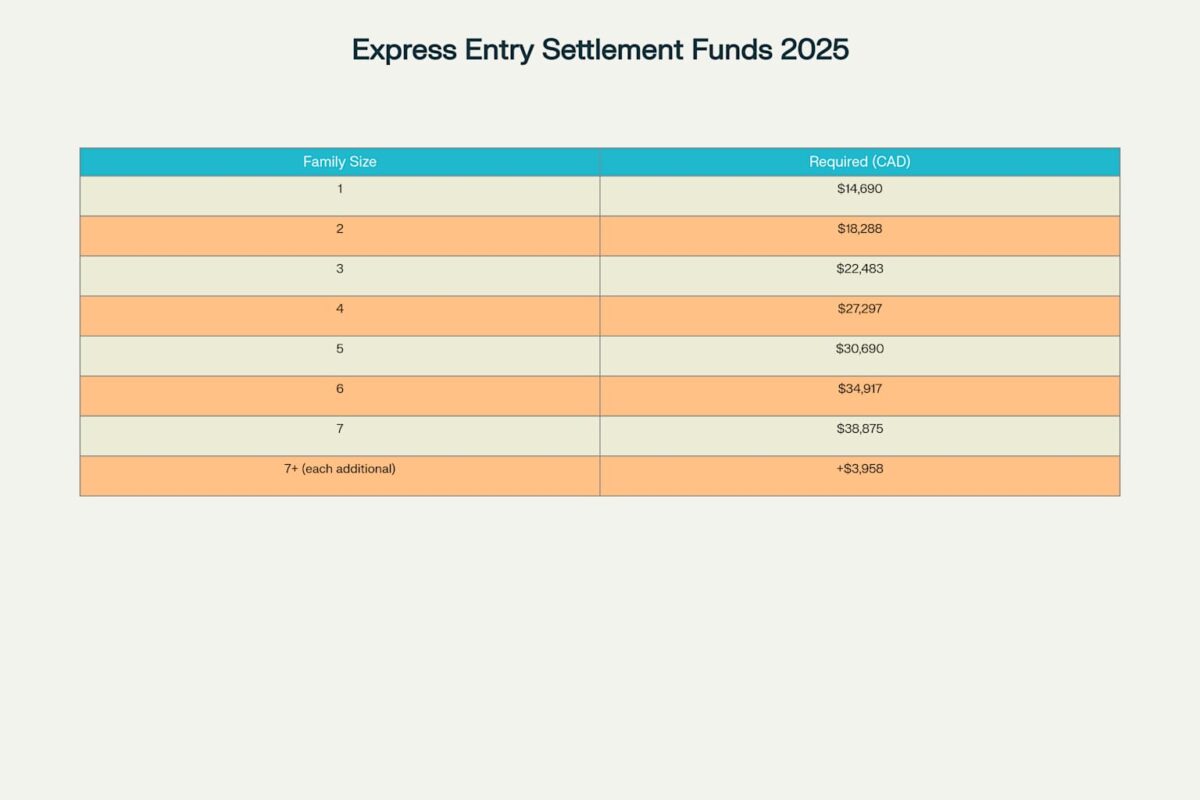
Settlement fund requirements are updated annually, with 2025 amounts ranging from $14,690 for single applicants to $38,875 for families of seven or more members21. Acceptable proof includes bank statements, investment accounts, and official letters from financial institutions confirming account details and available balances21.
Phase 10: Application Processing
IRCC aims to process 80% of Express Entry applications within six months of submission. Processing times may vary based on application completeness, background verification requirements, and current processing volumes. Applications requiring additional verification or missing documents may experience delays.
During processing, IRCC officers verify all submitted information against supporting documentation and may request additional evidence if discrepancies arise. Misrepresentation can result in application refusal and potential inadmissibility for several years.
Phase 11: Final Decision and COPR Issuance
Successful applicants receive a Confirmation of Permanent Residence (COPR) document, which serves as their authorization to travel to Canada as permanent residents. The COPR includes important details such as validity dates and conditions that must be met upon landing.
Before traveling, new permanent residents must ensure their passport remains valid for the duration of their journey and that they carry all required documentation for border inspection.
Phase 12: Landing in Canada
The final step involves arriving in Canada and completing the landing process at a port of entry5. Border officers verify the COPR against the traveler’s identity and may ask questions about settlement plans and funds. Upon successful completion, individuals officially become Canadian permanent residents with rights to live, work, and study anywhere in Canada.
Work Experience Requirements
Minimum Experience Standards
Express Entry programs have specific work experience requirements that candidates must meet. FSWP requires at least one year of continuous full-time work experience (or equivalent part-time) in a skilled occupation within the past 10 years. This translates to 1,560 hours total, calculated as 30 hours per week for 52 weeks.
CEC candidates need at least 12 months of skilled Canadian work experience within the 36 months preceding their application. The experience must be gained in NOC TEER 0, 1, 2, or 3 categories and can be accumulated through multiple positions.
NOC Classification System
The National Occupational Classification (NOC) system categorizes occupations based on Training, Education, Experience, and Responsibilities (TEER). Eligible occupations fall under TEER categories 0 (management), 1 (professional), 2 (technical), and 3 (skilled trades and technical).
Candidates must demonstrate that their actual job duties align with the NOC description for their claimed occupation. This includes performing the actions described in the lead statement and completing a substantial number of the main duties listed.
Reference Letter Requirements
Employment verification requires detailed reference letters from all employers covering the claimed experience period24. Letters must include company contact information, employment dates, job title, duties performed, hours worked per week, and annual salary or wage.
Self-employed work generally does not count toward Express Entry eligibility, though there may be exceptions for certain professional practices. Unpaid internships, volunteer work, and employment gained while studying full-time are also excluded.
Language Requirements and Testing
Accepted Language Tests
IRCC accepts specific language tests for Express Entry applications, with results valid for two years from the test date. For English proficiency, candidates may choose IELTS General Training, CELPIP General, or PTE Core. French testing options include TEF Canada and TCF Canada.
Test selection should consider individual strengths, test availability, and scoring systems. CELPIP and IELTS remain the most popular English tests, while TEF Canada dominates French language assessment.
Canadian Language Benchmark Levels
Express Entry uses the Canadian Language Benchmark (CLB) system to standardize language proficiency across different tests. Minimum requirements vary by program and occupation level10. FSWP requires CLB 7 in all four abilities (reading, writing, listening, speaking).
CEC language requirements depend on the NOC TEER level of the candidate’s occupation. TEER 0 and 1 positions require CLB 7, while TEER 2 and 3 occupations need CLB 5. Higher language scores significantly impact CRS rankings and competitiveness.
Bilingual Advantage
Candidates demonstrating proficiency in both English and French can earn additional CRS points, providing a significant competitive advantage. In 2025, French-speaking candidates receive particular priority in category-based draws, reflecting Canada’s commitment to francophone immigration.
The bilingual bonus applies when candidates achieve at least CLB 5 in all four French language abilities while maintaining minimum English requirements. This combination can add valuable points to overall CRS scores.
Provincial Nominee Programs
PNP Integration with Express Entry
Provincial Nominee Programs work in conjunction with Express Entry to address specific regional labor market needs. Provinces and territories can nominate candidates from the Express Entry pool who meet their particular requirements.
A provincial nomination adds 600 CRS points, virtually guaranteeing an ITA in subsequent draws. However, nominees must still meet federal Express Entry requirements and complete the standard application process.
Enhanced PNP Integration
Recent trends suggest increased coordination between federal and provincial immigration programs. Some provinces prioritize candidates already in the Express Entry pool, while others maintain separate streams for direct provincial nomination.
Candidates interested in provincial nomination should research specific program requirements and application processes for their target province. Each province maintains different streams targeting various occupations, education levels, and experience types.
Processing Times and Costs

Application Processing Timeline
IRCC’s service standard aims to process 80% of Express Entry applications within six months of submission. However, actual processing times can vary based on application complexity, country of residence, and current processing volumes.
Factors potentially extending processing times include incomplete documentation, complex employment histories, extensive travel records, and security or background verification requirements. Applications requiring additional medical examinations or police certificates may also experience delays.
Associated Costs
Express Entry applications involve multiple fees and expenses throughout the process. Government fees include the primary applicant fee ($1,365), spouse fee ($1,365), and dependent child fees ($230 each). Additional costs include language testing ($300-400), educational credential assessment ($200-400), medical examinations ($300-500 per person), and police certificates (varies by country).
Estimated Costs for Canadian Permanent Residency Application (Express Entry)
| Fee Type | Amount (CAD) | When Required |
|---|---|---|
| Primary applicant processing fee | $950 | After ITA received |
| Primary applicant right of PR fee | $575 | After ITA received (can pay now) |
| Spouse/partner processing fee | $950 | If accompanying spouse |
| Spouse/partner right of PR fee | $575 | If accompanying spouse (can pay now) |
| Dependent child (per child) | $260 | Per dependent child under 22 |
| Biometrics fee (individual) | $85 | If applying alone |
| Biometrics fee (family) | $170 | If family of 2+ applying |
| Language test (IELTS) | $385-$450 | Before creating profile |
| Language test (CELPIP) | $280 | Before creating profile |
| Language test (TEF – French) | $275-$400 | For French proficiency |
| Educational Credential Assessment | $200-$400 | Before creating profile |
| Medical examination (approx) | $450-$700 | After ITA received |
| Police clearance certificate | $100-$300 | After ITA received |
Right of Permanent Residence Fee ($515 per adult) is required before landing but can be paid upfront to expedite processing. Total costs typically range from $3,000-5,000 for a single applicant, with additional expenses for families.
Settlement Fund Requirements
Financial self-sufficiency requirements ensure newcomers can support themselves during initial settlement21. Required amounts are updated annually and vary based on family size21.
Funds must be readily available and documented through bank statements, investment accounts, and official letters from financial institutions21. Money borrowed against assets, such as home equity loans, does not qualify as settlement funds21.
Recent Updates and Changes
Category-Based Selection
The most significant change in 2025 involves the shift toward category-based Express Entry draws. Rather than general all-program draws, IRCC now targets specific categories including French-language proficiency, Canadian work experience, and high-demand occupations.
This targeted approach aims to address specific labor market needs while managing overall immigration volumes. Categories receiving priority include healthcare workers, STEM professionals, skilled trades, transportation workers, and French-speaking candidates.
Elimination of Job Offer Points
Recent discussions suggest potential changes to how job offers are weighted in the CRS calculation. Some sources indicate job offer points may be reduced or eliminated to level the playing field for international candidates.
This change would increase the importance of other CRS factors such as language proficiency, education, and age. Candidates should focus on maximizing controllable factors rather than relying solely on job offer points.
Enhanced French Language Priority
French-speaking immigration receives increased emphasis in 2025, reflecting Canada’s commitment to maintaining linguistic duality. Category-based draws specifically targeting French-proficient candidates occur regularly, with generally lower CRS cut-off scores.
This trend presents significant opportunities for bilingual candidates and those willing to develop French language skills9. The French-language priority is expected to continue as Canada seeks to strengthen francophone communities outside Quebec.
Frequently Asked Questions
How long does the entire Express Entry process take?
The complete Express Entry process typically takes 6-12 months from profile creation to landing in Canada. This includes time for language testing, credential assessment, profile submission, receiving an ITA, and application processing. Processing times can vary based on individual circumstances and current IRCC workloads.
Can I improve my CRS score after submitting my profile?
Yes, candidates can update their Express Entry profiles to reflect improved circumstances such as higher language test scores, additional education, or new work experience. Updates must be supported by appropriate documentation and can impact overall CRS rankings.
What happens if my documents expire while my application is being processed?
Document validity is assessed at the time of application submission. However, IRCC may request updated documents if significant time passes during processing. Language test results, medical examinations, and police certificates have specific validity periods that must be considered.
Do I need a job offer to apply through Express Entry?
A job offer is not required for Express Entry applications, though it can provide additional CRS points. In 2025, the emphasis on category-based draws may reduce the importance of job offers compared to other factors such as language proficiency and Canadian experience.
Can I include my spouse in my application?
Yes, spouses and dependent children can be included in Express Entry applications. Including a spouse may provide additional CRS points if they have Canadian education, work experience, or strong language skills. However, each family member requires individual documentation including medical examinations and background checks.
What is the difference between CRS points and FSW points?
The Federal Skilled Worker (FSW) points system determines basic eligibility for the FSWP, requiring a minimum of 67 points. The Comprehensive Ranking System (CRS) ranks candidates within the Express Entry pool for invitation purposes, with scores reaching up to 1,200 points. Both systems evaluate similar factors but serve different purposes in the overall process.
Can I work in Canada while my Express Entry application is being processed?
Work authorization depends on current immigration status. Candidates with valid work permits can continue working during application processing. However, Express Entry applications alone do not provide work authorization.
What happens if I decline an ITA?
Declining an ITA allows candidates to remain in the Express Entry pool for future draws. There is no penalty for declining, though candidates should only do so if they cannot submit a complete application within the 60-day deadline. Profiles may need to be updated if information changes significantly.
How often does IRCC conduct Express Entry draws?
Traditionally, IRCC conducted draws approximately every two weeks. However, 2025 has seen a shift toward less frequent but more targeted category-based draws. The frequency and type of draws may continue evolving based on immigration targets and labor market needs.
What should I do if my profile expires?
Express Entry profiles expire after 12 months if no ITA is received. Candidates can create a new profile with updated information and current documentation. This may be beneficial if circumstances have improved since the original submission.
Can I apply to multiple provinces simultaneously?
Candidates can apply to multiple Provincial Nominee Programs simultaneously, though each province has specific requirements and processing times. However, accepting one nomination typically requires withdrawing from other provincial programs.
What happens after I receive permanent residence?
New permanent residents must maintain their status by meeting residency obligations (2 years in Canada out of every 5-year period). They gain rights to live, work, and study anywhere in Canada, access healthcare and social services, and eventually apply for Canadian citizenship.
Tips for Success
Maximizing CRS Scores
Focus on improvable factors such as language test scores, which often provide the highest return on investment. Consider pursuing additional education or credentials that align with Canadian standards. Gaining Canadian work experience through temporary work permits can significantly boost competitiveness.
Document Management
Maintain organized records of all education, employment, and personal documents throughout the process. Begin gathering required documentation early, as some items like police certificates can take several weeks to obtain. Ensure all documents meet IRCC specifications for format, language, and content.
Staying Informed
Immigration policies and procedures can change frequently, making it essential to stay updated through official IRCC communications. Consider subscribing to IRCC newsletters and following official social media accounts for timely updates8.
Professional Assistance
Complex cases may benefit from consultation with regulated immigration consultants or lawyers. Professional assistance can be particularly valuable for candidates with complicated employment histories, previous immigration issues, or unique circumstances.
This comprehensive guide provides the foundation for understanding and navigating Canada’s Express Entry system in 2025. Success requires careful preparation, attention to detail, and staying informed about evolving requirements and procedures. With proper planning and execution, Express Entry remains the most efficient pathway for skilled workers to achieve Canadian permanent residence.
Conclusion
Express Entry remains Canada’s premier immigration pathway for skilled workers, with significant updates in 2025 reflecting the country’s commitment to addressing specific labor market needs.
The introduction of enhanced category-based selection and the focus on candidates with Canadian experience demonstrates a strategic approach to immigration management. While the system has become more targeted and competitive, it continues to offer multiple pathways for skilled immigrants to achieve permanent residence in Canada.
Success in Express Entry requires careful preparation, strategic planning, and staying current with policy changes and draw trends. Candidates who invest in language proficiency, particularly French, pursue provincial nominations, or work in priority occupations have enhanced prospects for receiving invitations to apply.
With proper preparation and understanding of the system’s requirements, Express Entry continues to provide an efficient pathway to Canadian permanent residence for qualified skilled workers.
Related reading: How to Create Your Express Entry Profile: Complete — a closer look at this topic.
Quick answers from official sources
Does entering the Express Entry pool guarantee an invitation?
No. IRCC says completing an online Express Entry profile or entering the pool doesn’t guarantee an invitation to apply for permanent residence; you can only apply if you receive an invitation.
How long is an Express Entry invitation to apply valid?
An invitation to apply is valid for 60 days only, so IRCC advises starting the application form right away.
Which programs are managed through Express Entry?
The Federal Skilled Worker Program, the Canadian Experience Class and the Federal Skilled Trades Program.
Sources (checked October 27, 2026):
- canada.ca/en/immigration-refugees-citizenship/services/immigrate-canada/express-entry/create-profile.html
- canada.ca/en/immigration-refugees-citizenship/services/immigrate-canada/express-entry/apply-permanent-residence.html
- canada.ca/en/immigration-refugees-citizenship/services/immigrate-canada/express-entry/who-can-apply.html