Canadian Experience Class (CEC): Complete Eligibility Guide

The Canadian Experience Class (CEC) offers one of the most streamlined pathways to permanent residence for skilled workers who have already gained valuable work experience in Canada123. This comprehensive guide will walk you through everything you need to know about CEC eligibility, requirements, and the application process in simple, easy-to-understand terms.
Quick answer: The Canadian Experience Class needs 1,560 hours of Canadian work experience (1 year full time). Minimum language levels are CLB 7 for TEER 0 or 1 occupations and CLB 5 for TEER 2 or 3. IRCC says you can’t count experience gained while studying full-time or while self-employed.
Whether you’re currently working in Canada on a temporary visa or planning your immigration strategy, understanding the CEC program can be your gateway to calling Canada home permanently. This guide covers all the essential information, requirements, checklists, and recent trends to help you navigate the process successfully.
What is the Canadian Experience Class (CEC)?
The Canadian Experience Class is a federal immigration program designed specifically for skilled workers who have gained Canadian work experience while on temporary status. Launched in 2008, the CEC recognizes that individuals who have already lived and worked in Canada are more likely to successfully integrate into Canadian society and contribute to the economy.
The program is managed through Canada’s Express Entry system, which uses the Comprehensive Ranking System (CRS) to rank candidates and issue Invitations to Apply (ITAs) for permanent residence. Unlike other immigration programs, CEC applicants do not need to demonstrate proof of settlement funds, making it particularly attractive for temporary workers already established in Canada.
Key advantages of the CEC program include:
- No settlement funds requirement – A major financial relief for applicants
- Fast processing times – Typically 4-6 months after submission
- Streamlined documentation – Fewer documents required compared to other programs
- Higher success rates – Candidates already familiar with Canadian work culture
Canadian Experience Class (CEC) Complete Checklist
📋 Pre-Application Preparation Checklist
✅ Eligibility Verification
- Work Experience: Have at least 1 year (1,560 hours) of skilled work experience in Canada within the last 3 years
- TEER Category: Work experience is in TEER 0, 1, 2, or 3 occupations
- Legal Status: Work was performed on valid work permit or authorized status
- NOC Classification: Confirmed correct National Occupational Classification code for your job
✅ Language Requirements
- Language Test Completed: Taken approved language test (IELTS, CELPIP, TEF, or TCF)
- Minimum Scores Met:
- TEER 0/1 jobs: CLB 7 in all four abilities
- TEER 2/3 jobs: CLB 5 in all four abilities
- Test Validity: Language test results are less than 2 years old
- Spouse Language Test (if applicable): Spouse has taken language test for additional CRS points
✅ Document Preparation
- Passport: Valid passport with at least 6 months remaining
- Birth Certificate: Official birth certificate
- Educational Credentials: Degrees, diplomas, transcripts
- ECA Report (optional): Educational Credential Assessment for foreign education
- Employment Letters: Reference letters from Canadian employers
- Pay Stubs: Recent 12 months of Canadian pay stubs
- Work Permits: Copies of all work permits used in Canada
- Marriage Certificate (if applicable)
- Children’s Documents (if applicable): Birth certificates, adoption papers
🎯 Express Entry Profile Creation
✅ Profile Setup
- Create IRCC Account: Set up secure online account
- Complete Personal Information: Name, date of birth, country of birth
- Enter Language Results: Input exact test scores and reference numbers
- Work Experience Details: Add Canadian and foreign work experience
- Education Information: Include all post-secondary education
- CRS Score Calculation: Verify your Comprehensive Ranking System score
- Profile Submission: Submit complete and accurate profile
✅ Post-Submission
- Profile Confirmation: Receive confirmation number and keep records
- Monitor Draws: Track Express Entry draws and CRS cutoff scores
- Update Profile: Keep information current (job changes, new education, etc.)
- Improve CRS Score (if needed): Consider retaking language tests, additional education
🎉 After Receiving ITA (Invitation to Apply)
✅ Immediate Actions (First 7 Days)
- Read ITA Carefully: Understand requirements and deadline (60 days)
- Start Document Collection: Begin gathering all required documents
- Book Medical Exam: Schedule immigration medical examination
- Request Police Certificates: Apply for police clearances from all countries
✅ Document Upload Preparation
Identity Documents
- Passport: Biographical page and any pages with stamps
- National ID: If applicable
- Birth Certificate: Official government-issued certificate
- Name Change Documents: If name has changed (marriage, legal name change)
Language and Education
- Language Test Results: Official test report forms
- ECA Report: If claiming points for foreign education
- Education Transcripts: Official transcripts from institutions
- Degree/Diploma Certificates: Official certificates
Work Experience
- Employment Reference Letters: Must include specific details:
- Job title and duties
- Employment dates
- Salary and hours per week
- Company letterhead and contact information
- Employment Contracts: Signed employment agreements
- Pay Stubs: Recent 12 months from Canadian employers
- T4 Slips: Tax documents showing employment income
- Work Permit Copies: All permits used for Canadian work experience
Medical and Background
- Medical Examination: Completed by panel physician
- Police Certificates: From all countries where you lived 6+ months since age 18
- Military Records: If you served in military
Family Documents (if applicable)
- Marriage Certificate: Official marriage certificate
- Common-law Evidence: Proof of 12+ months cohabitation
- Spouse Documents: All required documents for spouse/partner
- Children’s Documents: Birth certificates, custody documents
✅ Fee Payment
- Processing Fee: CAD $950 per adult, CAD $260 per child
- Right of PR Fee: CAD $575 per adult (pay now to avoid delays)
- Biometrics Fee: Already paid during profile creation
- Payment Confirmation: Keep all payment receipts
📤 Application Submission
✅ Final Review
- Document Quality: All documents are clear, legible scans
- Translation: Non-English/French documents professionally translated
- Completeness Check: All required documents uploaded
- Information Accuracy: All information matches supporting documents
- File Size Limits: Documents meet IRCC file size requirements
✅ Submission
- Upload Documents: All documents uploaded to correct categories
- Pay Fees: All required fees paid
- Review and Submit: Final review before submission
- Confirmation: Receive application confirmation and keep records
- Timeline: Submitted within 60-day deadline
⏳ Post-Submission Monitoring
✅ During Processing
- Check Messages: Regularly check IRCC account for updates
- Respond Quickly: Reply to any additional document requests promptly
- Keep Information Current: Update address, phone, email if changed
- Track Processing Times: Monitor average processing times
- Maintain Status: Keep legal status in Canada if residing there
✅ Additional Requests (if any)
- Additional Documents: Provide any requested additional documents
- Interview Preparation: Prepare for interview if requested (rare for CEC)
- Medical Updates: Redo medical if expires during processing
🎊 After Approval
✅ COPR Receipt
- Review COPR: Check Confirmation of Permanent Residence for accuracy
- Report Errors: Immediately report any errors to IRCC
- Landing Preparation: Prepare for landing (if outside Canada) or confirmation (if in Canada)
✅ Landing Process
- Schedule Landing: Book appointment if required
- Landing Documents: Bring COPR, passport, and any required documents
- Complete Landing: Confirm permanent residence status
- PR Card Application: Apply for Permanent Resident card
- SIN Update: Update Social Insurance Number status
- Health Card: Apply for provincial health insurance
📞 Important Resources
Contact Information
- IRCC Client Support Centre: 1-888-242-2100
- Technical Support: For online portal issues
⚠️ Common Mistakes to Avoid
- Don’t submit incomplete application – All required documents must be included
- Don’t miss the 60-day deadline – Set reminders and start early
- Don’t provide false information – This can result in permanent ban
- Don’t forget to pay all fees – Missing fees will cause delays
- Don’t use expired documents – Ensure all documents are current
- Don’t forget to translate documents – All non-English/French documents need certified translations
📈 Tips for Success
Improve Your CRS Score
- Retake Language Tests: Aim for CLB 9+ for maximum points
- Canadian Education: Consider additional Canadian education
- Additional Work Experience: Gain more skilled work experience
- Provincial Nomination: Apply for PNP for 600 additional points
- Job Offer: Secure valid job offer for additional points
- French Language: Learn French for additional points
Application Best Practices
- Start Early: Begin document collection immediately after ITA
- Organize Documents: Keep all documents well-organized and labeled
- Use Professional Help: Consider immigration lawyer/consultant if needed
- Keep Copies: Maintain copies of all submitted documents
- Stay Informed: Follow IRCC updates and policy changes
Last Updated: June 2025
This checklist is for guidance only. Always refer to official IRCC website for the most current requirements.
Core Eligibility Requirements
To qualify for the Canadian Experience Class, you must meet several fundamental requirements that demonstrate your ability to contribute to Canada’s economy and integrate successfully into Canadian society123.
Work Experience Requirements
The cornerstone of CEC eligibility is your Canadian work experience:
- Minimum Duration: At least 12 months (1,560 hours) of skilled work experience in Canada
- Timeframe: Work experience must have been gained within the last 3 years before applying
- Legal Status: All work must have been performed while on valid work permits or authorized status
- Skill Level: Work must be in TEER 0, 1, 2, or 3 occupations under the National Occupational Classification system
Important Exclusions:
- Self-employment does not count toward the requirement
- Work experience gained while a full-time student is not eligible
- Unpaid internships and volunteer work do not qualify
Special Exception for Physicians: Since April 2023, foreign physicians providing publicly funded medical services may count certain self-employed work as Canadian experience under specific conditions1.
Understanding TEER Categories
The National Occupational Classification (NOC) system categorizes jobs based on Training, Education, Experience, and Responsibilities (TEER). As of November 2022, the system replaced the previous skill levels with TEER categories.
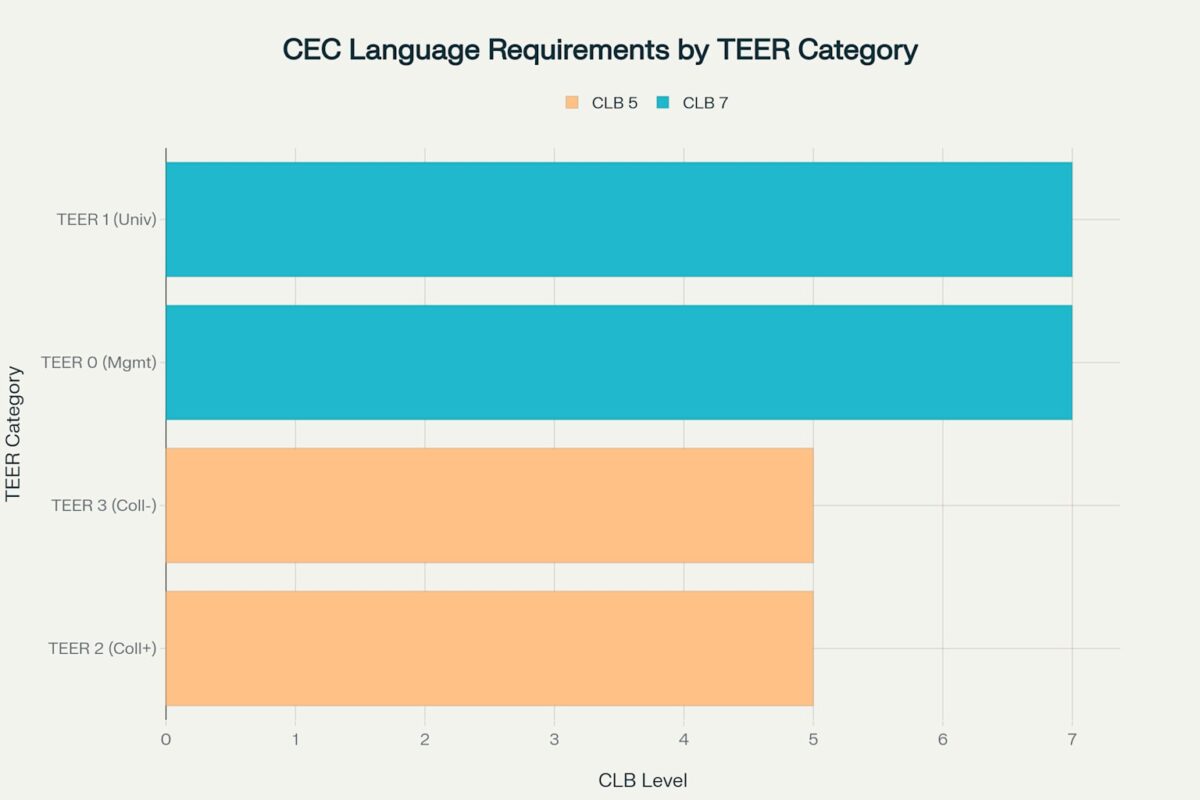

Language requirements (CLB levels) for different TEER categories in Canadian Experience Class
CEC-Eligible TEER Categories:
- TEER 0: Management occupations (e.g., financial managers, advertising managers)
- TEER 1: University degree typically required (e.g., software engineers, financial advisors)
- TEER 2: College diploma or 2+ years apprenticeship (e.g., computer technicians, medical lab technologists)
- TEER 3: College diploma or less than 2 years training (e.g., bakers, dental assistants)
Non-Eligible Categories:
- TEER 4: High school diploma or weeks of training
- TEER 5: Short-term demonstration, no formal education
Language Proficiency Requirements
Language proficiency is crucial for CEC eligibility and significantly impacts your CRS score.
Minimum Requirements by TEER Category:
- TEER 0 and 1 positions: Canadian Language Benchmark (CLB) 7 in all four abilities
- TEER 2 and 3 positions: CLB 5 in all four abilities
Accepted Language Tests:
- English: IELTS General Training, CELPIP-General, PTE Core
- French: TEF Canada, TCF Canada
Test Validity: Language test results must be less than 2 years old when you apply.
Additional Requirements
- Medical Examinations: All applicants and their family members must pass medical examinations conducted by IRCC-approved panel physicians.
- Security and Background Checks: Police certificates are required from all countries where you have lived for 6 months or more since the age of 18.
- Admissibility: You must be legally admissible to Canada, with no criminal history or security concerns that would make you inadmissible.
The CEC Application Process
Understanding the step-by-step application process helps ensure you don’t miss any critical deadlines or requirements.

Step-by-step flowchart of the Canadian Experience Class application process
Phase 1: Preparation (2-6 months)
Document Collection:
- Gather all employment reference letters from Canadian employers
- Take approved language tests (IELTS, CELPIP, TEF, or TCF)
- Obtain Educational Credential Assessment (ECA) if claiming points for foreign education
- Collect identity documents, transcripts, and certificates
NOC Classification: Carefully determine the correct NOC code for your Canadian work experience using the official NOC website.
Phase 2: Express Entry Profile Creation (1-2 hours)
Profile Setup:
- Create an IRCC online account
- Complete all sections accurately with supporting document information
- Calculate your Comprehensive Ranking System (CRS) score
- Submit your profile to the Express Entry pool
Post-Submission:
- Receive confirmation number and Express Entry profile number
- Monitor Express Entry draws and CRS cutoff scores
- Update profile information if circumstances change
Phase 3: Waiting in the Pool (Variable Timeline)
Monitoring Draws: IRCC conducts express entry draws approximately every two weeks, inviting candidates with the highest CRS scores.
CRS Score Management: Use this time to improve your score through:
- Retaking language tests for higher scores
- Gaining additional work experience
- Pursuing Canadian education
- Learning French as a second language
Phase 4: Invitation to Apply (ITA)
Once you receive an ITA, you have exactly 60 days to submit your complete application. This timeline was reduced from 90 days in 2018 to speed up the process.
Immediate Actions:
- Schedule medical examinations
- Apply for police certificates from all relevant countries
- Begin gathering all required documents
- Pay required fees
Phase 5: Application Submission and Processing
Submission Requirements:
- Upload all required documents in the correct format
- Pay processing fees and right of permanent residence fees
- Ensure all information matches your supporting documents exactly
Processing Timeline: Current processing times for CEC applications average 4-6 months, though this can vary based on application volume and complexity.
Understanding Fees and Costs
Planning your budget is essential for a successful CEC application. Here’s a comprehensive breakdown of all associated costs.
Government Processing Fees:
- Processing fee (main applicant): CAD $950
- Processing fee (spouse/partner): CAD $950
- Processing fee (dependent child): CAD $260
- Right of Permanent Residence fee (adults): CAD $575
- Biometrics fee (individual): CAD $85
- Biometrics fee (family): CAD $170
Additional Required Costs:
- Language tests: CAD $300-400
- Medical examinations: CAD $450 average per adult
- Police certificates: CAD $100-200 per country
- Educational Credential Assessment (if needed): CAD $200
Total Estimated Costs:
- Single applicant: CAD $2,660-3,260
- Couple with one child: CAD $4,740-5,540
Important Note: CEC applicants are exempt from proving settlement funds, which is a significant advantage over other immigration programs.
Recent CEC Draw Trends and Statistics
Understanding recent draw patterns helps set realistic expectations for your application timeline and required CRS score.

CRS cutoff score trends for Canadian Experience Class draws from 2024-2025
2024-2025 Draw Highlights:
- May 13, 2025: 500 ITAs issued, CRS cutoff 547 (record high)
- February 5, 2025: 1,000 ITAs issued, CRS cutoff 509 (return after 3-month pause)
- September 19, 2024: 4,000 ITAs issued, CRS cutoff 509 (largest recent draw)
- July 17, 2024: 6,300 ITAs issued, CRS cutoff 515
Key Observations:
- Inconsistent Draw Sizes: Recent draws have varied significantly, from 500 to 6,300 invitations
- Rising CRS Scores: Cutoff scores have generally increased, with the latest draw requiring 547 points
- Irregular Timing: CEC-specific draws have become less frequent and less predictable
Processing Time Trends: Recent data shows CEC processing times averaging 4.9 months in early 2025, with some variation month to month.
Essential Document Checklist
Proper documentation is critical for a successful CEC application. Here’s your complete checklist organized by category and priority.
Critical Priority Documents:
- Language test results with valid scores
- Employment reference letters from all Canadian employers
- Medical examination results
- Police certificates from all countries of residence
- Processing and PR fee payment receipts
High Priority Documents:
- Passport biographical pages
- Birth certificates
- Work permit copies
- Marriage certificate (if applicable)
- Spouse language test results (if applicable)
Medium Priority Documents:
- Educational Credential Assessment (for CRS points)
- National ID documents
- Military records (if applicable)
- Provincial nomination certificate (if applicable)
Common Mistakes to Avoid
Learning from others’ mistakes can save you time, money, and potential application refusal.
Documentation Errors:
- Incomplete applications: Missing even one required document can lead to refusal
- Expired documents: Ensure all documents are current and within validity periods
- Poor quality scans: Documents must be clear and legible
- Missing translations: All non-English/French documents need certified translations
Timeline Mistakes:
- Missing the 60-day deadline: Start document collection immediately after receiving ITA
- Procrastinating on medical exams: Book appointments as soon as you receive your ITA
- Delayed police certificates: These can take several weeks or months to obtain
Information Accuracy:
- Misrepresentation: Providing false information can result in permanent inadmissibility
- Inconsistent information: Ensure all details match across documents and application forms
- Wrong NOC codes: Carefully verify your job duties match the selected NOC code
Tips for Maximizing Your CRS Score
A higher CRS score improves your chances of receiving an ITA in future draws.
Language Improvement Strategies:
- Aim for CLB 9+: Higher language scores significantly boost your CRS points
- Consider bilingual bonuses: Strong French skills can add valuable points
- Retake tests strategically: Even small improvements can make a difference
Education and Experience:
- Canadian education bonus: Consider additional Canadian credentials for extra points
- Gain more work experience: Additional years of experience increase your score
- Spouse contributions: Include spouse’s language abilities and education
Alternative Pathways:
- Provincial Nominee Programs: A provincial nomination adds 600 CRS points, virtually guaranteeing an ITA
- Valid job offers: Arranged employment can add 50-200 points depending on the position
Success Stories and What They Mean for You

The CEC program has helped thousands of temporary workers transition to permanent residence successfully. Recent statistics show that CEC remains one of the most reliable pathways for individuals already established in Canada.
What Makes CEC Attractive:
- Higher success rates: Candidates already familiar with Canadian workplace culture
- No settlement funds: Major financial advantage over other programs
- Faster integration: Applicants already have Canadian networks and experience
Future Outlook: Despite recent changes in draw patterns, Canada continues to prioritize domestic candidates (those already in Canada) as stated by Immigration Minister Marc Miller21. The 2025-2027 Immigration Levels Plan targets over 395,000 new permanent residents in 2025, with a significant portion expected through Express Entry programs.
Conclusion
The Canadian Experience Class represents an excellent opportunity for skilled workers who have gained valuable Canadian work experience to transition to permanent residence. While recent trends show higher CRS requirements and less predictable draw patterns, the program remains one of the most accessible pathways for those who meet the eligibility criteria.
Key Takeaways:
- Start early: Begin preparing your documents and improving your CRS score well before applying
- Stay informed: Monitor draw trends and adjust your strategy accordingly
- Be thorough: Complete, accurate applications are essential for success
- Get professional help: Consider consulting with immigration professionals for complex cases
Remember that meeting the minimum requirements is just the first step. In today’s competitive environment, having a strong CRS score, complete documentation, and strategic planning are essential for success.
The journey to Canadian permanent residence through CEC may require patience and persistence, but for those who qualify, it offers one of the most direct paths to building a permanent life in Canada.
Ready to Start Your CEC Journey? Use the comprehensive checklist provided in this guide, calculate your CRS score, and begin gathering your documents today. Your Canadian dream could be closer than you think.
Related reading: Apply Now: 3000 Invited in Latest Canada CEC — a closer look at this topic.
Quick answers from official sources
How many work hours does the Canadian Experience Class require?
1,560 hours of work experience, which equals 1 year full time, and which can be met with part-time work that adds up to the same total.
What language level is required for the Canadian Experience Class?
CLB 7 for TEER 0 or TEER 1 occupations and CLB 5 for TEER 2 or TEER 3 occupations.
What work experience can’t be counted?
Per IRCC, experience gained while studying full-time (including co-op work terms) or while self-employed can’t be counted, although some physicians can count self-employed time.
Sources (checked October 27, 2026):