
July 2026 Express Entry: Lower Targets, CEC Focus, Key Trends

Canada has dramatically reduced its Express Entry immigration targets for 2025, issuing 41,845 Invitations to Apply (ITAs) in the first six months—down 11% from 2024—while prioritizing candidates with Canadian work experience through increased Canadian Experience Class (CEC) draws. The policy shift reflects Prime Minister Mark Carney’s conservative approach to immigration management, emphasizing retention of skilled workers already contributing to Canada’s economy.
The policy shift reflects Prime Minister Mark Carney’s conservative approach to immigration management, emphasizing retention of skilled workers already contributing to Canada’s economy.
Key Updates
Immigration Targets Slashed by 18.6%
- 2025 target: 395,000 permanent residents (down from 485,000 in 2024)
- Economic class allocation: 232,150 (down 17.4% from 281,135)
- First-ever temporary resident caps introduced: 673,650 in 2025
express entry draw Statistics (January-June 2025)
- Total ITAs issued: 41,845 (vs. 43,741 in same period 2024)
- Average CRS score: 612.8 (up from 481 in 2024)
- CEC draws: 6 out of 23 total draws (26.1% focus on Canadian experience)
- Largest single draw: 7,500 ITAs (French-language, March 21)
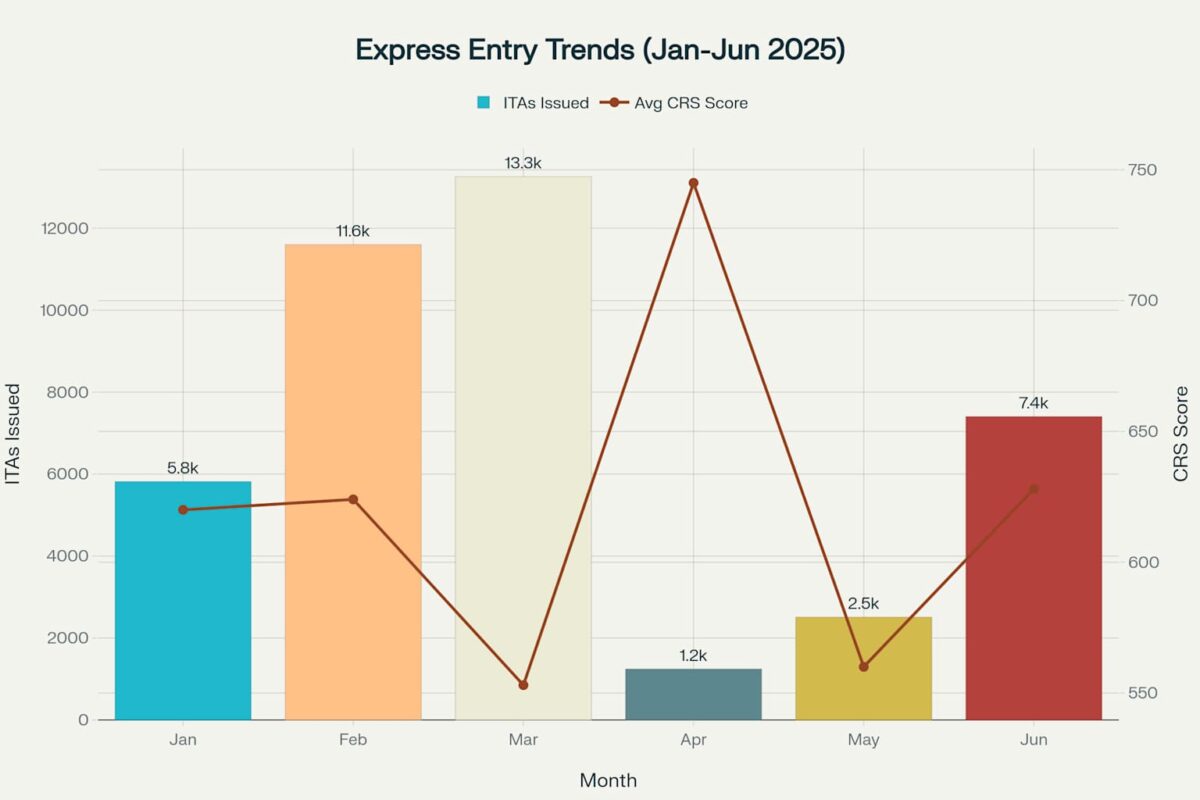

Express Entry monthly trends showing declining ITA volumes and fluctuating CRS scores throughout 2025
Recent Draw Activity
- June 26, 2025: 3,000 CEC ITAs issued, CRS score 521
- June 12, 2025: 3,000 CEC ITAs issued, CRS score 529
- Draw frequency: Approximately every 7 business days
Background
Policy Evolution Under Carney Government
Prime Minister Mark Carney’s Liberal government, elected in April 2025, has maintained the reduced immigration trajectory established by the previous administration while emphasizing sustainable population growth. Key policy changes include:
- February 27, 2025: New Express Entry categories announced, adding Education while removing Transport
- March 2025: Job offer points eliminated from CRS to combat fraud
- May 28, 2025: Stricter maintained status rules for temporary residents
Category-Based Selection Priorities
Immigration, Refugees and Citizenship Canada (IRCC) has prioritized specific categories for 2025:
- French language proficiency: 3 draws, 18,500 ITAs, average CRS 406
- Canadian Experience Class: 6 draws, 15,850 ITAs, average CRS 531
- Healthcare and social services: 2 draws, 1,000 ITAs, average CRS 507
- Education occupations: 1 draw, 1,000 ITAs, CRS 479
- Provincial Nominee Program: 11 draws, 5,495 ITAs, average CRS 745
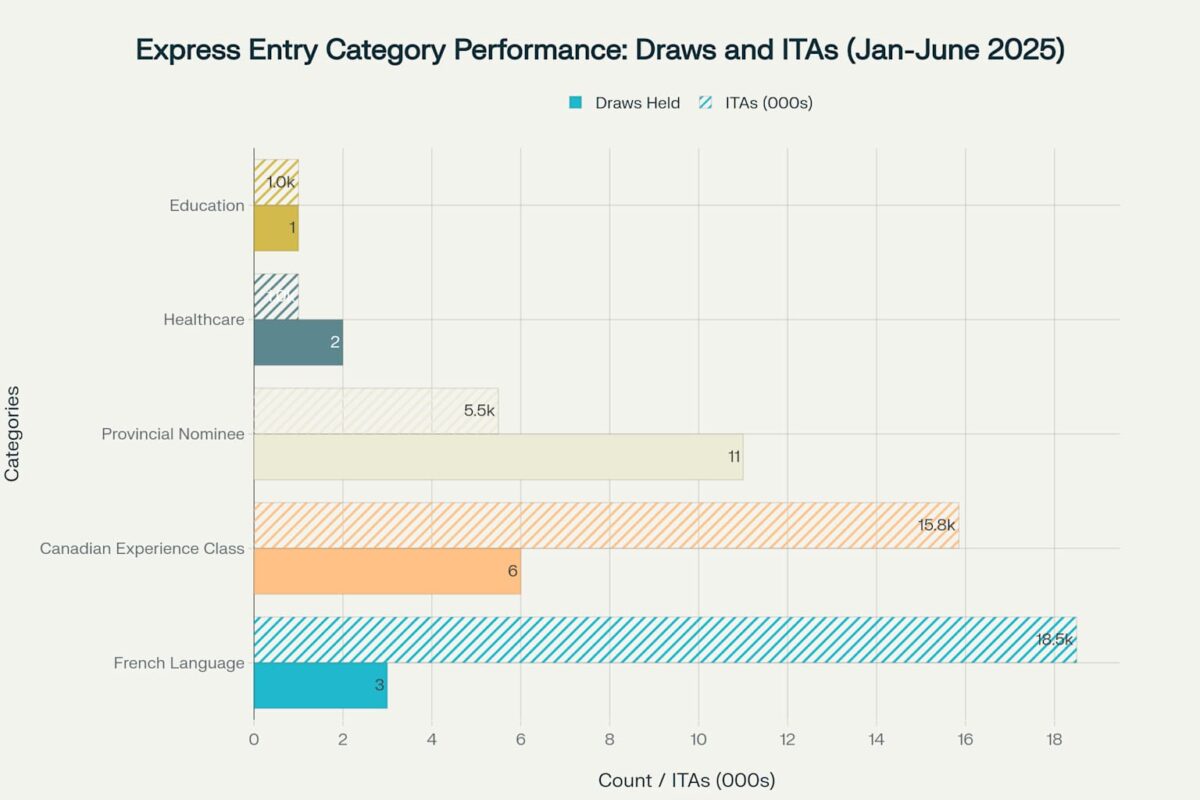
Express Entry category performance showing the emphasis on French language and Canadian Experience Class draws in 2025
Immigration Levels Plan 2025-2027
Canada’s Immigration Levels Plan 2025–2027 outlines the country’s strategy to welcome new permanent residents over the next three years. The plan aims to support economic growth, reunite families, and provide refuge to those in need. The government projects continued reductions:
- 2026: 380,000 permanent residents (-3.8%)
- 2027: 365,000 permanent residents (-3.9%)
- Temporary residents capped at 5% of population by 2026
What’s Next
Upcoming Policy Developments
- Economic Mobility Pathways Pilot to become permanent program by end of 2025
- New foreign labour stream for agriculture and fish processing sectors
- Updated post-graduation work permit (PGWP) field of study requirements
- Enhanced spousal open work permit (SOWP) eligibility criteria
Draw Predictions
Based on biweekly patterns, the next Express Entry draw is expected early July 2025, likely targeting:
- French-speaking candidates (CRS 360-380)
- Healthcare professionals (CRS 490-510)
- Canadian Experience Class candidates (CRS 520-540)
CRS Score Trends
- Scores remain elevated due to reduced invitation volumes
- CEC draws showing slight score decreases (529→521 in June)
- Category-based draws offering lower thresholds for priority occupations
Summary and Implications
Canada’s Express Entry system reflects a fundamental shift toward selective, sustainable immigration under the Carney government. The 18.6% reduction in permanent resident targets, combined with increased focus on Canadian Experience Class candidates, signals prioritization of economic integration over volume.
For prospective immigrants, this means:
- Higher competition with elevated CRS scores
- Premium on Canadian work experience through CEC pathway
- Strategic advantage for French speakers and priority occupation workers
- Reduced processing backlogs but fewer overall opportunities
The policy direction aligns with public sentiment concerns about housing and infrastructure pressures while maintaining Canada’s commitment to skilled worker immigration. Success will depend on balancing economic needs with integration capacity as the government works toward its 2027 target of 365,000 annual permanent residents.
Next Steps for Candidates: Focus on gaining Canadian work experience, improving French language proficiency, or qualifying for priority occupation categories to maximize chances in the increasingly competitive Express Entry landscape.
Related reading: Apply Now: 3000 Invited in Latest Canada CEC — a closer look at this topic.