Federal Skilled Worker Program: Complete Requirements Guide

The Federal Skilled Worker Program (FSWP) is Canada’s main Express Entry pathway for skilled professionals with foreign work experience who want permanent residence. It is one of three programs managed under the Express Entry system, and IRCC describes it as the program for skilled workers who have foreign work experience.
Quick answer: To qualify for the Federal Skilled Worker Program, you must score 67 points or higher on the six selection factors (scored out of 100), meet the work requirement of at least 1 year of continuous skilled work (1,560 hours, which equals 1 year full time) in TEER 0, 1, 2 or 3 within the last 10 years, and reach at least CLB 7 in all four language abilities. You also need an Educational Credential Assessment (ECA) for foreign education and proof of funds (unless you are authorized to work in Canada and have a valid job offer). As of November 3, 2026, IRCC changes how it awards CRS points for Canadian work experience and job offers, and no longer requires an LMIA for job offers.
Last updated: · Sources checked: IRCC FSWP page, language test, education assessment, CRS criteria, proof of funds, fee list, rounds data, changes page
This comprehensive guide will walk you through every requirement, process step, and essential detail you need to successfully navigate your FSW application.
What changes on November 3, 2026: IRCC adds a new Labour Market Integration factor to the Comprehensive Ranking System (CRS). It awards points for either your Canadian work experience (with extra points for eligible high-wage occupations) or a qualifying job offer in an eligible high-wage occupation, but not both, up to 150 points. IRCC also no longer requires a Labour Market Impact Assessment (LMIA) for a job offer to count for program eligibility or CRS points. IRCC says it will recalculate existing profiles, which could take up to two weeks, and will pause invitation rounds during that time. The FSWP minimum requirements and the 67-point selection grid described below are separate from the CRS. Details are on IRCC’s 2026 changes page.
What is the Federal Skilled Worker Program?
The Federal Skilled Worker Program is a points-based selection system designed to attract skilled workers who can contribute to Canada’s economic growth. Unlike other immigration streams, FSW candidates are not required to have Canadian work experience, making it ideal for international professionals.
The program uses a two-tiered evaluation system: first, candidates must meet minimum FSW requirements and score at least 67 out of 100 points, then they can submit a profile to the Express Entry pool, where they’re ranked using the Comprehensive Ranking System (CRS). If you qualify for more than one Express Entry program, IRCC invites you under the first one you are eligible for, in this order: Canadian Experience Class, Federal Skilled Worker Program, then Federal Skilled Trades Program.

FSW Eligibility Requirements: The 67-Point System
To qualify for the Federal Skilled Worker Program, you must meet specific minimum requirements and score at least 67 points across six selection factors. This initial assessment determines your eligibility to enter the Express Entry pool.
| Selection Factor | Maximum Points | Description |
|---|---|---|
| Language Skills (First Official Language) | 24 | CLB 7 minimum in all four abilities; 4, 5 or 6 points per ability for CLB 7, 8 or 9+ |
| Language Skills (Second Official Language) | 4 | 4 points if you reach at least CLB 5 in all four abilities |
| Education | 25 | Points based on your highest credential (an ECA is required for foreign education) |
| Skilled Work Experience | 15 | 9 points for 1 year, 11 for 2-3 years, 13 for 4-5 years, 15 for 6 or more years |
| Age | 12 | 12 points for ages 18-35, then one fewer point per year; 0 points at 47 and older |
| Arranged Employment in Canada | 10 | Valid job offer of at least 1 year from a Canadian employer (see the IRCC page for the conditions) |
| Adaptability | 10 | Spouse’s language level, past study or work in Canada, and relatives in Canada |
The Six Selection Factors Breakdown
The FSW points system evaluates candidates across six key areas, each contributing to your overall eligibility score:
1. Language Skills (Maximum 28 Points)
- First official language: Up to 24 points (CLB 7 minimum required in all four abilities)
- Second official language: Up to 4 additional points
- Points awarded for reading, writing, listening, and speaking abilities
2. Education (Maximum 25 Points)
- Points based on highest level of education completed
- Educational Credential Assessment (ECA) required for foreign credentials
- Higher education levels receive more points (up to 25 under the FSWP grid)
3. Work Experience (Maximum 15 Points)
- At least one year of continuous skilled work, or 1,560 hours in total (30 hours per week)
- Must be in NOC TEER categories 0, 1, 2, or 3
- Experience must be paid, with the same NOC as your primary occupation, and gained within the last 10 years, in Canada or abroad
4. Age (Maximum 12 Points)
- Maximum points awarded to candidates aged 18-35
- Points decrease by one for each year after 35 (36 earns 11 points, 46 earns 1 point)
- No points awarded for candidates 47 years or older
5. Arranged Employment (Maximum 10 Points)
- Valid job offer of at least 1 year of continuous, paid, full-time, non-seasonal work in TEER 0, 1, 2 or 3
- IRCC’s FSWP page still describes situations tied to LMIAs. From November 3, 2026, IRCC says an LMIA is no longer required for a job offer to count toward program eligibility, so check the current IRCC page for how this applies to these 10 points
- Not mandatory; you can qualify without a job offer
6. Adaptability (Maximum 10 Points)
- Your past study or full-time work in Canada (5 points for 2 years of study, 10 points for 1 year of work)
- Your spouse or partner’s language level (CLB 4 in all abilities), past study or work in Canada (5 points each)
- A relative in Canada who is 18 or older and a citizen or permanent resident (5 points); the combined adaptability total is capped at 10
Language Requirements: Your Gateway to Success
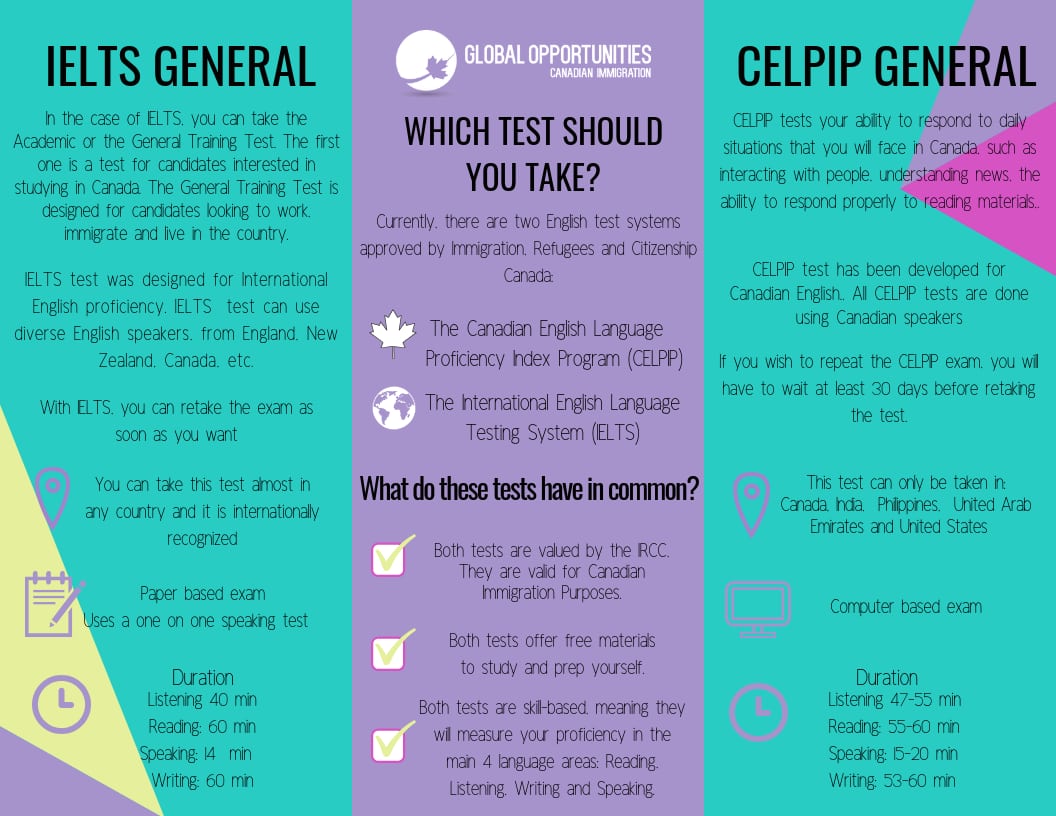
Language proficiency is crucial for FSW eligibility, with a minimum Canadian Language Benchmark (CLB) 7 required in all four abilities. This requirement ensures candidates can effectively integrate into the Canadian workforce and society.
Approved Language Tests
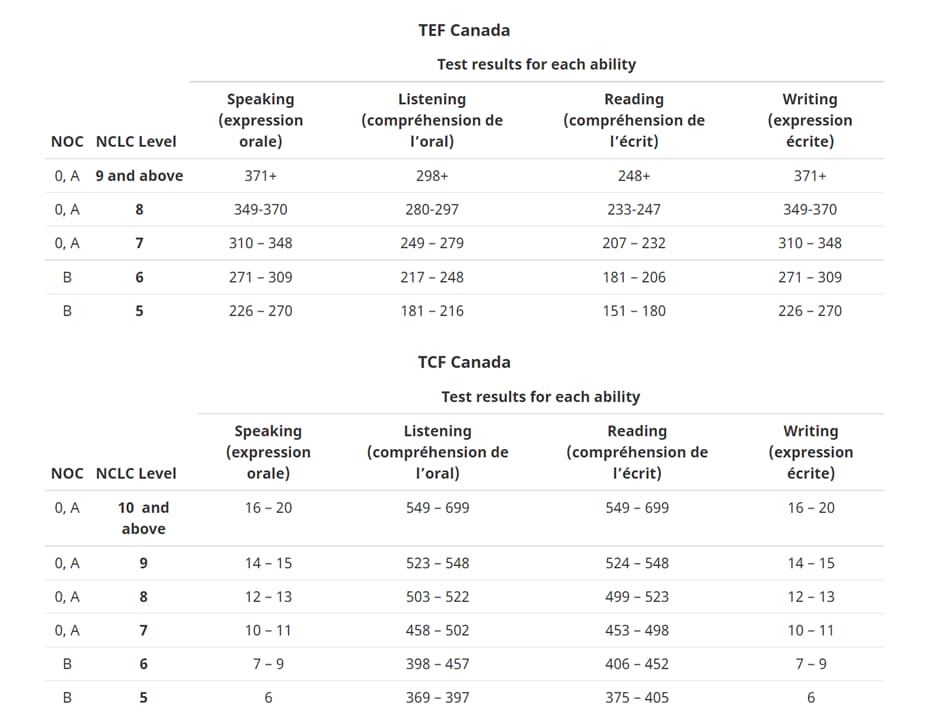
| Test Type | Language | CLB/NCLC 7 minimum per ability | Validity |
|---|---|---|---|
| IELTS (General Training) | English | Speaking 6.0, Listening 6.0, Reading 6.0, Writing 6.0 | Less than 2 years old |
| CELPIP-General | English | Speaking 7, Listening 7, Reading 7, Writing 7 | Less than 2 years old |
| PTE Core | English | Speaking 68, Listening 60, Reading 60, Writing 69 | Less than 2 years old |
| TEF Canada | French | Speaking 310, Listening 249, Reading 207, Writing 310 | Less than 2 years old |
| TCF Canada | French | Speaking 10, Listening 458, Reading 453, Writing 10 | Less than 2 years old |
English Tests:
- IELTS (International English Language Testing System), General Training option only; IRCC does not accept IELTS One Skill Retake
- CELPIP (Canadian English Language Proficiency Index Program), CELPIP-General only
- PTE Core (Pearson Test of English), PTE Core option only
French Tests:
- TEF Canada (Test d’évaluation de français)
- TCF Canada (Test de connaissance du français)
Important Notes:
- Test results must be less than 2 years old when you complete your Express Entry profile and when you submit your application for permanent residence; IRCC refuses applications that use expired results
- You must meet CLB 7 (or NCLC 7) in all four language abilities (reading, writing, listening, speaking)
- Higher language scores earn more points: under the FSWP grid each ability earns 4 points at CLB 7, 5 at CLB 8 and 6 at CLB 9 or above, and CRS points rise at higher levels too
Educational Requirements and Credential Assessment
Education plays a vital role in both FSW eligibility and CRS scoring. Foreign educational credentials must be assessed to determine their Canadian equivalence through an Educational Credential Assessment (ECA).
Education Points Breakdown
| Education Level | Points | Requirements |
|---|---|---|
| Doctoral (PhD) university credential | 25 | Doctoral degree + ECA (if foreign) |
| Master’s degree or entry-to-practice professional degree | 23 | Master’s or professional degree for a licensed TEER 1 occupation + ECA (if foreign) |
| Two or more post-secondary credentials (one 3+ years) | 22 | Multiple credentials, an ECA for each if foreign |
| Post-secondary credential of three years or longer | 21 | Bachelor’s degree or 3+ year program + ECA (if foreign) |
| Two-year post-secondary credential | 19 | Two-year diploma or degree + ECA (if foreign) |
| One-year post-secondary credential | 15 | One-year certificate or diploma + ECA (if foreign) |
| Secondary school (high school) credential | 5 | High school diploma + ECA (if foreign) |
ECA Process
An Educational Credential Assessment (ECA) is required if you have foreign education and want points for it, and IRCC says you must get your report from a designated organization or professional body:
- Determines if your foreign education is equivalent to Canadian standards
- Performed by an organization designated by IRCC. Most people must use one of: Comparative Education Service (University of Toronto School of Continuing Studies), International Credential Assessment Service of Canada, World Education Services, International Qualifications Assessment Service (IQAS) or International Credential Evaluation Service (BCIT). Some professions have designated professional bodies; see the IRCC ECA page
- Processing times and costs vary by organization or professional body, so check with the one you choose
- Your ECA must be less than 5 years old when you complete your Express Entry profile and when you submit your application
Work Experience Requirements
Work experience is fundamental to FSW eligibility (see IRCC’s FSWP page). Your occupation must be classified under the National Occupational Classification (NOC) system in specific skill levels to qualify.
NOC TEER Categories
| TEER Category | Occupation Type | FSW Eligible | Examples |
|---|---|---|---|
| TEER 0 | Management occupations | Yes | Corporate managers, Restaurant managers |
| TEER 1 | University degree required | Yes | Doctors, Engineers, Lawyers, Scientists |
| TEER 2 | College diploma/2+ years apprenticeship | Yes | Executive assistants, Bookkeepers, Paralegals |
| TEER 3 | College diploma/<2 years apprenticeship/6+ months training | Yes | Real estate agents, Cooks, Hairstylists |
| TEER 4 | High school diploma/weeks of training | No | Retail salespersons, Childcare providers |
| TEER 5 | Short-term demonstration/no formal education | No | Delivery drivers, Landscaping labourers |
Work Experience Criteria
- Minimum Duration: At least 1 year of continuous work or 1,560 hours total (30 hours per week)
- Timeline: Gained within the last 10 years, in Canada or abroad
- Nature: Paid work (wages or commission); volunteer work and unpaid internships don’t count
- Skill Level: Must be in NOC TEER 0, 1, 2, or 3 occupations
Calculating Work Hours:
- Full-time: 30+ hours per week for 12 months
- Part-time: Equivalent hours (e.g., 15 hours/week for 24 months = 1,560 hours)
- Multiple jobs: Combined hours can meet the requirement, but IRCC doesn’t count hours above 30 per week
Work experience points (selection factor, maximum 15): 1 year earns 9 points, 2-3 years earn 11, 4-5 years earn 13 and 6 or more years earn 15. For these points, IRCC says experience counts if gained in Canada or abroad, while studying, or while self-employed, as long as it was paid, continuous and met the other requirements.
Express Entry and the Comprehensive Ranking System (CRS)
Once you meet FSW requirements, you enter the Express Entry pool where candidates are ranked using the CRS. The CRS is a separate points system from the 67-point FSWP grid, and IRCC publishes the full criteria on its CRS page.

CRS Score Components
The Comprehensive Ranking System evaluates candidates across four main categories:
- Core Factors (up to 460 points with a spouse, 500 without)
- Age, education, language proficiency, Canadian work experience
- Spouse/Partner Factors (40 points max)
- Spouse’s education, language skills, Canadian experience
- Skill Transferability (100 points max)
- Combinations of education, language, and work experience
- Additional Points (600 points max)
- Provincial nomination (600), French language skills (up to 50), Canadian post-secondary education (up to 30), brother or sister in Canada (15)
New from November 3, 2026 – Labour Market Integration factor (up to 150 points): IRCC awards points for either Canadian work experience or a qualifying job offer in an eligible high-wage occupation, whichever gives you more, but not both. Work-length points stay the same as before (for example, 1 year earns 35 points with a spouse or 40 without, and 5 years or more earns 70 or 80). High-wage experience adds up to 70 points, and a qualifying job offer is worth 100, 70 or 50 points. See IRCC’s explanation of the changes and the CRS criteria.
Recent Express Entry Draw Trends
Understanding recent draw patterns helps you gauge your competitiveness in the Express Entry pool.
Cutoffs change with every round and IRCC pauses rounds while it recalculates profiles after the November 3, 2026 CRS changes, so treat the figures below as history, not a prediction. The live list is on IRCC’s rounds of invitations page.
Express Entry CRS Score Trends – Recent Draws (2026)
Recent Express Entry Draws
| Draw Number | Date | CRS Score | ITAs Issued | Draw Type |
|---|---|---|---|---|
| 453 | Oct 28, 2026 | 477 | 150 | Transport |
| 452 | Oct 27, 2026 | 407 | 5,000 | French |
| 451 | Oct 26, 2026 | 761 | 792 | PNP |
| 450 | Oct 16, 2026 | 435 | 5,000 | French |
| 449 | Oct 15, 2026 | 519 | 2,500 | CEC |
| 448 | Oct 13, 2026 | 772 | 752 | PNP |
| 447 | Oct 1, 2026 | 476 | 3,500 | Trades |
| 446 | Sep 29, 2026 | 518 | 2,000 | CEC |
| 445 | Sep 28, 2026 | 725 | 733 | PNP |
| 444 | Sep 16, 2026 | 389 | 250 | Senior managers |
| 443 | Sep 15, 2026 | 519 | 2,000 | CEC |
| 442 | Sep 14, 2026 | 734 | 576 | PNP |
| 441 | Sep 4, 2026 | 475 | 3,500 | Healthcare |
| 440 | Sep 3, 2026 | 198 | 229 | Physicians |
Key Insights from 2026 Draws (calculated from IRCC’s round data):
- IRCC held 65 rounds between January 5 and October 28, 2026, according to its rounds data
- Provincial Nominee Program (PNP) rounds had cutoffs of 697-805 across 21 rounds in 2026
- Canadian Experience Class rounds had cutoffs of 507-523 across 18 rounds in 2026
- French-language proficiency rounds had cutoffs of 382-435 across 12 rounds in 2026
- Other category-based rounds in 2026 included Healthcare and social services (467-475), Trades (476-477), Transport (470-477), Senior managers (389-429), Physicians (169-223) and Skilled military recruits (368)
Application Process Timeline
The FSW application process involves multiple phases, from preparation to landing in Canada. Understanding the timeline helps you plan effectively and avoid delays.
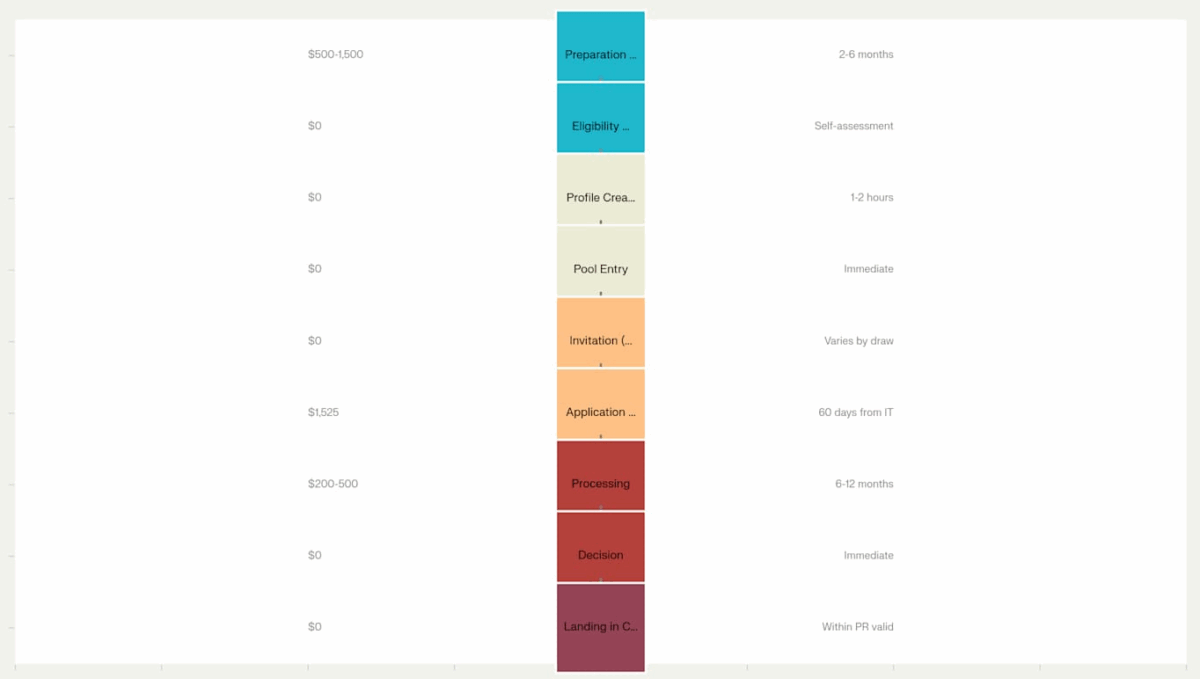
Express Entry Process: Phases, Timelines, and Costs
| Phase | Duration | Key Activities | Approximate Cost (CAD) |
|---|---|---|---|
| Pre-Application | Varies | Language tests, ECA, documents preparation | Set by providers |
| Profile Creation | Up to 60 days to complete and submit | Complete Express Entry profile online | $0 |
| Pool Entry | Up to 12 months | Wait for invitation, improve CRS score | $0 |
| Invitation to Apply (ITA) | Varies by round | Receive invitation based on CRS rank | $0 |
| Application Submission | 60 days from ITA | Submit complete application with documents | $1,590 per adult (processing + right of permanent residence fee), plus biometrics |
| Processing | Varies | Background checks, medical exam, verification | Medical exam fee set by the panel physician |
| Decision | Varies | Confirmation of permanent residence (COPR) issued if approved | $0 |
| Landing in Canada | Within PR validity | Present COPR at port of entry | $0 |
Phase-by-Phase Breakdown
Pre-Application Phase (time varies)
- Complete language tests and receive results
- Obtain Educational Credential Assessment
- Gather work experience documentation
- Prepare proof of funds
Express Entry Profile Creation (up to 60 days to complete)
- Create online profile with accurate information
- Receive a CRS score based on your profile
- If you are not invited within 12 months of submitting your profile, it expires automatically
Pool Management (Ongoing)
- Monitor rounds of invitations on the IRCC site
- Work to improve CRS score if needed
- Update profile with any changes
Post-ITA Application (60 days)
- Gather all required documents
- Complete detailed application form
- Pay the application fees ($990 processing + $600 right of permanent residence fee per adult, plus biometrics)
- Submit before deadline
Processing Phase (time varies, see IRCC’s processing times tool)
- Background checks and verification
- Immigration medical exam (required for you and your family members, even those not coming with you)
- Additional document requests
Required Documents Checklist
Proper documentation is critical for a successful FSW application. Missing or incomplete documents are among the most common reasons for application delays or rejections.
| Document Category | Required Documents | Validity Period | Cost |
|---|---|---|---|
| Identity Documents | Passport, Birth certificate, National ID | Valid throughout process | Varies by country |
| Language Tests | IELTS General Training/CELPIP-General/PTE Core/TEF Canada/TCF Canada results | Less than 2 years old | Set by test provider |
| Education | ECA report, Diplomas, Transcripts, Degrees | ECA less than 5 years old | Set by ECA organization |
| Work Experience | Reference letters, Employment records, Pay stubs, NOC verification | Current and updated | Varies |
| Financial Support | Bank letters, Proof of funds, Investment records | Available when you apply and when the visa is issued | $0 |
| Family Information | Marriage certificate, Spouse documents, Children documents | Valid throughout process | Varies |
| Additional Documents | Police certificates, Medical exam, Digital photos, Travel history | As specified by IRCC | Varies by country and provider |
Document Categories and Requirements
Identity Documents
- Valid passport (must remain valid throughout process)
- Birth certificate
- National identity card
Language Test Results
- Valid test results from approved testing agencies
- Results must not be older than 2 years
- All four language abilities must meet minimum requirements
Educational Documents
- ECA report for foreign credentials
- Original diplomas and transcripts
- Academic records from all institutions attended
Work Experience Documentation
- Employment reference letters on company letterhead
- Job contracts and offer letters
- Pay stubs and tax documents
- Professional licenses or certifications
Proof of Funds
- Official bank letters on letterhead showing account numbers, opening dates, current balances, your outstanding debts and the average balance for the past 6 months
- Investment statements
- Letter from financial institution
Family Information
- Marriage certificate (if applicable)
- Birth certificates for dependent children
- Spouse’s educational and language documents
Additional Documents
- Police certificates for you and family members 18 or older from every country you stayed in for 6 months in a row or longer in the last 10 years, per IRCC’s police certificates page
- Immigration medical exam results (IRCC lists a medical exam as a requirement; get it after you’re invited, close to your application date)
- Digital photos to confirm your identity
Application Costs and Fees
Understanding the financial requirements helps you budget for your FSW application. Costs include both government fees and preparation expenses.
Government Fees
Express Entry Application Fees:
- Principal applicant: $990 (processing) + $600 (right of permanent residence fee) = $1,590
- Spouse or partner: $990 + $600 = $1,590
- Dependent child: $270 per child
Additional Fees:
- Biometrics: $85 per person or $170 per family of 2 or more applying at the same time
- Medical examination: fee set by the panel physician (not a government fee)
Source: IRCC’s fee list and Express Entry pages, checked November 3, 2026. Fees change, so confirm the amounts before you pay. Example (government fees only, calculated from the figures above): a single applicant pays $990 + $600 + $85 = $1,675, and a couple pays $1,590 + $1,590 + $170 = $3,350.
Preparation Costs
Pre-Application Expenses:
- Language tests: fees are set by the test provider and vary by country
- Educational Credential Assessment: fees vary by designated organization
- Document translation and notarization: costs vary by provider
- Police clearance certificates: fees are set by each issuing country
Total cost: Government fees are listed above. Third-party costs (tests, ECA, translations, certificates, medical exam) depend on your country and providers, so we do not quote a total.
Complete Step-by-Step Checklist
Use this comprehensive checklist to track your progress through the FSW application process. Each step lists timing and cost information to help you plan effectively.
| Phase | Step | Task | Timeline | Estimated Cost CAD |
|---|---|---|---|---|
| Pre-Application | 1 | Take approved language test (IELTS General Training/CELPIP-General/PTE Core/TEF Canada/TCF Canada) | Book early | Set by provider |
| Pre-Application | 2 | Obtain Educational Credential Assessment (ECA) | Varies by organization | Set by organization |
| Pre-Application | 3 | Gather work experience documentation and reference letters | Varies | Varies |
| Pre-Application | 4 | Check if your occupation is in NOC TEER 0, 1, 2, or 3 | 1 day | $0 |
| Pre-Application | 5 | Calculate your FSW points (need minimum 67/100) | 1 day | $0 |
| Pre-Application | 6 | Gather proof of funds documentation (bank letters) | Varies | $0 |
| Pre-Application | 7 | Get digital photos and ensure passport is valid | Varies | Varies |
| Profile Creation | 8 | Create Express Entry profile online (60 days to complete and submit) | Up to 60 days | $0 |
| Profile Creation | 9 | Submit profile and receive CRS score | Immediate | $0 |
| Pool Management | 10 | Monitor Express Entry rounds and CRS cutoff scores | Ongoing | $0 |
| Pool Management | 11 | Improve CRS score if needed (language, education, experience) | Ongoing | Varies |
| Post-ITA | 12 | Receive Invitation to Apply (ITA) | Varies | $0 |
| Post-ITA | 13 | Gather all required documents within 60 days | 60 days | Varies |
| Post-ITA | 14 | Complete online application form accurately | Within the 60 days | $0 |
| Post-ITA | 15 | Pay application fees ($1,590 per adult, plus biometrics) | 1 day | $1,590 per adult |
| Post-ITA | 16 | Submit complete application before deadline | 1 day | $0 |
| Processing | 17 | Complete immigration medical exam | Varies | Set by panel physician |
| Processing | 18 | Provide additional documents if requested by IRCC | As needed | Varies |
| Processing | 19 | Wait for application processing (see IRCC’s processing times tool) | Varies | $0 |
| Final Steps | 20 | Receive Confirmation of Permanent Residence (COPR) | On approval | $0 |
| Final Steps | 21 | Land in Canada and complete PR formalities | 1 day | $0 |
Quick Reference Checklist
☐ Pre-Application Phase
- ☐ Take approved language test (IELTS/CELPIP/PTE/TEF/TCF)
- ☐ Obtain Educational Credential Assessment (ECA)
- ☐ Gather work experience documentation
- ☐ Verify occupation in eligible NOC categories
- ☐ Calculate FSW points (minimum 67 required)
- ☐ Prepare proof of funds documentation
- ☐ Update passport and obtain photos
☐ Express Entry Profile
- ☐ Create online Express Entry profile
- ☐ Submit profile and receive CRS score
- ☐ Enter Express Entry pool
☐ Pool Management
- ☐ Monitor Express Entry draws
- ☐ Improve CRS score if needed
- ☐ Keep profile updated
☐ Post-ITA Application
- ☐ Receive Invitation to Apply
- ☐ Gather all required documents (60-day deadline)
- ☐ Complete application form
- ☐ Pay application fees ($1,590 per adult plus biometrics)
- ☐ Submit complete application
☐ Processing and Final Steps
- ☐ Complete medical examination if requested
- ☐ Provide additional documents if requested
- ☐ Receive Confirmation of Permanent Residence (COPR)
- ☐ Plan travel to Canada
- ☐ Complete landing procedures
Tips for Maximizing Your Success
Improving your competitiveness requires strategic planning and understanding of the points systems.
Strategies to Improve Your CRS Score
Language Enhancement:
- Aim for CLB 9-10 in all language abilities
- Consider learning French as a second official language
- Retake language tests if needed (results must be less than 2 years old when you create your profile and when you apply)
Education Optimization:
- Consider additional credentials or certifications
- Ensure proper ECA for all educational qualifications
- Pursue Canadian education if feasible
Work Experience:
- Gain additional skilled work experience
- Obtain Canadian work experience through temporary work permits
- Ensure proper documentation of all employment
Additional Points:
- Explore Provincial Nominee Programs (a provincial nomination adds 600 CRS points)
- Secure a valid job offer in an eligible high-wage occupation (from November 3, 2026 no LMIA is needed for CRS job offer points)
- Develop French language proficiency
Common Mistakes to Avoid
Application Errors:
- Incomplete or inconsistent forms
- Missing required documents
- Expired language test results
- Insufficient or inaccessible proof of funds
Documentation Issues:
- Poor quality reference letters
- Missing employment details
- Inadequate proof of work experience
- Incorrect NOC code selection
Timeline Management:
- Missing ITA deadline (60 days)
- Delayed medical examination
- Late document submission
Proof of Funds Requirements
Proof of funds is how you show IRCC that you have enough money to settle in Canada. It is a minimum requirement of the Federal Skilled Worker Program, and IRCC updates the amounts every year based on 50% of the low income cut-off totals.
FSW Proof of Funds (IRCC table updated July 7, 2025)
| Family Size | Funds Required (CAD) |
|---|---|
| 1 | $15,263 |
| 2 | $19,001 |
| 3 | $23,360 |
| 4 | $28,362 |
| 5 | $32,168 |
| 6 | $36,280 |
| 7 | $40,392 |
| 7+ (each additional) | +$4,112 |
Acceptable Proof of Funds
Bank Documents:
- Official letters from banks or financial institutions, printed on letterhead, with contact information, your name, your outstanding debts, and for each account: account numbers, opening dates, current balances and the average balance for the past 6 months
- Your family size includes you, your spouse or partner, your dependent children and your spouse’s dependent children, even if they aren’t coming with you
Important Requirements:
- Funds must be available to you when you apply and when IRCC issues your permanent resident visa
- You can’t use equity on real property as proof, and you can’t borrow the money from another person
- If your spouse is coming with you, you can count money you have together in a joint account; you may be able to count money in an account under your spouse’s name only if you prove you have access to it
- You must be able to use the money to pay for your family’s living costs (even if they aren’t coming with you)
Exemptions:
- Applicants who are authorized to work in Canada and have a valid job offer from a Canadian employer (even under the FSWP)
- Canadian Experience Class applicants (IRCC says the system may still ask you to upload a letter explaining why you don’t need to show funds)
Conclusion and Action Plan
The Federal Skilled Worker Program offers an excellent pathway to Canadian permanent residence for skilled professionals worldwide. Success requires careful preparation, attention to detail, and strategic planning to maximize your competitiveness.
Your Next Steps:
- Assess Your Eligibility: Calculate your FSW points using the six selection factors
- Prepare Documentation: Begin gathering required documents early
- Take Language Tests: Achieve CLB 7 or higher in all abilities
- Obtain ECA: Get your foreign credentials assessed
- Create Express Entry Profile: Enter the pool and monitor draws
- Improve Your Score: Work on enhancing your CRS ranking
Remember that immigration requirements and procedures can change. Always consult the official IRCC website for the most current information and consider seeking professional guidance for complex situations. With proper preparation and persistence, the Federal Skilled Worker Program can be your gateway to a new life in Canada.
How long the process takes depends on how quickly you prepare, how your CRS score compares with the rounds, and current IRCC processing times (see IRCC’s processing times tool). Costs also vary, since only the government fees listed above are fixed. While the process requires significant preparation and investment, the long-term benefits of Canadian permanent residence make it a worthwhile endeavor for qualified skilled workers seeking new opportunities and a better future.
Quick answers from official sources
How many points do I need for the Federal Skilled Worker Program?
IRCC says that if you score 67 points or higher out of 100 on the selection factors, you may qualify for the Federal Skilled Worker Program. If you score lower than 67, you won’t qualify for the program.
How many work hours count as one year?
1,560 hours equals 1 year full time, for example up to 30 hours a week for 12 months, or an equal amount of part-time work.
What language level does the Federal Skilled Worker Program require?
A minimum of Canadian Language Benchmark (CLB) 7 in all four abilities, according to IRCC.
Do I need proof of funds for the Federal Skilled Worker Program?
Yes, unless you are authorized to work in Canada and have a valid job offer. IRCC publishes the required amount by family size and updates it every year.
What changes for Express Entry on November 3, 2026?
IRCC changes how it awards CRS points for Canadian work experience and job offers through a new Labour Market Integration factor worth up to 150 points, and no longer requires an LMIA for a job offer. IRCC will recalculate profiles, which could take up to two weeks, and will pause invitation rounds during that time.
Sources (checked November 3, 2026):
- canada.ca/en/immigration-refugees-citizenship/services/immigrate-canada/express-entry/who-can-apply/federal-skilled-workers.html
- canada.ca/en/immigration-refugees-citizenship/services/immigrate-canada/express-entry/who-can-apply.html
- canada.ca/en/immigration-refugees-citizenship/services/immigrate-canada/express-entry/documents/language-test.html
- canada.ca/en/immigration-refugees-citizenship/services/immigrate-canada/express-entry/documents/proof-funds.html
- canada.ca/en/immigration-refugees-citizenship/services/immigrate-canada/express-entry/changes.html
- canada.ca/en/immigration-refugees-citizenship/services/immigrate-canada/express-entry/check-score/crs-criteria.html
Related reading: How to Create Your Express Entry Profile: Complete — a closer look at this topic.