5,000 PNP Spots Set Aside for Francophones Outside Quebec

Canada’s immigration figures set aside 5,000 federal selection spaces for Francophone immigration outside Quebec through the Provincial Nominee Program. That figure does not mean Canada invited 6,000 Francophones to apply for permanent residence; it describes spaces reserved for provincial and territorial nominations. The separate 2026 Francophone immigration target is 9%, pursued primarily through the Federal High Skilled and Provincial Nominee programs.
Did Canada invite 6,000 Francophones to apply for permanent residence?
Quick answer: No. The figure is 5,000 PNP selection spaces reserved to boost Francophone immigration outside Quebec, not 6,000 invitations to apply for permanent residence. It applies to federal selection spaces for provincial and territorial nominations; the binder gives no start date for the reservation.
- Who it applies to: Provinces and territories, through the Provincial Nominee Program, for Francophone immigration outside Quebec.
- Separate target: The economic-class Francophone immigration target is 9% in 2026, pursued primarily through Federal High Skilled and Provincial Nominee programs.
- What to do: Don’t treat the 5,000 spaces as invitations; category-based Federal High Skilled selection can invite applicants based on French proficiency and bilingualism.
What changed and when it starts
The reservation is for the Provincial Nominee Program (PNP), which lets provinces and territories nominate candidates.
The separate figure of 5,000 federal selection spaces is reserved for provinces and territories to nominate licensed doctors and address critical healthcare shortages. These figures describe reserved selection spaces, not invitations issued to Francophones.
The binder gives a 9% Francophone immigration target for 2026, with the economic class as the main pathway. It says the target is pursued primarily through the Federal High Skilled and Provincial Nominee programs.
For 2026, the binder sets a 109,000 admissions target for federal high-skilled programs. Those programs include the Canadian Experience Class, Federal Skilled Worker Program and Federal Skilled Trades Program, managed through Express Entry. Express Entry uses a points system to assess human-capital attributes and invite prospective applicants.
The IRCC Deputy Minister Transition Binder 2026 – Economic Immigration identifies a 5,000-space Francophone reservation.
Last checked: Rules and dates can change; confirm on Canada.ca.
Who is affected and who is not
The measures address provinces and territories nominating licensed doctors, Francophone-minority communities outside Quebec, and small, rural and remote communities.
- Licensed doctors: Provinces and territories have federal selection spaces to nominate licensed doctors for critical healthcare shortages.
- Francophone-minority communities: The Francophone Community Immigration Pilot was designed to help French-speaking immigrants work and settle in these communities outside Quebec.
- Small, rural and remote communities: The Rural Community Immigration Pilot and the Francophone Community Immigration Pilot aimed to address critical labour shortages in priority sectors across Canada.
The two community pilots are 2025–2029 programs. They are listed as 2025–2029 programs.
For Francophone immigration, the economic class has been the main pathway to meeting targets, primarily through the Federal High Skilled and Provincial Nominee programs. Category-based selection in Federal High Skilled programs can invite applicants based on economic priorities such as French proficiency and bilingualism.
The binder describes Express Entry as a points system that assesses key human-capital attributes to invite prospective applicants to apply. The selection spaces for provinces and territories to nominate licensed doctors address healthcare shortages; they are separate from the spaces reserved to boost Francophone immigration outside Quebec through the Provincial Nominee Program.
Key figures and dates
| What | Figure or date | Applies to |
|---|---|---|
| Federal selection spaces reserved through the Provincial Nominee Program | 5,000 | Boosting Francophone immigration outside Quebec |
| Federal selection spaces reserved for doctor nominations | 5,000 | Provinces and territories addressing healthcare shortages |
| Francophone immigration target | 9% in 2026 | Economic class |
| Admissions target | 109,000 in 2026 | Federal High Skilled programs |
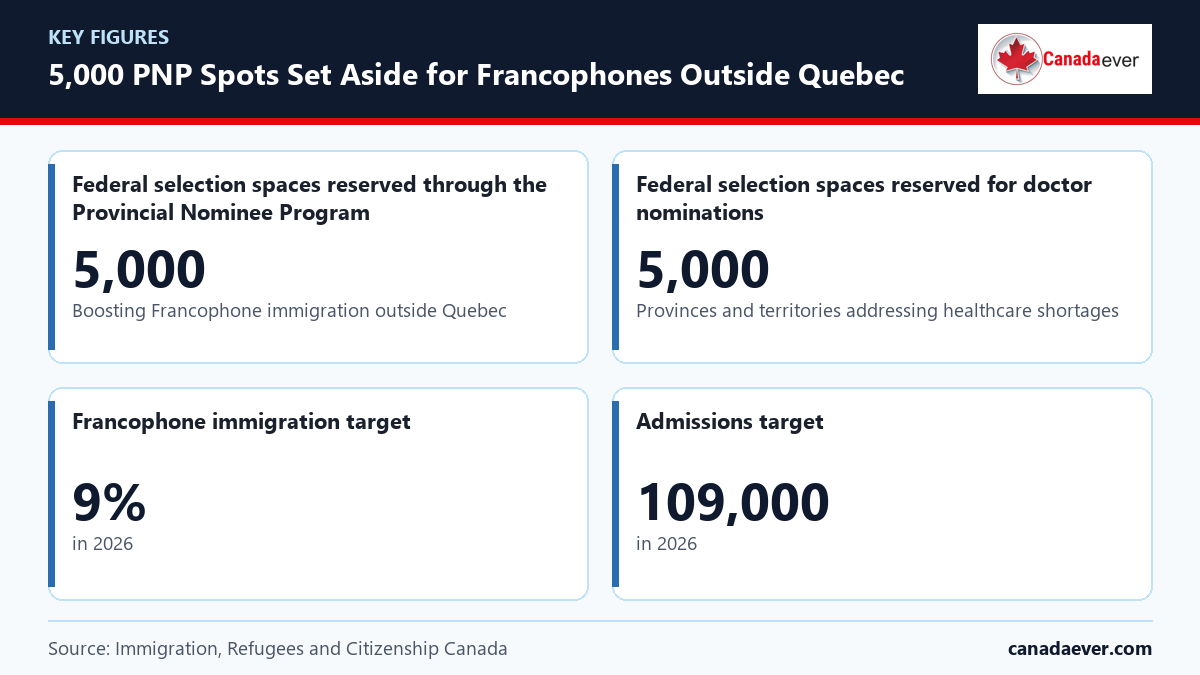
These figures refer to different program measures: selection spaces, an immigration target and an admissions target. The economic class has been the main pathway for achieving Francophone immigration targets, primarily through Federal High Skilled and Provincial Nominee programs.
| Key fact | Source |
|---|---|
| Targeted Federal Provincial Nominee Program (PNP) spaces: The federal government reserved 10,000 supplemental spaces that provinces and territories can use to support federal priorities via their PNP. | Immigration, Refugees and Citizenship Canada |
| In 2026, economic immigration will account for 63% of permanent immigration to Canada, rising to 64% in 2027 and 2028, the highest proportion in decades. | Immigration, Refugees and Citizenship Canada |
| In 2025, landed immigrants represented 27.8% of the Canadian population and 28.4% of the Canadian labour force. | Immigration, Refugees and Citizenship Canada |
| For example, whereas the median Canadian employment income in 2021 was $40,870, individuals admitted through Express Entry managed programs in 2020 had median employment earnings of $62,800 in 2021 and $72,000 in 2022. | Immigration, Refugees and Citizenship Canada |
| Under the Provincial Nominee Program, the number of economic immigrants settling outside of Ontario, Quebec, and British Columbia has increased, from 11% in 1998 to 30% in 2025. | Immigration, Refugees and Citizenship Canada |
| The 2026 admissions target for federal high skilled programs is 109,000. | Immigration, Refugees and Citizenship Canada |
What to do next
- Review category-based Federal High Skilled selection. It can invite applicants to apply for permanent residence based on economic priorities, including French proficiency and bilingualism.
- Identify the Federal High Skilled program that may fit. The programs managed through Express Entry are the Canadian Experience Class, Federal Skilled Worker Program, and Federal Skilled Trades Program.
- Understand how Express Entry assesses applicants. It uses a points system that evaluates human-capital attributes when inviting prospective applicants.
Frequently Asked Questions
How do provinces nominate Francophone candidates using these reserved PNP spaces?
The spaces are reserved for the Provincial Nominee Program to boost Francophone immigration outside Quebec. The binder does not describe how provinces nominate individual candidates.
Are the 5,000 Francophone PNP spaces limited to specific provinces or territories?
The 5,000 spaces are reserved for provinces and territories through the Provincial Nominee Program to boost Francophone immigration outside Quebec.
Will Francophone applicants need Express Entry profiles to be considered under PNP?
Express Entry is the system for the Federal High Skilled programs; the Francophone spaces are reserved for the Provincial Nominee Program.
Where can I find the exact Canada.ca program instructions for these PNP spaces?
The IRCC Deputy Minister Transition Binder 2026 – Economic Immigration identifies the 5,000 PNP spaces for Francophone immigration outside Quebec.