
Canada’s rural immigration program to open Jan. 1, 2027

On November 9, the Honourable Lena Metlege Diab, Minister of Immigration, Refugees and Citizenship, announced that the Rural Community Immigration Pilot would become a permanent program. It offers skilled workers and international graduates in priority sectors a pathway to permanent residence in Canada. If you’re considering this route, community and employer rules will shape where you can apply and who can hire you.
What is the rural community immigration program?
Quick answer: The Rural Community Immigration Program is a permanent economic immigration program scheduled to open January 1, 2027. It carries on the Rural Community Immigration Pilot’s model, offering skilled workers and international graduates in priority sectors a pathway to permanent residence in Canada. To participate, a community must have a population under 200,000 and score 0.20 or higher on the Index of Remoteness.
- The permanent program was announced on November 9 by the Honourable Lena Metlege Diab, Minister of Immigration, Refugees and Citizenship.
- Participating communities identify priority sectors and occupations based on local labour-market needs and economic development strategies.
- Only employers designated by communities in priority sectors can access the program; employers have mandatory training, monitoring and reporting requirements.
- If you’re considering the program, review the community criteria and check whether your employer and sector are included.
What changed and when it starts
The permanent program is scheduled to open January 1, 2027, so it isn’t in effect yet.
Community-designated employers in priority sectors are the only employers that can access the program.
Read the official announcement for program details.
Who is affected and who is not
The program is for skilled workers and international graduates in priority sectors, offering a pathway to permanent residence in Canada.
A community can apply through the expression of interest process if its population is under 200,000 and it is remote, defined as a score of 0.20 or higher on Statistics Canada’s Index of Remoteness. The 14 communities that took part in the pilot are expected to participate in the permanent program:
- Pictou County, North Bay, Sudbury, Timmins, Sault Ste. Marie, Thunder Bay
- Steinbach, Altona/Rhineland, Brandon, Moose Jaw, Claresholm
- West Kootenay, North Okanagan Shuswap, Peace Liard
Access for employers is limited to community-designated employers in priority sectors. Employers must meet the program’s training, monitoring and reporting requirements.
Key dates and amounts
| Milestone or measure | Date or figure |
|---|---|
| Transition announcement | November 9 |
| Rural Community Immigration Program opening | January 1, 2027 |
| Population threshold for community applications | Under 200,000 |
| Remoteness threshold for community applications | 0.20 or higher |
| Expected participating communities | 14 |
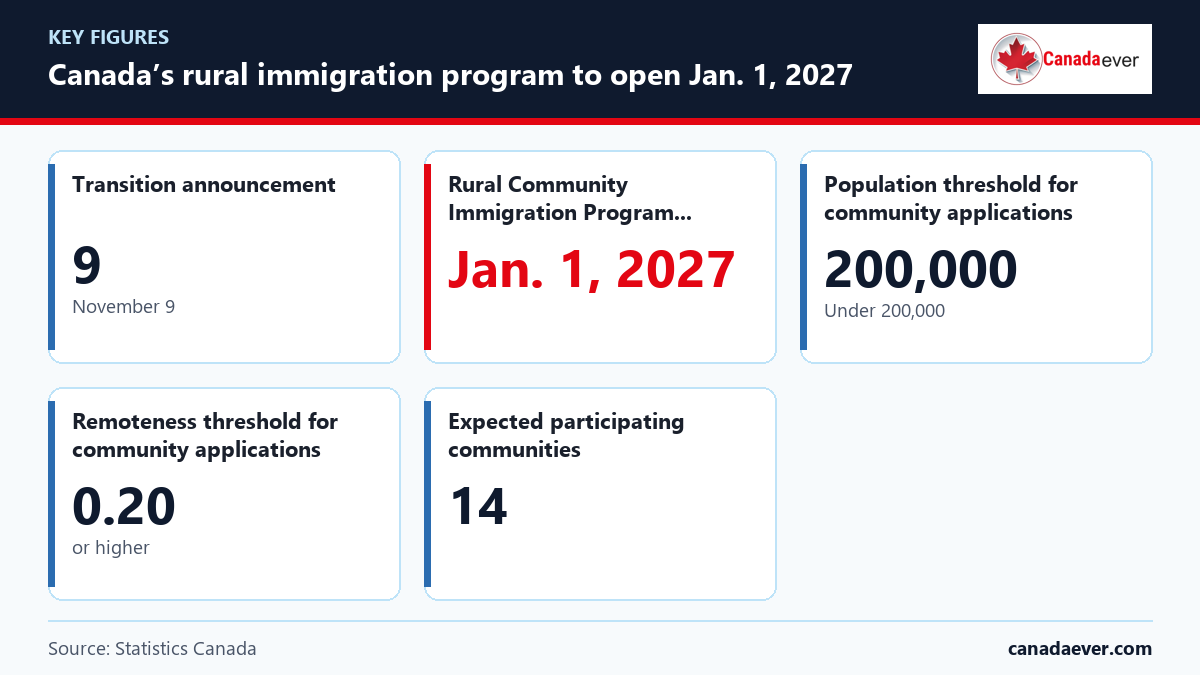
The key distinction is between a community’s application criteria and a worker’s pathway: the population and remoteness thresholds apply to communities seeking to apply, while the program is intended for skilled workers and international graduates in priority sectors. Communities identify priority sectors and occupations based on local labour-market needs and economic development strategies.
Last checked: 2026-11-09. Rules and dates can change; confirm on Canada.ca.
Sources
- Index of Remoteness, April 3, 2020
What to do next
Confirming whether your community can apply or whether you can use the program starts with the community criteria and participating employers.
Check your community’s eligibility. A community can apply during the expression of interest process if its population is under 200,000 and it scores 0.20 or higher on Statistics Canada’s Index of Remoteness. Use the Index of Remoteness to review the remoteness measure.
Check whether your employer and sector are included. Participating communities identify priority sectors and occupations based on local labour-market needs and economic development strategies. Only employers designated by communities in priority sectors can access the program. Employers also have mandatory training, monitoring and reporting requirements.
For Ontario-specific immigration options, see the OINP guide.
Last checked: November 11, 2026.
Frequently Asked Questions
How do workers apply through a community-designated employer?
The program is intended to give skilled workers and international graduates in priority sectors a pathway to permanent residence, and only employers designated by participating communities can access it.
What training, monitoring, and reporting requirements apply to employers?
Employers must meet mandatory training, monitoring and reporting requirements.
Related on CanadaEver:
What does the official page say about To support these communities?
To support these communities, Immigration, Refugees and Citizenship Canada launched the Rural Community Immigration Pilot in January 2025. Source: canada.ca
What does the official page say about Communities?
Communities can apply during the expression of interest process if they have a population under 200,000 and are a remote community, meaning they score 0.20 or higher on Statistics Canada’s Index of Remoteness. Source: canada.ca
Sources
- gc.ca: Index of Remoteness