
Canada targets 380,000 permanent residents annually through 2029

Canada’s 2027–2029 Immigration Levels Plan sets 380,000 permanent resident admissions each year from 2027 through 2029. The plan’s separate 370,000 annual target is for new temporary resident arrivals. If you’re comparing figures or considering permanent residence, keep the two targets separate and explore a pathway that fits your situation.
How many permanent residents does the 2027–2029 plan admit?
Quick answer: The 2027–2029 Immigration Levels Plan sets 380,000 permanent resident admissions in each of those years. The separate target of 370,000 applies to new temporary resident arrivals in each year, not permanent resident admissions.
- Permanent residents: 380,000 admissions in each of 2027, 2028 and 2029.
- Temporary residents: 370,000 new arrivals in each of 2027, 2028 and 2029.
- Economic immigration: 64.4% of permanent resident admissions in each plan year.
- Outside Quebec: 9.5% in 2027, 10.5% in 2028 and 12% in 2029.
Who is affected and who is not
The 370,000 annual target applies to new temporary resident arrivals, not permanent resident admissions. It is a separate target for people arriving temporarily, so it does not change the plan’s permanent resident admissions target.
Canada’s stated focus is on granting permanent residence to people already living and working in Canada and contributing to the country. This identifies the people the government says it will prioritize for permanent residence.
The commitment also covers the level of future permanent resident admissions: Canada aims to keep annual new permanent residents below 1% of the population beyond 2027.
Important
The 370,000 target is for new temporary resident arrivals, while the below-1% commitment concerns annual new permanent residents beyond 2027.
Key dates and amounts
Plan targets by year:
| What | Figure or date | Applies to |
|---|---|---|
| Permanent resident admissions | 380,000 in 2027, 2028 and 2029 | Overall admissions |
| New temporary resident arrivals | 370,000 in 2027, 2028 and 2029 | New temporary resident arrivals |
| Economic immigration | 64.4% in 2027, 2028 and 2029 | Share of permanent resident admissions |
| Admissions outside Quebec | 9.5% in 2027; 10.5% in 2028; 12% in 2029 | Permanent resident admissions outside Quebec |
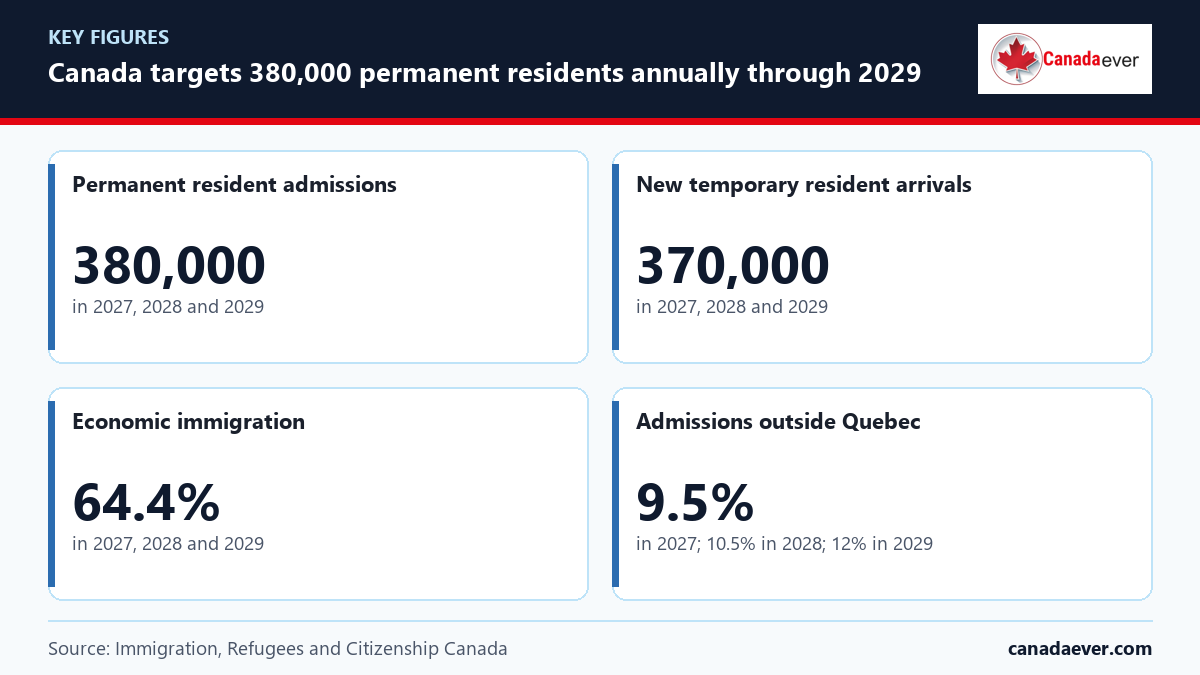
The economic share stays level across the plan years, while the outside-Quebec commitment rises.
Other figures in the 2027–2029 plan
According to the supplementary information for the 2027-2029 Immigration Levels Plan, workers are expected to represent approximately 60% of new arrivals over the course of the Plan, and students approximately 40%. IRCC will also continue delivering existing one-time initiatives announced in Budget 2025 to accelerate the transition of up to 115,000 Protected Persons in Canada (PPiC) and their in-Canada dependants and 33,000 work permit holders to permanent residence in 2026 and 2027. Notional targets and ranges for 2028 and 2029 will be confirmed or adjusted by November 1 of next year.
IRCC’s permanent residents statistics page says the one-time In-Canada Workers Initiative is accelerating permanent residence for 33,000 workers who are already contributing to Canadian communities in in-demand sectors, with a particular focus on those living in smaller communities. Asylum claimant volumes and in-Canada study/work permit applications are included in the overall methodology and calculations to reach the less than 5% non-permanent resident target.
| Key fact | Source |
|---|---|
| In 2026, we’re aiming for 9% (30,150) of our new permanent residents outside Quebec to be francophone or bilingual. | Immigration, Refugees and Citizenship Canada |
| As part of our commitment to recalibrate the immigration system and reduce our temporary population to less than 5% of Canada’s total population, we’ve introduced two one-time initiatives that will run in 2026 and 2027. | Immigration, Refugees and Citizenship Canada |
| In 2026, we plan to admit at least 20,000 workers as permanent residents through this initiative. | Immigration, Refugees and Citizenship Canada |
| Targets for new temporary resident arrivals will stabilize at 370,000 for all three years of the 2027-2029 Levels Plan. | Immigration, Refugees and Citizenship Canada |
| Workers are expected to represent approximately 60% of new arrivals over the course of the Plan, and students approximately 40%. | Immigration, Refugees and Citizenship Canada |
| Overall permanent resident admissions will remain at 380,000 for all three years of the 2027-2029 Levels Plan. | Immigration, Refugees and Citizenship Canada |
What to do next
- Open Canada’s immigration levels page. Find the 2027–2029 Immigration Levels Plan and read its permanent resident admissions targets.
- Keep permanent and temporary resident figures separate. The plan lists them in different categories. The temporary resident target isn’t part of the permanent resident admissions target.
- Consider the Provincial Nominee Program and the Atlantic Immigration Program. The official announcement names both programs. The Atlantic program is for skilled foreign workers and international graduates who want to work and live in one of Canada’s Atlantic provinces.
Frequently Asked Questions
Will the lower admissions target affect permanent residence application processing times?
The plan sets permanent resident admissions at 380,000 in each year from 2027 through 2029.
Does the plan change eligibility requirements for permanent residence programs?
The plan sets annual admission targets, including 380,000 permanent resident admissions in each year from 2027 through 2029.
How do I check whether my immigration pathway is affected by the new targets?
The announcement links to the Provincial Nominee Program and the Atlantic Immigration Program.
Related on CanadaEver:
- Permanent residence: latest news and guides
- Canada PNP express entry draw
- PR obligation rules
- Canada new permanent immigration pathway
What does the official page say about We?
We have committed to returning immigration to sustainable levels, stabilizing the number of new permanent residents each year to less than 1% of our total population beyond 2027 with a focus on giving permanent residence to people already living in, working in, and contributing to our country. Source: canada.ca
Sources
- canada.ca: Canada’s immigration levels
- canada.ca: Supplementary Information for the 2027-2029 Immigration Levels Plan
- canada.ca: Permanent residents (IRCC statistics)