
Express Entry Processing Times: What to Expect in 2026

Canada’s Express Entry system remains the fastest pathway to permanent residence for skilled workers, but understanding current processing times and how to navigate the system efficiently can make all the difference in your immigration journey. With significant changes implemented in 2025 and evolving processing standards, prospective immigrants need up-to-date information to plan their applications effectively.
Quick answer: IRCC’s processing-times tool showed about 6 months for the Canadian Experience Class and about 7 months for the Federal Skilled Worker and Provincial Nominee Program (via Express Entry) as of October 9, 2026. These are IRCC estimates and change, so check the tool for the latest figure.
For current official estimates, see our IRCC processing times tracker.
Canada’s Express Entry system remains the fastest pathway to permanent residence for skilled workers, but understanding current processing times and how to navigate the system efficiently can make all the difference in your immigration journey.
This comprehensive guide covers everything you need to know about Express Entry processing times in 2025, including current timelines, factors that affect processing speed, and actionable strategies to expedite your application.
Whether you’re just starting your immigration journey or waiting for a decision, this information will help you understand what to expect and how to optimize your chances of success.
Current Express Entry Processing Times in 2025
Official IRCC Service Standards
Immigration, Refugees and Citizenship Canada (IRCC) maintains a service standard of 180 days (6 months) for processing 80% of complete Express Entry applications. This standard applies to all three federal economic programs managed under Express Entry: the Canadian Experience Class (CEC), Federal Skilled Worker Program (FSWP), and Federal Skilled Trades Program (FSTP).
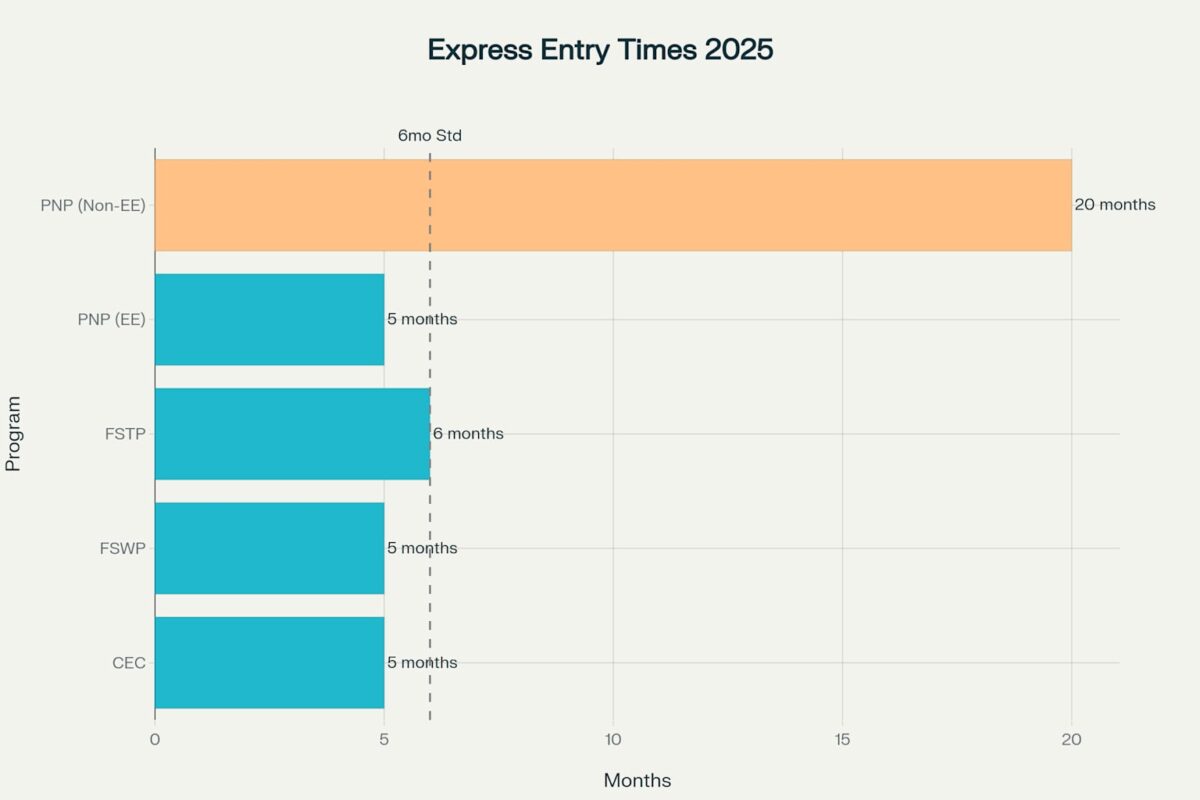

Express Entry Processing Times Comparison for 2025 – Most programs meet the 6-month service standard
Program-Specific Processing Times
Current processing times for 2025 show that most Express Entry programs are meeting or exceeding the service standard:
- Canadian Experience Class (CEC): 5 months (85% performance rate)
- Federal Skilled Worker Program (FSWP): 5 months (86% performance rate)
- Federal Skilled Trades Program (FSTP): 6 months
- Provincial Nominee Program (Express Entry stream): 5 months (80% performance rate)
- Provincial Nominee Program (Non-Express Entry): 20 months
| Program | Current Processing Time (2025) | IRCC Service Standard | Performance Rate |
|---|---|---|---|
| Canadian Experience Class (CEC) | 5 months | 180 days (6 months) | 85% |
| Federal Skilled Worker Program (FSWP) | 5 months | 180 days (6 months) | 86% |
| Federal Skilled Trades Program (FSTP) | 6 months | 180 days (6 months) | N/A |
| Provincial Nominee Program (Express Entry) | 5 months | 180 days (6 months) | 80% |
| Provincial Nominee Program (Non-Express Entry) | 20 months | No specific standard | N/A |
The significant difference between Express Entry-aligned PNP applications (5 months) and traditional PNP applications (20 months) demonstrates the efficiency advantage of the Express Entry system.
Understanding the Express Entry System
How Express Entry Works
Express Entry is a points-based system that uses the Comprehensive Ranking System (CRS) to rank candidates. The system manages applications for three federal programs and conducts regular draws to invite the highest-ranking candidates to apply for permanent residence.

Infographic detailing Express Entry application processing times, with 80% processed within six months, alongside historical newcomer statistics
2025 CRS Score Requirements by Draw Type
Understanding CRS score requirements is crucial for setting realistic expectations. Current trends show significant variation based on draw type:
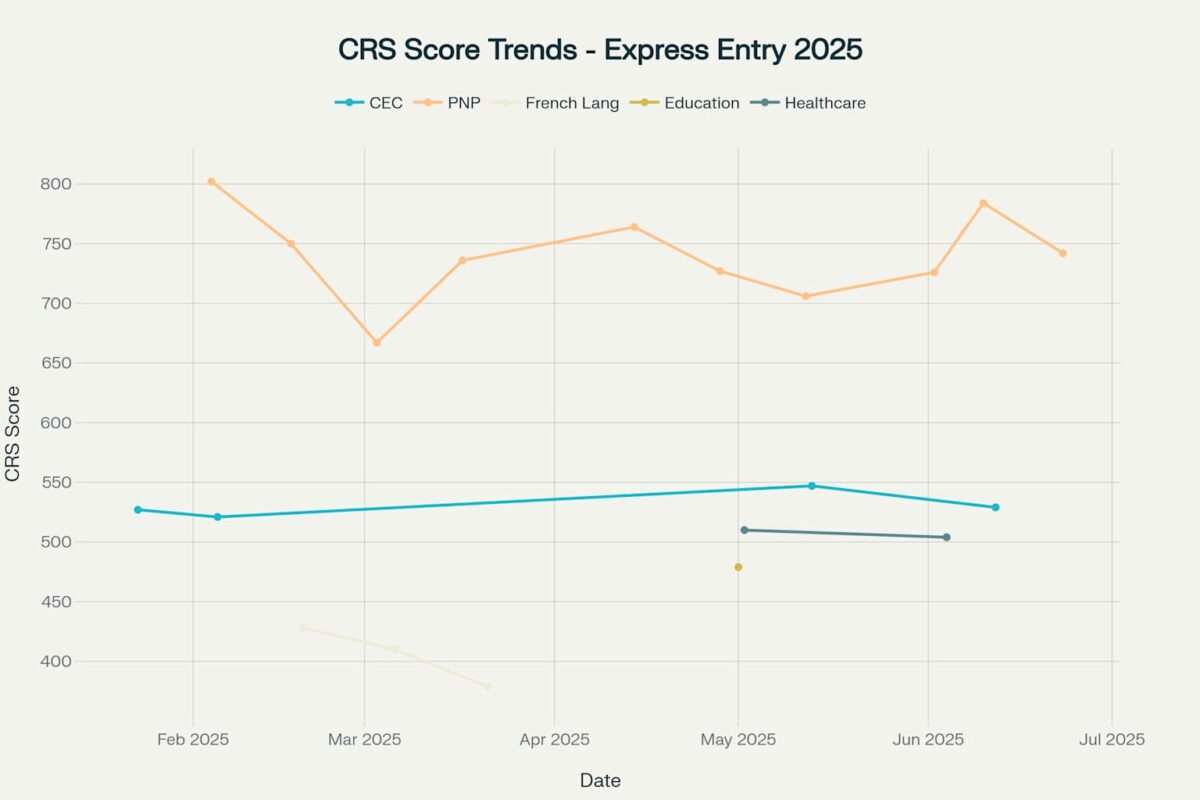
Express Entry CRS Score Trends by Draw Type in 2025 – French draws have significantly lower requirements
The most recent draw data reveals distinct scoring patterns:
- French Language Proficiency draws: 380-430 CRS (lowest requirements)
- Education Occupations: 475-485 CRS
- Healthcare and Social Services: 500-510 CRS
- Canadian Experience Class: 520-550 CRS
- Provincial Nominee Program: 660-800+ CRS
The Complete Express Entry Timeline
Step-by-Step Process Overview
The Express Entry process involves multiple stages, each with specific timelines and requirements. Understanding each phase helps you plan effectively and avoid delays.

Express Entry Process Flowchart – Complete timeline from eligibility to landing in Canada
Detailed Timeline Breakdown
The complete journey from profile creation to landing in Canada typically takes 8-18 months, depending on various factors:
| Stage | Timeline | Your Action Required | Key Tips |
|---|---|---|---|
| Profile Creation | 1-2 hours | Complete profile accurately | Double-check all information |
| Pool Waiting Period | 2 weeks – 12 months | Monitor draws, improve CRS | Update profile as needed |
| Invitation to Apply (ITA) | Immediate | Accept invitation promptly | Start document preparation |
| Document Preparation | 30-60 days | Gather all required docs | Use certified translations |
| Application Submission | 60 days from ITA | Submit complete application | Review before submission |
| IRCC Review | 1-2 months | Respond to requests promptly | Check email regularly |
| Medical Exam Request | 2-4 weeks | Schedule and attend exam | Use approved panel physician |
| Background Checks | 1-3 months | Provide additional info if requested | Maintain valid documents |
| Final Decision | 1-2 weeks | Wait for decision | Be patient but prepared |
| COPR Issuance | 1-2 weeks | Prepare for travel | Book travel arrangements |
| Landing in Canada | Within 1 year of COPR | Complete landing process | Bring all required documents |
Phase 1: Pre-Application (1-6 months)
- Eligibility assessment and document gathering
- Language testing and Educational Credential Assessment
- Profile creation and CRS optimization
Phase 2: Invitation and Application (2-4 months)
- Waiting for invitation to apply (ITA)
- Document preparation and submission
- Medical examinations and police certificates
Phase 3: Processing and Decision (5-6 months)
- IRCC review and background checks
- Final decision and COPR issuance
- Travel planning and landing preparation
Major Changes in Express Entry for 2025
Policy Updates and Their Impact
Several significant changes have been implemented in 2025 that affect processing times and candidate selection:
1. Removal of CRS Points for Job Offers
As of 2025, arranged employment no longer provides additional CRS points, shifting focus to other factors like language skills, education, and work experience.
2. Increased Immigration Targets for Express Entry
Despite an overall 20% reduction in total immigration levels, Express Entry allocations have increased to 124,680 for 2025, up from 110,770 in 2024.
| Year | Total Immigration Target | Express Entry Target | Provincial Nominee Program |
|---|---|---|---|
| 2024 | 485000 | 110770 | 110000 |
| 2025 | 395000 | 124680 | 55000 |
| 2026 | 380000 | TBD | TBD |
| 2027 | 365000 | TBD | TBD |
The IRCC 2025-2027 Immigration Levels Plan sets total permanent resident admissions at 395,000 in 2025, 380,000 in 2026 and 365,000 in 2027.
3. Enhanced Focus on In-Canada Applicants
IRCC has prioritized candidates already residing in Canada, particularly through increased Canadian Experience Class draws.
4. Expansion of Category-Based Draws
More frequent targeted draws for specific occupations, including healthcare, education, and French-language proficiency.
Factors That Affect Processing Times
Application Completeness and Quality
The most significant factor affecting processing speed is application completeness. Incomplete applications can cause delays of 4-8 weeks while missing documents typically add 2-6 weeks to processing time.
Country-Specific Factors
Processing times can vary significantly based on your country of residence due to different verification requirements and visa office workloads. Some countries may experience delays of 4-20 weeks due to processing complexities.
Volume and Seasonal Variations
Application volumes affect processing times, with peak periods typically experiencing longer waits. IRCC has reduced its backlog to approximately 760,200 applications as of April 2025, down from over 1 million earlier in the year.
How to Speed Up Your Express Entry Application
Pre-Application Strategies
Preparation is key to avoiding delays and ensuring smooth processing. The most effective strategies begin before you even receive an invitation to apply.
| Category | Tip | Impact on Processing | Timeline Impact |
|---|---|---|---|
| Pre-Application | Complete profile accurately the first time | Prevents delays and rejections | No delay |
| Pre-Application | Improve CRS score through language tests | Increases invitation chances | Faster ITA receipt |
| Pre-Application | Get Provincial Nomination if eligible | Adds 600 CRS points | Much faster ITA |
| Pre-Application | Prepare documents before receiving ITA | Reduces stress and rush | Save 2-4 weeks |
| Document Preparation | Use certified translations for all documents | Avoids document rejections | Save 2-6 weeks |
| Document Preparation | Get police certificates from all countries early | Prevents security clearance delays | Save 8-16 weeks |
| Document Preparation | Complete medical exam with approved physician | Speeds up medical processing | Save 2-4 weeks |
| Application Submission | Submit complete application within 60 days | Stays within deadline | No penalty delay |
| Application Submission | Double-check all forms and signatures | Prevents return for corrections | Save 4-8 weeks |
| Post-Submission | Respond to IRCC requests immediately | Avoids processing delays | Save 2-8 weeks |
| Post-Submission | Keep contact information updated | Ensures communication delivery | No delay |
| Post-Submission | Be patient and avoid multiple inquiries | Maintains application priority | No delay |
Essential Pre-Application Steps:
- Complete your profile accurately the first time to prevent rejections
- Improve your CRS score through language testing to increase invitation chances
- Research Provincial Nominee Programs that could add 600 CRS points
- Begin document preparation early, especially police certificates
Document Preparation Best Practices
Proper document preparation can save weeks or months in processing time. Critical requirements include:
Before Receiving ITA:
| Document Type | Required For | Validity Period | Notes |
|---|---|---|---|
| Passport or Travel Document | All applicants | Must be valid | Valid for at least 6 months |
| Language Test Results | All applicants | Less than 2 years old | IELTS, CELPIP, TEF, or TCF |
| Educational Credential Assessment (ECA) | FSWP & points claims | Less than 5 years old | From designated organizations |
| Proof of Work Experience | All programs | Within last 10 years | Reference letters required |
| Proof of Funds | All applicants | Recent bank statements | Based on family size |
| Provincial Nomination (if applicable) | PNP applicants | Valid nomination | Adds 600 CRS points |
| Job Offer Letter (if applicable) | If claiming points | Valid offer | No longer adds CRS points (2025) |
| Certificate of Qualification (trades) | FSTP applicants | Valid certificate | From Canadian province/territory |
After Receiving ITA:
| Document Category | Required Documents | Processing Time | Cost (Approximate) |
|---|---|---|---|
| Identity Documents | Passport, birth certificate, photos | Immediate | $50-200 |
| Police Certificates | From all countries lived 6+ months | 2-16 weeks (varies by country) | $50-300 per country |
| Medical Examinations | Immigration Medical Exam (IME) | 30 days or less | $300-500 |
| Proof of Funds | Bank statements, investment records | Immediate | Bank fees only |
| Work Experience Proof | Reference letters, employment records | 2-4 weeks | $50-200 |
| Education Documents | Degrees, diplomas, transcripts, ECA | Immediate (if ready) | $200-500 |
| Language Test Results | Official test results | Immediate (if valid) | Already completed |
| Family Documents | Marriage certificate, divorce decree | Immediate | $50-150 |
| Additional Documents | Military records, name change docs | Varies | Varies |
Medical Examinations
Since October 2023, Express Entry applicants no longer need to complete medical examinations upfront. Instead, you’ll receive instructions after your application is reviewed, typically taking 30 days or less to complete.
Monthly Action Checklist for Express Entry Success
Your Year-Long Immigration Timeline
Following a structured monthly plan helps ensure you don’t miss critical deadlines or opportunities. This timeline assumes a 12-month journey from initial assessment to landing in Canada.
| Month | Primary Tasks | Key Focus Areas |
|---|---|---|
| Month 1 | Complete eligibility assessment, create profile | Profile accuracy, initial CRS score |
| Month 2 | Improve CRS score, research PNP programs | Score improvement strategies |
| Month 3 | Take language tests, get ECA assessment | Language and education credentials |
| Month 4 | Apply for police certificates, gather documents | Document gathering, police certificates |
| Month 5 | Update profile, monitor draws | Profile optimization, draw monitoring |
| Month 6 | Prepare ITA documentation, medical prep | Document preparation, health preparation |
| Month 7 | Submit application if ITA received | Application submission, accuracy check |
| Month 8 | Respond to IRCC requests, medical exam | IRCC communication, medical completion |
| Month 9 | Background checks, final document updates | Final verifications, patience required |
| Month 10 | Decision expected, prepare for COPR | Travel preparation, document validity |
| Month 11 | Travel planning, landing preparation | Immigration planning, accommodation |
| Month 12 | Land in Canada, activate PR status | Landing process, PR card application |
Key Milestones to Track:
- Months 1-3: Foundation building (eligibility, testing, documentation)
- Months 4-6: Application optimization and ITA pursuit
- Months 7-9: Application submission and processing
- Months 10-12: Decision, travel planning, and landing
Common Delays and How to Avoid Them
Most Frequent Processing Delays
Understanding common delay factors helps you proactively address potential issues. These delays can extend your processing time significantly if not properly managed.
| Delay Factor | Typical Delay | How to Avoid | Prevention Strategy |
|---|---|---|---|
| Incomplete Application | 4-8 weeks | Review application thoroughly before submission | Use professional review service |
| Missing Documents | 2-6 weeks | Use IRCC document checklist | Prepare documents before ITA |
| Invalid Language Tests | 4-12 weeks | Ensure tests are less than 2 years old | Retake tests if expiring soon |
| Expired Documents | 2-4 weeks | Check all document expiry dates | Renew documents proactively |
| Police Certificate Delays | 8-16 weeks | Apply for certificates early from all countries | Start process 6 months early |
| Medical Exam Issues | 2-6 weeks | Use approved panel physician | Book exam immediately after ITA |
| Background Check Complications | 2-12 weeks | Disclose all information accurately | Include explanatory letters |
| Additional Verification Required | 4-16 weeks | Provide complete work/education history | Gather comprehensive documentation |
| High Application Volume | 2-8 weeks | Apply during lower volume periods | Monitor IRCC processing reports |
| Country-Specific Processing Issues | 4-20 weeks | Apply from countries with faster processing | Consider temporary relocation |
Critical Prevention Strategies:
- Start police certificate applications 6 months early from all countries where you’ve lived
- Use only IRCC-approved panel physicians for medical examinations
- Ensure all language test results are less than 2 years old at time of application
- Maintain valid documents throughout the entire process
Country-Specific Processing Considerations
Recent IRCC data shows processing time variations by country:
- India: 4 weeks for visitor visas (reduced by 1 week)
- United States: 7 weeks (increased by 1 week)
- Nigeria: 6 weeks (increased by 1 week)
- Pakistan: 11 weeks (no change)
- Philippines: 16 weeks (no change)
What to Expect During IRCC Review
The Processing Phase Breakdown
Once you submit your complete application, IRCC begins a systematic review process. This phase typically takes 5-6 months and includes several distinct stages:
Initial Review (Weeks 1-4):
- Application completeness verification
- Document authentication
- Security screening initiation
Detailed Assessment (Months 2-4):
- Background checks and verification
- Medical examination review
- Employment and education verification
Final Decision (Months 5-6):
- File review and decision making
- COPR preparation and issuance
- Final communication to applicant
Communication During Processing
IRCC communicates primarily through your online account. Key communication milestones include:
- Acknowledgment of receipt (within 24-48 hours)
- Medical examination instructions (if required)
- Requests for additional documentation
- Final decision notification
Success Tips for 2025 Applicants
Maximizing Your Chances
With increased competition and evolving selection criteria, strategic planning is more important than ever. Consider these evidence-based approaches:
CRS Score Optimization:
- Target scores above 520 for CEC draws and 470+ for category-based draws
- Prioritize language test improvements, which can add 50-60 points per band increase
- Consider French language learning for access to lower-scoring draws
Draw Strategy:
- Monitor IRCC draw patterns and timing
- Apply for Provincial Nominee Programs early in the year
- Focus on category-based draws that match your occupation
Conclusion
Express Entry processing times in 2025 remain competitive, with most applications processed within the 6-month service standard. Success requires strategic planning, thorough preparation, and understanding of the evolving immigration landscape.
Key takeaways for 2025 applicants include the increased focus on in-Canada experience, the removal of job offer points, and the expansion of category-based draws. By following the comprehensive checklists and timelines provided, preparing documents proactively, and understanding common delay factors, you can optimize your application for success.
Remember that Express Entry is designed to attract skilled workers who can contribute to Canada’s economic growth. With proper preparation and realistic expectations about processing times, your journey to Canadian permanent residence can be both successful and efficient. Stay informed about policy updates, maintain accurate documentation, and be patient during the processing phase – your Canadian dream is within reach.
Related reading: Express Entry Complete Guide — a closer look at this topic.
Quick answers from official sources
How long does Canadian Experience Class processing take?
About 6 months as of October 9, 2026, with about 53,900 people waiting, per IRCC’s tool.
How long does Federal Skilled Worker processing take?
About 7 months as of October 9, 2026, with about 58,300 people waiting.
Does Express Entry have a time for Federal Skilled Trades?
IRCC’s tool showed ‘Not enough data’ for Federal Skilled Trades as of October 21, 2026.
Sources (checked October 27, 2026):