
CRA Tax Changes 2026: What’s New for Canadians?

As we navigate through 2025, Canadian taxpayers are experiencing significant changes to the tax system that could impact their financial planning and filing obligations. The Canada Revenue Agency (CRA) has implemented several updates designed to provide relief to middle-class families while modernizing tax administration processes.
Quick answer: The federal government cut the lowest personal income tax rate from 15% to 14%, effective July 1, 2025. Because the cut took effect halfway through the year, the full-year lowest rate is 14.5% for 2025 and 14% for 2026 and future tax years, according to the Department of Finance Canada.
- What changed: The lowest federal income tax rate went from 15% to 14% on July 1, 2025 (14.5% full-year for 2025).
- Who is affected: Canadian taxpayers, since the lowest bracket applies to everyone with taxable income.
- What to do: Use 14.5% for 2025 and 14% for 2026 onward when estimating federal tax.
This comprehensive guide breaks down everything you need to know about the 2025 tax changes, from new tax rates to updated filing requirements.
The Big Picture: What’s Changed in 2025?
The most significant change for Canadian taxpayers in 2025 is the reduction of the lowest federal income tax rate from 15% to 14%, effective July 1, 2025. This change, combined with inflation-adjusted tax brackets and increased benefit amounts, represents the government’s commitment to providing meaningful tax relief to working families.
Additionally, the CRA has modernized its communication systems, transitioning to digital-first approaches for business correspondence while enhancing audit capabilities to ensure compliance across all taxpayer segments.
Major Tax Changes for Individual Taxpayers
New Tax Rates and Brackets
The federal tax brackets for 2025 have been adjusted upward by 2.7% to account for inflation, providing taxpayers with slightly higher income thresholds before moving into higher tax brackets. However, the most impactful change is the tax rate reduction for the lowest bracket.


Federal Tax Brackets Comparison: 2024 vs 2025
Key highlights of the new tax structure:
- Income up to $57,375: Taxed at 15% (reduced to 14% from July 1, 2025)
- Income from $57,376 to $114,750: Taxed at 20.5%
- Income from $114,751 to $177,882: Taxed at 26%
- Income from $177,883 to $253,414: Taxed at 29%
- Income over $253,414: Taxed at 33%
Understanding the July 1 Tax Rate Change
The timing of this tax rate reduction means that for 2025, taxpayers will experience:
- First half of 2025: 15% rate on the lowest bracket
- Second half of 2025: 14% rate on the lowest bracket
- 2026 and beyond: Full 14% rate for the entire year
Real-world impact: A single taxpayer earning $50,000 annually will save approximately $500 per year once the full 14% rate takes effect in 2026.
Increased Basic Personal Amount
The Basic Personal Amount (BPA) has increased to $16,129 for 2025, up from $15,705 in 2024. This means Canadians can earn up to $16,129 before paying any federal income tax.
The Canada Revenue Agency indexation table lists the 2025 basic personal amount maximum at $16,129 (up from $15,705 in 2024), based on a 2.7% indexation increase.
Who benefits most: Lower and middle-income taxpayers will see the greatest impact from this increase, as it effectively provides tax-free income up to this threshold.
Business-Related Changes
Transition to Online Mail
Starting in spring 2025, the CRA is making online mail the default method for most business correspondence. This affects:
- New businesses registering for business numbers
- Existing businesses already using My Business Account
- Businesses with tax representatives using “Represent a Client”
What businesses need to do:
- Log into My Business Account and update email addresses
- Ensure access to online accounts is maintained
- Consider opting for paper mail if preferred (requires Form RC681)
Updated T619 Forms and Filing Requirements
Beginning January 2025, significant changes to business tax filing include:
- Updated T619 Electronic Transmittal Form: New version required for all submissions
- One Return Type Per Submission: No more combining multiple return types
- Enhanced Real-Time Validation: Improved error checking before submission
Digital Services Tax Implementation
Large digital businesses may be subject to the new Digital Services Tax (DST) at a rate of 3% on qualifying Canadian digital services revenue. This applies to businesses with:
- Global revenues exceeding €750 million
- Canadian digital services revenue over $20 million
Benefit Updates and Increases
Canada Child Benefit Enhancements
The Canada Child Benefit has increased by 2.7% for the 2025-2026 benefit year:
- Children under 6: Up to $7,997 annually ($666 monthly)
- Children aged 6-17: Up to $6,748 annually ($562 monthly)
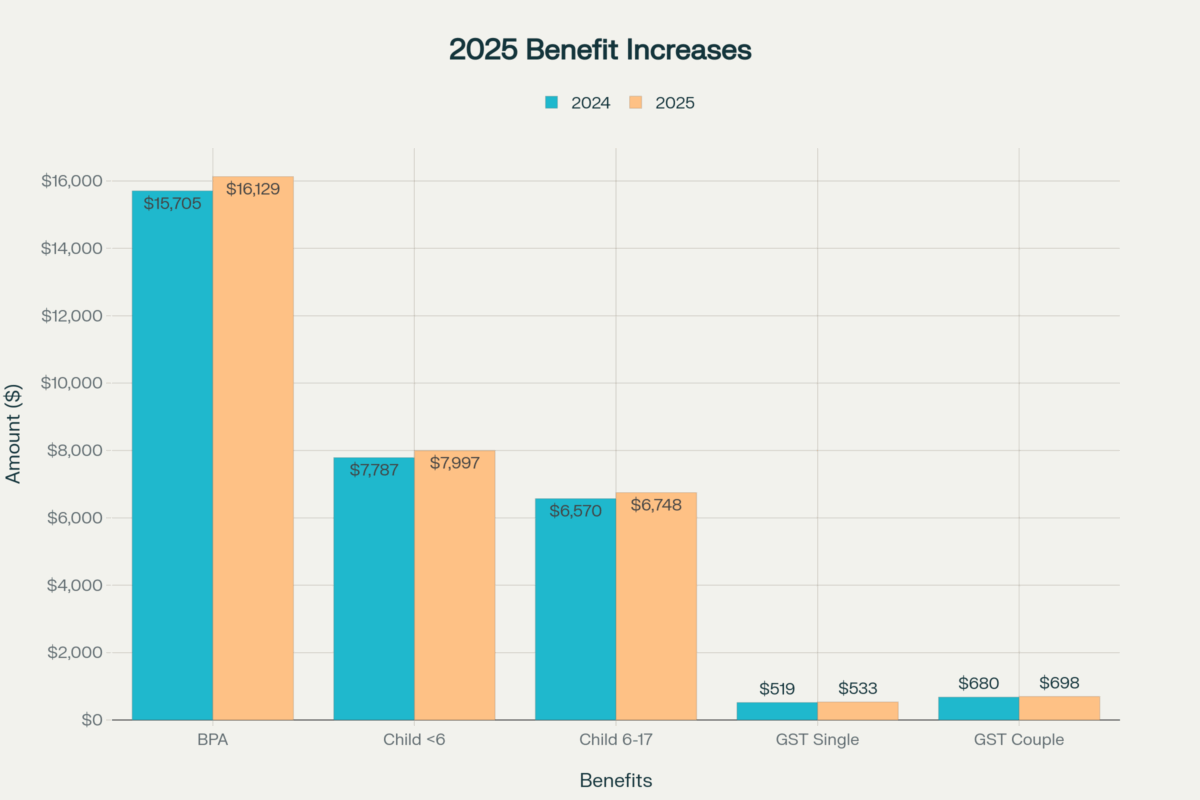
2025 Tax Benefits & Savings: Key Amounts and Increases
GST/HST Credit Increases
The quarterly GST/HST credit amounts have been updated:
- Single individuals: Up to $533 annually ($133 quarterly)
- Married couples: Up to $698 annually ($174 quarterly)
- Per child under 19: Additional $184 annually ($46 quarterly)
Enhanced Provincial Top-ups
Some provinces offer additional GST/HST credit supplements:
- Newfoundland and Labrador: Up to $575 per quarter
- Saskatchewan: Up to $299 per quarter
- New Brunswick: Up to $200 per quarter
Capital Gains Changes: What Happened?
Important update: The proposed increase to the capital gains inclusion rate has been deferred to January 1, 2026. This means:
- All capital gains realized in 2025 remain subject to the current 50% inclusion rate
- The previously announced increase to 66.7% for gains over $250,000 will not take effect until 2026
- Taxpayers have additional time to plan for potential future changes
Important Dates and Deadlines for 2025
Understanding key dates is crucial for staying compliant and maximizing benefits:

2025 CRA Tax Changes & Important Dates Timeline
Critical Filing Deadlines:
- February 24, 2025: CRA opens online filing (NETFILE)
- March 3, 2025: RRSP contribution deadline
- April 30, 2025: Individual tax filing and payment deadline
- June 16, 2025: Self-employed tax filing deadline
Key Benefit Payment Dates:
- Quarterly GST/HST Credit: January 5, April 4, July 4, October 3
- Monthly Canada Child Benefit: 20th of each month
- Advanced Canada Workers Benefit: January 10, May 10, July 11
Enhanced CRA Audit Powers and Penalties
The CRA has introduced new enforcement tools for 2025:
New Penalties and Compliance Measures
- Notices of Non-Compliance: Daily penalties up to $25,000 for incomplete responses
- Enhanced Audit Selection: AI-driven systems to identify unusual patterns
- Faster Processing: Real-time validation and error checking
Late Filing Penalties
Standard penalties remain:
- 5% of unpaid taxes for late filing
- Additional 1% per month up to 12 months
- Doubled penalties for repeat offenders
Practical Preparation Tips
For Individual Taxpayers
Essential actions before filing:
- Gather all tax documents (T4, T5, receipts)
- Update CRA My Account contact information
- Consider RRSP contributions before March 3 deadline
- Review potential deductions and credits
- File early to avoid last-minute issues
For Business Owners
Key preparation steps:
- Update business email in My Business Account
- Review new T619 requirements for electronic filing
- Organize records for potential audits
- Understand DST obligations if applicable
- Plan for online communication transition
For Parents and Families
Maximize your benefits:
- File taxes on time to maintain benefit eligibility
- Update family information with CRA promptly
- Monitor benefit payments for accuracy
- Plan for increased CCB amounts in budgeting
- Consider income splitting strategies with spouse
Your 2025 Tax Checklist
| Timeline | Action Item | Priority | Who This Affects |
|---|---|---|---|
| Before March 3, 2025 | Make RRSP contributions to reduce taxable income | High | All taxpayers with RRSP room |
| Before March 3, 2025 | Gather all tax documents (T4, T5, receipts) | High | All taxpayers |
| February 24 – April 30, 2025 | File your 2024 income tax return online | Critical | All individual taxpayers |
| Before April 30, 2025 | Pay any taxes owed to avoid penalties | Critical | Taxpayers who owe money |
| Before April 30, 2025 | Update CRA My Account contact information | Medium | All taxpayers |
| Before June 16, 2025 | Self-employed: File your tax return | Critical | Self-employed individuals |
| July 1, 2025 onwards | Benefit from new 14% tax rate (automatic) | Automatic | All taxpayers in lowest bracket |
| Spring 2025 | Update business email for CRA online mail | High | Business owners |
| Throughout 2025 | Check for GST/HST credit payments (quarterly) | Medium | Eligible low-income taxpayers |
| Throughout 2025 | Monitor Canada Child Benefit payments (monthly) | Medium | Parents with children under 18 |
| Ongoing | Keep organized records for next year | Medium | All taxpayers |
Common Questions and Answers
u003cstrongu003eQ: When will I see the tax rate reduction in my paycheque?u003c/strongu003e
A: The 14% rate takes effect July 1, 2025, so you should see reduced tax withholdings starting with your first paycheque after that date.
u003cstrongu003eQ: Do I need to do anything to get the increased Basic Personal Amount?u003c/strongu003e
A: No, the increased BPA is automatically applied when you file your 2025 tax return.
u003cstrongu003eQ: What if I miss the online mail transition for my business?u003c/strongu003e
A: You can request to continue receiving paper mail by filing Form RC681, which must be renewed every two years.
u003cstrongu003eQ: Are the capital gains changes completely cancelled?u003c/strongu003e
A: No, they’re deferred to January 1, 2026. The current 50% inclusion rate continues through 2025
Looking Ahead: What to Expect
The 2025 tax changes represent a significant shift toward digital-first tax administration while providing meaningful relief to Canadian taxpayers. The combination of reduced tax rates, increased benefits, and modernized processes creates both opportunities and responsibilities for taxpayers.
Key considerations for long-term planning:
- Monitor proposed capital gains changes for 2026
- Stay informed about digital service requirements for businesses
- Take advantage of increased benefit amounts for family budgeting
- Prepare for continued digitization of CRA services
Final Thoughts
The 2025 tax changes offer real financial benefits for most Canadians, particularly those in lower and middle-income brackets. However, staying compliant requires understanding new deadlines, digital requirements, and enhanced enforcement measures.

Who Do the 2025 Tax Changes Affect? A Simple Guide
Remember: The most important step is to file your taxes on time and accurately. When in doubt, consult with a qualified tax professional who can provide personalized advice based on your specific situation. The CRA also offers free tax clinics and resources to help taxpayers navigate these changes successfully.
By staying informed and proactive, Canadian taxpayers can take full advantage of the 2025 tax changes while avoiding potential penalties and complications. Start early, stay organized, and don’t hesitate to seek help when needed.
Related: Canada Tax Filing Deadlines
Quick answers from official sources
When did the lowest federal tax rate change?
The Department of Finance Canada says the lowest personal income tax rate fell from 15% to 14%, effective July 1, 2025.
What is the full-year lowest rate for 2025 and 2026?
Because the cut took effect halfway through 2025, the full-year rate is 14.5% for 2025 and 14% for 2026 and future tax years.
Which income does the lower rate apply to?
It applies to the lowest tax bracket; in 2025 that covers the first $57,375 of an individual’s taxable income, according to the Department of Finance Canada.
Sources (checked October 27, 2026):