Family Reunification: Alternative Options to Sponsorship
When traditional family sponsorship programs seem out of reach or unavailable, hope is not lost . There are numerous alternative pathways that can help reunite families across international borders, each designed to address specific circumstances and needs . Whether you’re facing program suspensions, eligibility restrictions, or lengthy waiting periods, understanding these alternatives can open new doors to bringing your loved ones together.
When traditional family sponsorship programs seem out of reach or unavailable, hope is not lost . There are numerous alternative pathways that can help reunite families across international borders, each designed to address specific circumstances and needs .
Whether you’re facing program suspensions, eligibility restrictions, or lengthy waiting periods, understanding these alternatives can open new doors to bringing your loved ones together.
Understanding Your Options: Beyond Traditional Sponsorship
Family reunification extends far beyond conventional sponsorship programs . Immigration systems worldwide recognize the fundamental importance of family unity and have developed various pathways to accommodate different situations .
These alternatives often provide faster processing times, lower barriers to entry, or address specific humanitarian concerns that traditional programs may not cover .
The key to success lies in understanding which pathway best matches your unique circumstances, family composition, and legal status . Each alternative comes with its own set of requirements, processing times, and success rates, making careful evaluation essential for choosing the right approach .
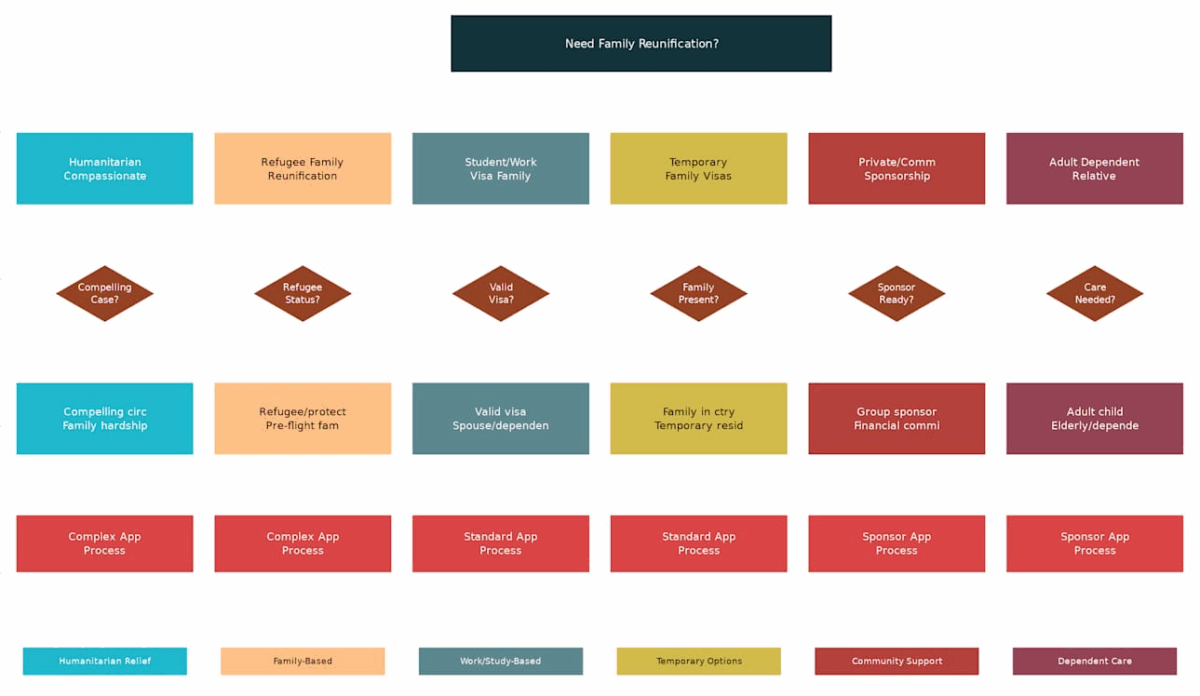

Humanitarian and Compassionate Grounds Applications
What Are Humanitarian and Compassionate (H&C) Applications?
Humanitarian and compassionate applications represent one of the most flexible alternatives to traditional sponsorship . These discretionary pathways allow immigration officers to grant permanent residence to individuals who would not otherwise qualify under standard immigration programs .
H&C applications are particularly valuable when families face exceptional circumstances that prevent reunion through normal channels . The assessment considers factors such as establishment in the destination country, family ties, potential hardship if separated, and the best interests of any children involved .
Key Factors for H&C Success
- Best Interests of Children: When children are involved, their welfare becomes a primary consideration in H&C applications . Immigration officers must assess how separation affects children’s education, safety, emotional wellbeing, and overall development .
- Establishment and Community Ties: Demonstrating strong connections to the destination country through employment, community involvement, and social networks significantly strengthens H&C applications . Evidence of integration and contribution to society carries substantial weight in decision-making .
- Hardship Assessment: Applicants must clearly articulate the hardship they would face if forced to return to their home country or remain separated from family members . This includes medical needs, safety concerns, and lack of support systems in the home country .
Countries Offering H&C Pathways
Canada’s H&C program is among the most established, with processing times averaging 21 months and success rates between 30-40% . Australia and New Zealand also offer similar discretionary pathways for exceptional cases . The key to success lies in thorough documentation and compelling evidence of humanitarian need .
Refugee Family Reunification Programs
Understanding Refugee-Specific Pathways
Refugees and asylum seekers have access to specialized family reunification programs that recognize their unique circumstances . These programs often provide more generous eligibility criteria and faster processing compared to general immigration pathways .
One Year Window Program: For resettled refugees, many countries offer specific timeframes during which non-accompanying family members can join them . Canada’s One Year Window program allows refugees to apply for their separated family members within one year of arrival, with high success rates of 85-95% .
Pre-Flight vs. Post-Flight Relationships: Most refugee family reunification programs only recognize relationships that existed before the refugee fled their home country . This “pre-flight” requirement ensures that family members were genuinely separated due to persecution or conflict rather than convenience .
Eligible Family Members
Refugee family reunification typically covers immediate family members including spouses, common-law partners, and dependent children under specific age limits . The definition of “dependent child” varies by country but generally includes unmarried children under 21 or 22 years of age .
Some programs extend eligibility to parents and siblings of unaccompanied refugee children, recognizing their particular vulnerability . However, these provisions are often limited and subject to best interest determinations .
Processing and Success Rates
Refugee family reunification programs generally offer high success rates, often exceeding 95% for eligible applicants . Processing times vary significantly, from 6-12 months for straightforward cases to several years for complex situations requiring extensive documentation .
Student and Work Visa Family Accompaniment
Bringing Family on Study Permits
International students often have options to bring their families during their studies . Student visa family accompaniment typically allows spouses and dependent children to accompany the primary applicant, with some restrictions on work authorization and duration of stay .
F-2 Dependent Visas in the United States: The U.S. F-2 visa allows spouses and unmarried children under 21 to accompany F-1 student visa holders . Processing times are relatively quick at 3-5 months, with very high success rates of 95% for complete applications .
Canadian Study Permit Dependents: Canada allows international students to include their spouses and dependent children on their study permit applications . Spouses may be eligible for open work permits, providing additional family stability and income opportunities.
Work Permit Family Programs
Many countries recognize that bringing families with work permit holders improves integration and retention . These programs often have streamlined processing and clear eligibility criteria based on the primary applicant’s work authorization .
PALM Scheme Family Accompaniment: Australia’s Pacific Australia Labour Mobility (PALM) scheme allows long-term workers to bring their families after 12 months in the country . This program specifically addresses the social impacts of family separation for temporary workers .
Financial and Duration Considerations
Student and work visa family accompaniment programs typically require proof of financial support for all family members . The duration of family member visas is generally tied to the primary applicant’s study or work authorization, requiring renewal or transition to other programs for permanent solutions .
Temporary Family Reunion Visas
Short-Term Reunion Options
Temporary family visas provide immediate relief for families seeking short-term reunification while pursuing long-term solutions . These visas typically allow stays of several months to a few years, providing time to explore permanent options .
Multi-Entry Family Visitor Visas: Countries like the UK offer multi-entry visitor visas for family members, allowing repeated visits over extended periods . While not providing permanent solutions, these visas maintain family connections during lengthy permanent residence processes .
Schengen Area Family Visits: European Union countries provide family reunification visas for temporary stays, often processed within 3-4 months . These visas can bridge gaps while permanent applications are under review .
Processing Times and Costs
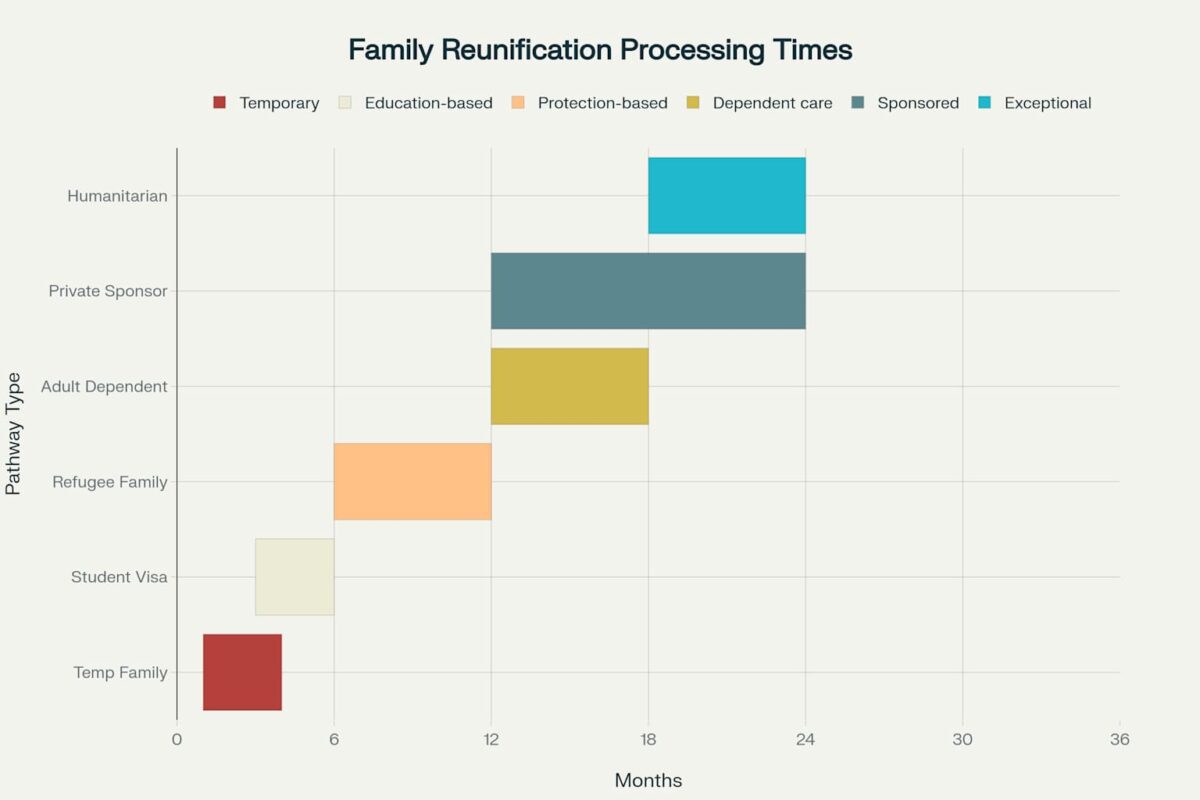
Processing Times for Family Reunification Pathways: What to Expect
Temporary family visas generally offer the fastest processing times among all reunification options, ranging from 1-4 months for most applications . Application fees are typically modest, ranging from €75 in Germany to several hundred dollars in other countries .
Adult Dependent Relative Visas
Caring for Elderly Parents
Adult dependent relative visas address the specific needs of elderly parents requiring care from their adult children . These programs recognize that some parents cannot access adequate care in their home countries and need to join their children for support .
UK Adult Dependent Relative Visa: The United Kingdom’s ADR visa requires demonstrating that the parent needs long-term personal care that is unavailable or unaffordable in their home country . Success rates are low at 15-25%, making strong evidence crucial .
Care Assessment Requirements: Applicants must provide comprehensive medical evidence showing the parent’s care needs and proof that suitable care is not available in the home country . Independent care assessments from qualified professionals strengthen applications significantly .
Financial Obligations
Adult dependent relative visas typically require substantial financial commitments from sponsors . In the UK, sponsors must demonstrate ability to provide care and accommodation without relying on public funds for at least five years . The application fee alone costs £3,250, plus additional health surcharge fees .
Private Community Sponsorship Programs
Community-Led Reunification
Private sponsorship programs allow individuals, community groups, and organizations to directly sponsor refugees and their families . These programs complement government resettlement efforts and often provide enhanced integration support .
Canada’s Private Sponsorship of Refugees: Canada’s PSR program has admitted over 300,000 refugees since 1979, with sponsors providing financial and emotional support during the first year . This program allows Canadian citizens and permanent residents to sponsor specific refugees, often including family members .
Australia’s Community Support Programme: Australia’s CSP permits individuals and groups to sponsor eligible refugees, with a limit of 1,000 places annually . Priority is given to applicants aged 18-50 with functional English and employment prospects .
Sponsor Responsibilities and Benefits
Private sponsors commit to providing financial support, housing assistance, and integration services for sponsored families . In return, sponsored individuals often experience better integration outcomes due to direct community support and personalized assistance .
Success rates for private sponsorship programs range from 70-80%, with processing times between 12-24 months depending on the country and specific circumstances .
Family Reunification Documentation Checklist
✅ Essential Documents (Required for All Pathways)
Personal Identity Documents
- Valid passport (with at least 6-12 months validity)
- Birth certificates for all family members
- Marriage certificate (if applicable)
- Recent passport-size photographs (biometric standard)
Relationship Proof Documents
- Marriage certificate (original + certified copy)
- Birth certificates showing parent-child relationship
- Adoption certificates (if applicable)
- Divorce decree (if previously married)
- Death certificate (if spouse/parent deceased)
Financial Documents
- Bank statements (3-6 months)
- Employment letters or income tax returns
- Proof of accommodation
- Financial undertaking/sponsorship forms
📋 Pathway-Specific Requirements
Humanitarian & Compassionate Grounds
- Medical reports (if health issues involved)
- Psychological assessments (trauma, mental health)
- Letters from community organizations
- Evidence of hardship in home country
- Children’s school records (best interests documentation)
- Police clearances from all countries of residence
Refugee Family Reunification
- Refugee recognition document or protection status certificate
- UNHCR registration (if applicable)
- Pre-flight relationship evidence (photos, communications)
- Declaration forms from original refugee application
- Travel documents for refugees
Student/Work Visa Family Accompaniment
- Letter of acceptance from educational institution
- Work permit or employment authorization
- Proof of enrollment and academic transcripts
- Financial support evidence (scholarships, bank statements)
- Insurance coverage documentation
Temporary Family Visas
- Invitation letter from family member in destination country
- Proof of legal status of family member (citizenship, residence permit)
- Accommodation arrangements
- Return ticket or proof of intent to return
- Travel insurance
Adult Dependent Relative Visas
- Medical evidence of care requirements
- Care assessment reports from qualified professionals
- Evidence care unavailable in home country
- Financial capacity to provide care
- Accommodation suitability assessment
🔍 Document Authentication Requirements
Legalization and Translation
- Apostille certification (for Hague Convention countries)
- Embassy/consulate authentication (for non-Hague countries)
- Certified translations by qualified translators
- Original documents and certified copies
Document Validity
- Recent documents (not older than 6 months for some)
- Clear, legible copies
- Complete documents (all pages included)
- Consistent names across all documents
🌍 Country-Specific Additional Requirements
Canada
- Police certificates from all countries lived in for 6+ months
- Medical examinations by panel physicians
- IMM forms specific to application type
- Quebec Selection Certificate (if applicable)
United States
- Affidavit of Support (Form I-864)
- Form I-130 (Petition for Alien Relative)
- Form I-730 (for refugees/asylees)
- NVC case number (National Visa Center)
United Kingdom
- English language test results (IELTS/equivalent)
- TB test certificate (from approved clinics)
- Biometric information appointment
- Life in the UK test (for some pathways)
Australia
- Skills assessment (if applicable)
- Character requirements (police checks)
- Health examinations by approved doctors
- Expression of Interest (SkillSelect system)
Germany
- German language certificate (A1-B1 level)
- Integration course completion certificate
- Residence permit of sponsor
- Housing certificate (Wohnungsgeberbestätigung)
⏰ Timeline Management
Pre-Application Phase (2-6 months)
- Gather all documents
- Obtain translations and authentications
- Complete language tests (if required)
- Schedule medical examinations
Application Phase (1-2 months)
- Complete application forms
- Pay application fees
- Submit complete application package
- Schedule biometric appointments
Post-Application Phase (Ongoing)
- Respond to additional document requests
- Attend interviews (if scheduled)
- Track application status
- Prepare for arrival (if approved)
💡 Pro Tips for Success
Document Preparation
- Make multiple copies of all documents
- Organize documents in the order specified by the immigration office
- Create a document checklist specific to your pathway
- Keep originals safe and submit certified copies when possible
Application Strategy
- Start early – some documents take months to obtain
- Double-check requirements as they change frequently
- Consider professional help for complex cases
- Maintain consistent contact information throughout the process
Common Mistakes to Avoid
- Incomplete applications (most common reason for delays)
- Expired documents at time of submission
- Inconsistent information across different forms
- Missing signatures or dates
- Poor quality photocopies or translations
This checklist is for guidance only. Requirements vary by country, pathway, and individual circumstances. Always verify current requirements with official immigration authorities.
Comparing Your Options: Pathway Analysis
Understanding the differences between various pathways helps you make informed decisions about which approach best suits your situation.
The following comparison highlights key factors across different countries and programs:
| Country | Pathway | Processing Time | Application Fee | Success Rate |
|---|---|---|---|---|
| Canada | H&C Applications | 21 months | CAD $550 | 30-40% |
| Canada | Refugee Reunification | 12-24 months | Free | 85-95% |
| United States | I-730 Petition | 8-33 months | Free | 85-90% |
| United Kingdom | Refugee Family Reunion | 9 months | Free | 95%+ |
| UK | Adult Dependent Relative | 6-12 months | £3,250 | 15-25% |
| Australia | Community Sponsorship | 12-18 months | AUD $4,000+ | 70-80% |
| Germany | Family Reunification | 3-4 months | €75 | 80-90% |
Source: Immigration statistics and policy documents from respective governments
Step-by-Step Application Process
Phase 1: Assessment and Planning (2-4 weeks)
- Evaluate Your Eligibility: Review each pathway’s requirements against your specific circumstances . Consider factors such as your legal status, family composition, financial resources, and timeline needs .
- Gather Initial Information: Collect basic documents such as passports, birth certificates, and marriage certificates to assess what additional documentation you’ll need .
- Consult Professionals: Consider seeking advice from immigration lawyers or consultants, especially for complex cases or humanitarian applications . Professional guidance can significantly improve success rates and avoid costly mistakes .
Phase 2: Document Preparation (2-6 months)
- Obtain Required Documents: Start gathering pathway-specific documents well in advance, as some items like police certificates and medical examinations can take months to obtain .
- Authentication and Translation: Ensure all foreign documents are properly authenticated through apostille or embassy certification, and obtain certified translations where required .
- Financial Documentation: Prepare comprehensive financial evidence including bank statements, employment letters, and tax returns covering the required periods .
Phase 3: Application Submission (1-2 months)
- Complete Application Forms: Fill out all required forms carefully, ensuring consistency across all documents and avoiding any discrepancies .
- Organize Supporting Documents: Arrange documents in the order specified by immigration authorities and include cover letters explaining your situation .
- Pay Fees and Submit: Pay required application fees and submit your complete package through the appropriate channels, keeping copies of everything .
Phase 4: Processing and Follow-up (Variable)
- Monitor Application Status: Regularly check application status through official government portals and respond promptly to any requests for additional information .
- Prepare for Interviews: If interviews are required, prepare thoroughly by reviewing your application and supporting documents .
- Plan for Arrival: Begin preparing for your family member’s arrival, including accommodation, healthcare registration, and integration support .
Tips for Success: Maximizing Your Chances
Documentation Excellence
- Start Early: Begin gathering documents 6-12 months before your intended application date to allow time for obtaining difficult items . Some documents, particularly from overseas authorities, can take months to process .
- Quality Over Quantity: Provide clear, relevant documentation rather than overwhelming immigration officers with unnecessary paperwork . Every document should serve a specific purpose in supporting your case .
- Professional Translation: Use certified translators for all foreign-language documents to ensure accuracy and acceptance by immigration authorities .
Building a Compelling Case
- Tell Your Story: For humanitarian applications, create a clear narrative explaining your family’s circumstances and why reunification is necessary . Use specific examples and evidence to support your claims .
- Demonstrate Integration: Show strong ties to the destination country through employment, community involvement, property ownership, or children’s education . These factors significantly strengthen humanitarian and compassionate applications .
- Address Potential Concerns: Anticipate and address any potential issues in your application, such as previous immigration violations or criminal history . Transparency and explanation are generally better than hoping issues won’t be noticed .
Common Challenges and Solutions
Document Availability Issues
- Missing Civil Documents: In conflict situations or countries with poor record-keeping, obtaining standard documents like birth certificates may be impossible . Consider alternative evidence such as affidavits from family members, community leaders, or religious organizations .
- Authentication Difficulties: Some countries lack functioning government services to authenticate documents . Contact the destination country’s embassy for guidance on alternative authentication methods or acceptable alternative documents .
Financial Barriers
- High Application Fees: Some pathways involve substantial fees that may be prohibitive for refugee families . Research fee waiver programs or consider less expensive temporary options while saving for permanent solutions .
- Income Requirements: Many programs require sponsors to meet minimum income thresholds . Consider finding co-sponsors or community groups to help meet financial requirements .
Language and Cultural Barriers
- Language Testing: Some pathways require family members to demonstrate language proficiency before approval . Invest in language training early in the process and consider programs that offer language requirement exemptions .
- Cultural Integration Support: Prepare family members for cultural adjustment through orientation programs and community connections . Many private sponsorship programs offer excellent integration support .
Planning Your Next Steps: Action Checklist
Immediate Actions (This Week)
- Assess your current legal status and determine which pathways you may be eligible for
- Gather basic family documents (passports, birth certificates, marriage certificates)
- Research specific requirements for your country of residence and intended pathway
- Contact immigration authorities or lawyers for initial guidance
Short-term Planning (Next Month)
- Create a timeline for your chosen pathway including all key deadlines
- Begin document collection starting with items that take longest to obtain
- Assess financial requirements and begin saving for application fees and support obligations
- Connect with community organizations that assist with family reunification
Medium-term Preparation (Next 3-6 Months)
- Complete all required documentation including translations and authentication
- Prepare family members in home country for potential interviews or medical examinations
- Arrange financial support and accommodation for family members’ arrival
- Submit complete application with all supporting documents
Long-term Considerations (6+ Months)
- Monitor application progress and respond to any additional requests
- Plan integration support including language training, healthcare, and education
- Prepare for arrival including airport pickup, initial accommodation, and orientation
- Consider future pathways to permanent residence if using temporary options
Conclusion: Hope Through Alternative Pathways
Family reunification through alternative pathways requires patience, preparation, and persistence, but success is achievable . Each pathway serves different circumstances and needs, making it essential to choose the approach that best matches your situation .
The key to success lies in thorough preparation, quality documentation, and understanding each pathway’s specific requirements . While processing times and success rates vary significantly, thousands of families successfully reunite each year through these alternative programs .
Remember that immigration policies and programs change frequently, so always verify current requirements with official government sources before proceeding . Consider professional assistance for complex cases, and don’t lose hope if your first application is unsuccessful – many families succeed on second attempts with improved documentation and strategy .
Your family’s reunion may take time and effort, but the alternative pathways described here provide genuine opportunities to overcome barriers and bring your loved ones together safely and legally . Take the first step today by assessing your options and beginning the preparation process that will ultimately lead to your family’s reunification .
Related reading: Dependent Children Sponsorship: Age and Eligibility Rules — a closer look at this topic.