Inland vs Outland Sponsorship: Which Option to Choose
Choosing between inland and outland sponsorship is one of the most important decisions couples face when navigating Canada’s immigration system. Both pathways allow Canadian citizens and permanent residents to sponsor their spouse, common-law partner, or conjugal partner for permanent residence, but they differ significantly in processing times, requirements, and benefits. Understanding these differences is crucial for making the right choice for your unique situation.
Choosing between inland and outland sponsorship is one of the most important decisions couples face when navigating Canada’s immigration system.
Both pathways allow Canadian citizens and permanent residents to sponsor their spouse, common-law partner, or conjugal partner for permanent residence, but they differ significantly in processing times, requirements, and benefits. Understanding these differences is crucial for making the right choice for your unique situation.
What is Spousal Sponsorship?
Spousal sponsorship is Canada’s family reunification program that enables Canadian citizens and permanent residents to bring their loved ones to Canada permanently. The sponsor must be at least 18 years old, financially capable of supporting their partner, and not receiving social assistance except for disability reasons.
The program recognizes three types of relationships: married spouses, common-law partners (living together for at least 12 months), and conjugal partners (in a committed relationship for 12+ months but unable to live together due to barriers).
Understanding Inland vs Outland Sponsorship
Inland Sponsorship
Inland sponsorship is designed for couples where the sponsored person is already living in Canada with valid temporary status. Both partners must remain in Canada throughout the application process, and the sponsored person typically holds a visitor, student, or work visa. This option falls under the “Spouse or Common-Law Partner in Canada Class” and is processed by Canadian immigration offices.
Outland Sponsorship
Outland sponsorship allows couples to apply regardless of where the sponsored person currently lives. Even if the sponsored person is in Canada, they can choose outland processing for greater flexibility. Applications are typically processed through visa offices in the sponsored person’s home country or country of residence. This pathway falls under the “Family Class” immigration category.
Key Differences: Inland vs Outland
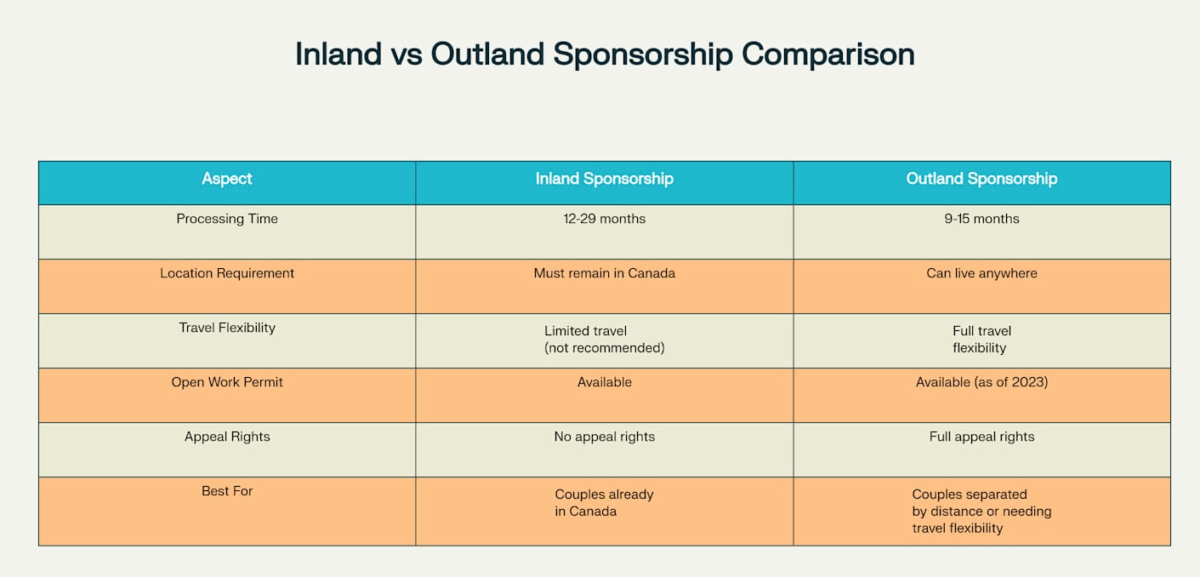

Inland vs Outland Sponsorship: Key Differences Comparison
The fundamental differences between these two options affect processing times, travel flexibility, work authorization, and appeal rights. Processing times for 2025 show outland applications taking 9-15 months compared to inland applications requiring 12-29 months. Travel flexibility represents another crucial distinction, with inland applicants advised against leaving Canada due to re-entry risks, while outland applicants can travel freely.
Work authorization differs significantly between the two pathways. Inland applicants can apply for an open work permit, allowing them to work for any Canadian employer while their application processes. Since 2023, outland applicants also gained access to open work permits, though this benefit was previously exclusive to inland applications.
Appeal rights provide another important consideration. Outland applicants enjoy full appeal rights through the Immigration Appeal Division if their application is refused, while inland applicants have no such recourse. This difference can be critical for couples whose applications face potential challenges.
How to Choose: Decision Framework

Decision Flowchart: Choosing Between Inland and Outland Sponsorship
The decision between inland and outland sponsorship depends on several key factors. Your partner’s current location serves as the primary consideration – if they’re outside Canada, outland is typically the only viable option. For couples already in Canada, the choice becomes more complex and depends on specific circumstances and priorities.
Travel needs during processing significantly influence the decision. If your partner needs to travel for work, family emergencies, or other commitments, outland sponsorship provides essential flexibility. Inland applicants risk application abandonment if denied re-entry to Canada.
Work authorization priorities also matter. If immediate work authorization is crucial for financial stability, inland sponsorship may be preferable, though outland applicants can now also access work permits. Processing speed increasingly favors outland applications, making this option attractive for couples prioritizing faster reunification.
Application Process Overview
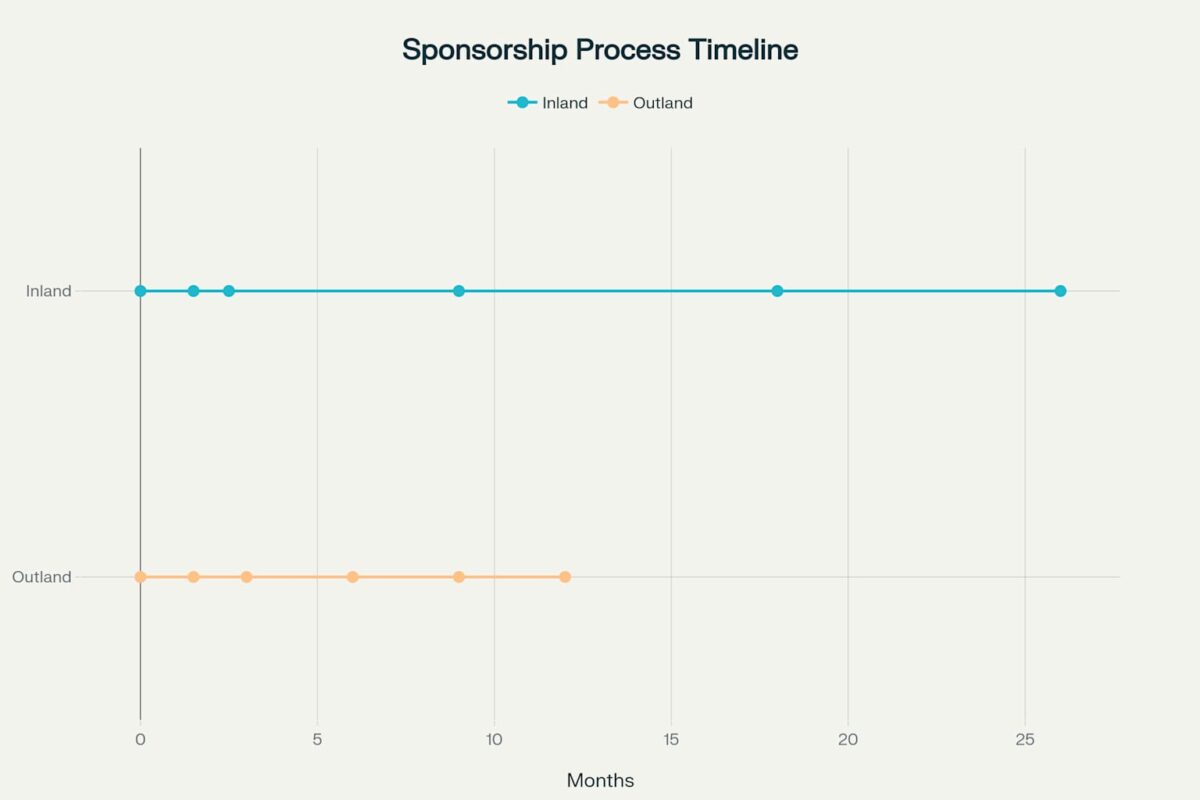
Processing Timeline: Inland vs Outland Sponsorship Applications
Both pathways require identical core documentation including application forms, identity documents, relationship proof, medical examinations, and police certificates. The sponsored person must undergo medical examinations with IRCC-approved physicians and obtain police certificates from every country where they’ve lived for six months or more after age 18.

Flowchart illustrating the ‘Inside Canada Process’ for spousal sponsorship, detailing the steps from application to citizenship and associated timelines
The inland process begins with application submission to Immigration, Refugees and Citizenship Canada (IRCC), followed by acknowledgment of receipt within 1-2 months. Open work permit applications can be submitted simultaneously, typically approved within 2-3 months. The application then proceeds through medical examinations, background checks, and detailed processing before final approval.
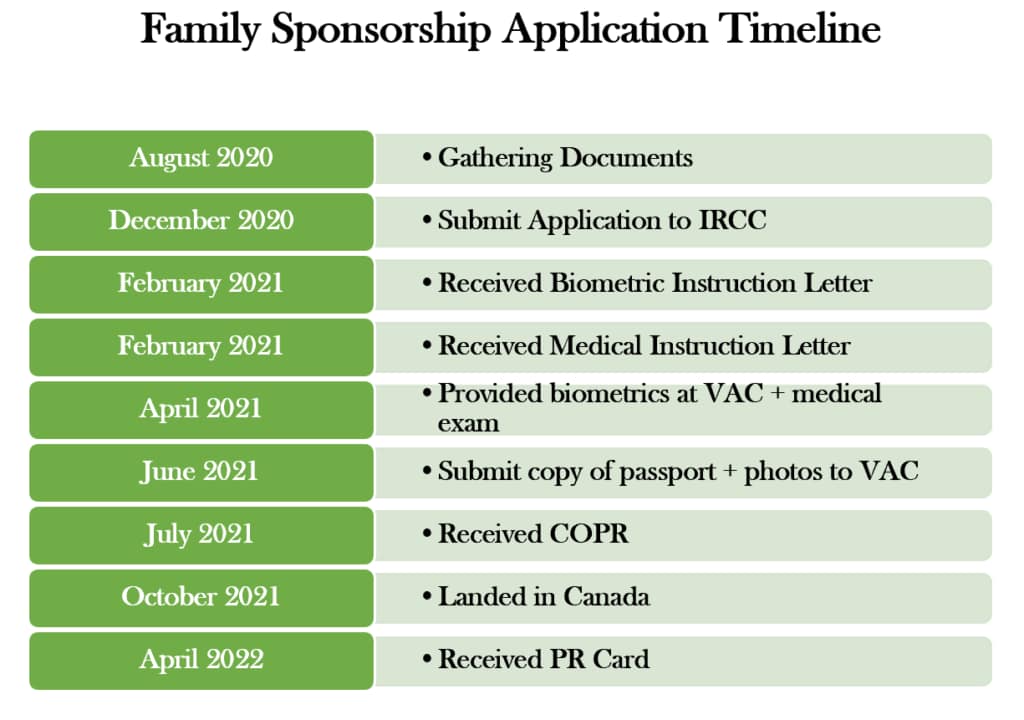
A detailed timeline illustrating the key stages and duration of a Canadian family sponsorship application process
Outland processing follows a similar initial timeline but includes file transfer to the appropriate visa office, typically occurring 2-4 months after submission. The overseas office then conducts medical examinations, background checks, and makes the final decision. Upon approval, the sponsored person receives a Confirmation of Permanent Residence (COPR) document.
Cost Breakdown
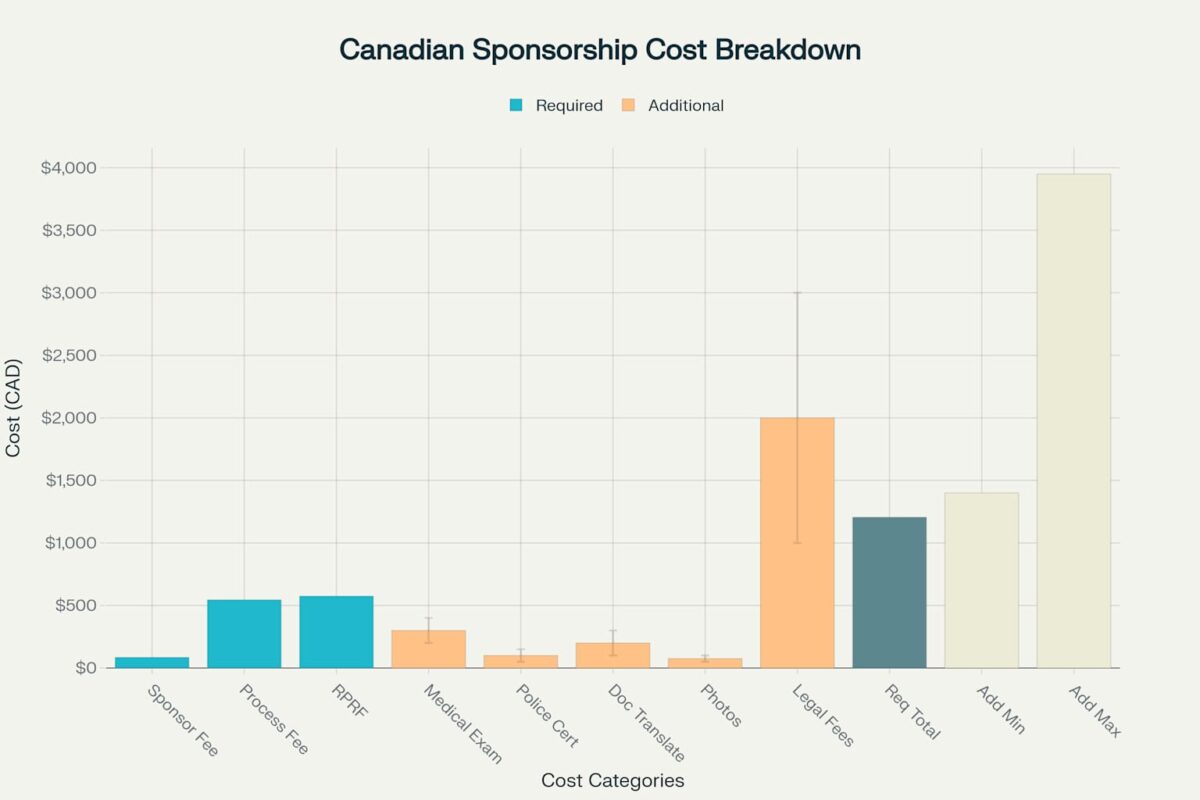
Cost Breakdown: Canadian Spousal Sponsorship Application Fees
The financial requirements are identical for both pathways. Government fees total $1,205 CAD, including the $85 sponsorship fee, $545 principal applicant processing fee, and $575 right of permanent residence fee. Additional costs vary but typically include medical examinations ($200-400), police certificates ($50-150), document translation ($100-300), and professional assistance if desired ($1,000-3,000).
Requirements and Documentation

A generic application form for Canada (IMM 0008) from Immigration, Refugees and Citizenship Canada
Both inland and outland applications require identical core forms: IMM 1344 (Application to Sponsor), IMM 5532 (Relationship Information), IMM 0008 (Generic Application Form), IMM 5406 (Additional Family Information), and IMM 5669 (Schedule A – Background/Declaration). Supporting documentation includes marriage certificates, birth certificates, passports, and extensive relationship proof.
Relationship evidence remains crucial for both pathways. Immigration officers require substantial proof of genuine relationships, including photographs, joint financial accounts, communication records, and letters from family and friends. Common-law couples must provide additional evidence of cohabitation for at least 12 months.
Spousal Sponsorship Application Checklist
Pre-Application Assessment
✅ Sponsor Eligibility Check
- At least 18 years old
- Canadian citizen or permanent resident
- Not receiving social assistance (except disability)
- Not in prison, bankrupt, or under removal order
- Have not been sponsored as spouse in last 5 years
- No outstanding sponsorship obligations
✅ Sponsored Person Eligibility
- At least 16 years old (18 for conjugal partners)
- Valid relationship (married, common-law, or conjugal)
- Not closely related by blood to sponsor
- Passes medical, criminal, and background checks
Application Forms Checklist
✅ Required Forms (Both Inland & Outland)
- IMM 1344 – Application to Sponsor
- IMM 5532 – Relationship Information and Sponsorship Evaluation
- IMM 0008 – Generic Application Form for Canada
- IMM 5406 – Additional Family Information
- IMM 5669 – Schedule A – Background/Declaration
✅ Additional Forms (If Applicable)
- IMM 5604 – Declaration from Non-Accompanying Parent/Guardian
- IMM 5476 – Use of a Representative (if using consultant/lawyer)
Supporting Documents
✅ Identity and Civil Status Documents
- Current passport (principal applicant and dependents)
- Birth certificates (all persons)
- Marriage certificate (if married)
- Divorce decree/death certificate (if previously married)
- Adoption papers (if applicable)
✅ Sponsor’s Documents
- Proof of Canadian citizenship or permanent residence
- Government-issued photo ID
- Recent tax returns (Notice of Assessment)
- Employment letter or proof of income
- Bank statements (last 3 months)
✅ Relationship Proof
- Maximum 20 photographs at different times/places
- Joint bank account statements
- Joint lease agreements or property ownership
- Joint utility bills or insurance policies
- Communication evidence (emails, texts, call logs)
- Travel documents showing trips together
- Letters from family/friends confirming relationship
- Wedding photos and documentation (if married)
✅ Police Certificates
- From every country lived in 6+ months since age 18
- Certificates must be less than 6 months old
- Include all family members over 18
✅ Medical Examination
- Complete medical exam with IRCC-approved physician
- Medical forms submitted directly by doctor
- All family members must complete medical
✅ Photographs
- Permanent residence photos for all applicants
- Meet IRCC photo specifications
- Name and date of birth on back
- Photography studio info on back
Financial Requirements
✅ Fees Payment
- Sponsorship fee: $85 CAD
- Principal applicant processing fee: $545 CAD
- Right of permanent residence fee: $575 CAD
- Dependent child fees: $175 CAD each (if applicable)
- Total: $1,205 CAD (for spouse without children)
✅ Additional Costs (Estimate)
- Medical examination: $200-400 CAD
- Police certificates: $50-150 CAD
- Document translation: $100-300 CAD
- Photos and photocopying: $50-100 CAD
- Legal/consultant fees: $1,000-3,000 CAD (optional)
Specific Considerations
✅ For Inland Applications
- Sponsored person has valid status in Canada
- Plan to remain in Canada during processing
- Consider applying for open work permit
- Understand no appeal rights if refused
✅ For Outland Applications
- Choose correct visa office for processing
- Understand travel flexibility during processing
- Know that appeal rights are available
- Consider faster processing times
Application Quality Checklist
✅ Before Submission
- All forms completed and signed
- All supporting documents included
- Documents translated if not in English/French
- Photos properly labeled
- Fees paid and receipt included
- Application organized with cover letter
- Photocopies clear and legible
- Double-check all information for accuracy
✅ After Submission
- Keep copies of entire application
- Monitor IRCC processing times
- Respond promptly to any requests
- Update address if you move
- Maintain valid status in Canada (if applicable)
Red Flags to Avoid
✅ Common Mistakes
- Incomplete or unsigned forms
- Missing supporting documents
- Insufficient relationship proof
- Expired police certificates
- Poor quality photocopies
- Inconsistent information across forms
- Missing translations
- Not declaring family members
Timeline Expectations
✅ Processing Times (2025)
- Inland Applications: 12-29 months
- Outland Applications: 9-15 months
✅ Key Milestones
- AOR (Acknowledgment of Receipt): 1-2 months
- Medical/Police requests: 2-6 months
- Decision: Within processing time estimate
- Landing/COPR: Final step
💡 Pro Tips:
- Start gathering documents early
- Keep everything organized
- Consider professional help for complex cases
- Be patient with processing times
- Maintain legal status throughout process
📞 Need Help?
- Immigration lawyer consultation recommended for complex cases
- IRCC Call Centre: 1-888-242-2100
- Online processing times: canada.ca
Special Considerations
Travel Restrictions for Inland Applications
Inland applicants face significant travel restrictions throughout processing. While not explicitly prohibited from leaving Canada, prolonged absences or re-entry difficulties can result in application abandonment. Border officers maintain discretion in allowing re-entry, and temporary resident status must remain valid throughout processing.
Conjugal Partner Requirements
Conjugal partner sponsorship requires demonstrating significant barriers preventing marriage or cohabitation. These barriers must be legal, cultural, religious, or social rather than merely financial or employment-related. Documentation must prove the committed relationship’s duration and the genuine obstacles preventing formal marriage or cohabitation.
Appeal Rights and Refusal Consequences
Outland applications offer comprehensive appeal rights through the Immigration Appeal Division. Sponsors can appeal within 30 days of refusal, potentially accessing Alternative Dispute Resolution or formal hearings. Inland applications provide no such recourse, making thorough preparation essential.
Processing Times and Expectations
Current processing times for 2025 significantly favor outland applications. Inland applications require 12-29 months while outland applications process within 9-15 months. These timeframes represent averages, with individual cases varying based on completeness, complexity, and country-specific factors.
Several factors influence processing speeds. Complete applications with thorough documentation process faster than incomplete submissions. Background check complexity, medical examination scheduling, and visa office workloads all affect timelines. Maintaining valid status and responding promptly to requests helps avoid delays.
Making Your Decision
The choice between inland and outland sponsorship ultimately depends on your specific circumstances and priorities. Couples already living together in Canada often prefer inland sponsorship for its stability and work permit benefits. Those requiring travel flexibility or seeking faster processing typically choose outland sponsorship.
Consider your risk tolerance regarding potential refusals. If appeal rights are important, outland sponsorship provides this protection. For couples prioritizing immediate work authorization and remaining together throughout processing, inland sponsorship may be preferable despite longer processing times.
Success Tips and Best Practices
Successful applications require meticulous preparation regardless of chosen pathway. Organize documentation systematically, ensuring all forms are complete and signed. Provide comprehensive relationship evidence spanning the relationship’s duration. Maintain valid status throughout processing and respond promptly to any IRCC requests.
Consider professional assistance for complex cases. Immigration lawyers or consultants can help navigate challenges, ensure complete applications, and provide ongoing support throughout processing. While not mandatory, professional guidance can significantly improve success rates for complicated situations.
Conclusion
Both inland and outland sponsorship offer viable paths to Canadian permanent residence, each with distinct advantages and limitations. Outland sponsorship generally provides faster processing, travel flexibility, and appeal rights, making it suitable for most couples. Inland sponsorship offers stability for couples already in Canada and immediate work authorization, though with longer processing times and travel restrictions.
Carefully evaluate your specific circumstances, priorities, and risk tolerance when making this important decision. Consider factors such as current location, travel needs, work requirements, and processing time preferences. Regardless of your choice, thorough preparation and complete documentation remain essential for successful applications.
Remember that immigration laws and processing times change regularly. Stay informed about current requirements and timelines throughout your application process. With proper preparation and realistic expectations, both pathways can successfully reunite couples in Canada.
Related reading: How to Sponsor Your Spouse: Complete Spousal Sponsorship — a closer look at this topic.