
From Study to PR: All Pathways for International Students
Transitioning from an international student to a permanent resident is one of the most sought-after journeys for millions of students worldwide . With the right strategy, proper planning, and understanding of available pathways, your dream of calling your study destination home can become reality .
This comprehensive guide covers everything you need to know about navigating the complex but rewarding path from student visa to permanent residence across major destination countries.
The statistics are encouraging: in Canada alone, 97.5% of international graduates who applied for permanent residency in 2021 were successful, compared to 91.5% for other applicants .
Three out of ten international students who arrived in Canada after 2000 successfully transitioned from student to permanent resident within 10 years . These numbers demonstrate that with proper preparation and understanding of the process, your chances of success are remarkably high.
Understanding Your Pathway Options
Canada: The Most Student-Friendly Destination
Canada offers multiple pathways for international students, making it one of the most accessible countries for student-to-PR transitions . The Canadian government has designed its immigration system to retain international graduates, recognizing their valuable contribution to the economy and society .
Key Canadian Pathways:
- Express Entry (Canadian Experience Class): Requires 12 months of Canadian work experience and offers processing in 3-6 months
- Provincial Nominee Programs (PNP): Each province has streams specifically for international graduates
- Post-Graduation Work Permit (PGWP): Essential bridge allowing 8 months to 3 years of work authorization
Recent Changes: As of November 1, 2024, new PGWP applicants must demonstrate CLB 5 language proficiency and study in priority fields (agriculture, education, healthcare, STEM, trades, or transport) .
Australia: Skills-Based Immigration
Australia’s pathway system focuses heavily on skilled occupations and points-based assessment . The Temporary Graduate Visa (Subclass 485) serves as the crucial stepping stone, providing 2-4 years of work rights after graduation .
Main Australian Pathways:
- General Skilled Migration: Points-based system requiring skills assessment and English proficiency
- Employer Nomination Scheme: Direct employer sponsorship for permanent residence
- State and Territory Nominations: Additional points through regional sponsorship
United States: Employment-Focused Routes
The US system requires strategic planning due to limited pathways and high competition . Optional Practical Training (OPT) provides the initial work authorization, which can be extended to 36 months for STEM graduates .
US Pathway Options:
- H-1B to Green Card: Most common route requiring employer sponsorship
- EB-1/EB-2 Employment-Based: For exceptional ability or advanced degree holders
- Family Sponsorship: Through marriage to US citizen or permanent resident
United Kingdom: Graduate Route to Skilled Worker
The UK reintroduced the Graduate Route in 2021, allowing 2 years (3 years for PhD graduates) to find skilled employment . The pathway requires transitioning to a Skilled Worker visa and accumulating 5 years of continuous residence for Indefinite Leave to Remain .
New Zealand: Skills in Demand
New Zealand’s system prioritizes occupations on the Green List and regional development . The Post-Study Work Visa provides up to 3 years, after which graduates can apply through the Skilled Migrant Category .
Germany: EU Blue Card Opportunity
Germany offers an 18-month post-study work visa for job searching, with pathways to EU Blue Card for skilled professionals . The system emphasizes German language proficiency and local degree recognition .
Step-by-Step Process: Your Journey Timeline
The journey from international student to permanent resident typically spans 4-8 years and involves seven distinct phases.
Understanding each phase helps you plan effectively and avoid common pitfalls that could derail your immigration goals.
Phase 1: Pre-Study Planning (6-12 months)
Research is crucial during this phase, as your choice of country, institution, and program significantly impacts your PR prospects . You must verify that your chosen program is eligible for post-study work permits and that your intended occupation appears on skilled worker lists .
Phase 2: Student Visa Application (2-6 months)
This phase involves substantial documentation and financial preparation . Most countries require proof of funds, health insurance, and academic credentials . Biometrics collection is now standard for most destinations .
Phase 3: Study Period (1-4 years)
Maintaining full-time status is critical, as violations can jeopardize future immigration applications . Many students underestimate the importance of networking and gaining relevant work experience during this phase .
Phase 4: Post-Graduation Work Permit (1-6 months)
The 180-day application deadline is non-negotiable in most countries . New language requirements and field-of-study restrictions have made this phase more complex since 2024 .
Phase 5: Work Experience (12+ months)
This phase requires strategic career planning to ensure your employment qualifies for skilled worker categories . Only work in specific National Occupational Classification (NOC) levels counts toward permanent residence eligibility .
Phase 6: Permanent Residence Application (6-24 months)
Success depends on meeting comprehensive eligibility criteria including language proficiency, work experience, education credentials, and health requirements . Medical examinations and police clearances must be current when submitted .
Phase 7: Final Approval and Settlement
Upon approval, you receive permanent resident status with specific obligations and rights . The pathway to citizenship typically opens after 3-5 years of permanent residence .
Financial Planning: Understanding the True Costs
Financial preparation extends far beyond tuition fees, as immigration-related costs can be substantial and vary significantly by destination . Understanding these costs upfront helps you budget effectively and avoid financial surprises that could derail your plans.
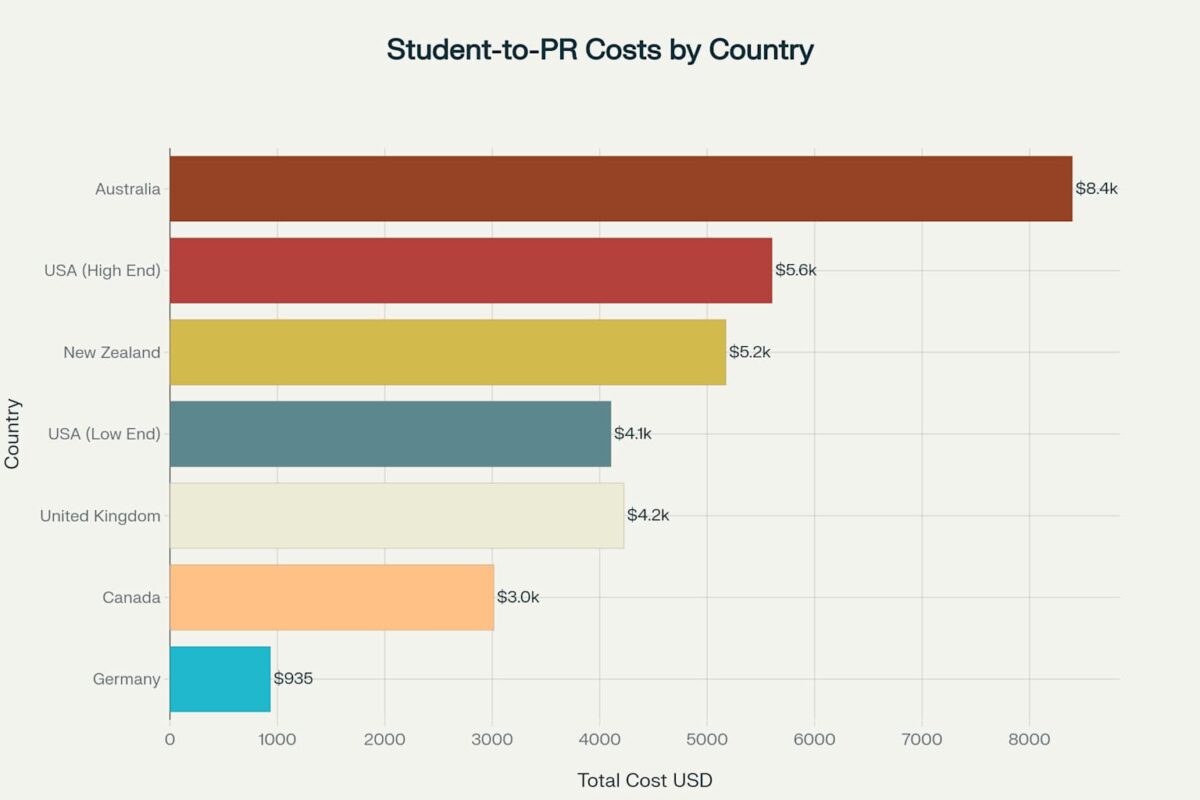

Total estimated costs for student-to-PR pathway by country (USD)
The cost differences between countries are striking, with Germany offering the most affordable pathway at approximately $935 total, while Australia requires the highest investment at around $8,400.
| Country | Student Visa | Post-Study Work Visa | Language Test | Credential Assessment | Medical Exam | Biometrics | PR Application | Total Estimate |
|---|---|---|---|---|---|---|---|---|
| Canada | $150 | $255 | $400 | $300 | $300 | $85 | $1,525 | $3,015 |
| Australia | $620 | $1,680 | $400 | $500 | $400 | $160 | $4,640 | $8,400 |
| United States | $510 | $410 | $300 | $300 | $500 | $85 | $1,500-3,000 | $4,105-5,605 |
| United Kingdom | $490 | $700 | $350 | $300 | $300 | $85 | $2,000 | $4,225 |
| New Zealand | $430 | $495 | $400 | $400 | $350 | $100 | $3,000 | $5,175 |
| Germany | $75 | $100 | $200 | $200 | $250 | $0 | $110 | $935 |
These figures include all major fees from student visa application through permanent residence approval, but don’t account for living expenses, tuition, or potential legal consultation fees .
Hidden Costs to Consider:
- Language test retakes if scores don’t meet requirements
- Educational credential assessments for degree recognition
- Multiple medical examinations throughout the process
- Translation and notarization of foreign documents
- Professional consultation fees ranging from $1,500-10,000
Processing Times: Managing Your Expectations
Understanding realistic processing timeframes helps you plan your transition effectively and manage expectations throughout the journey . Processing times vary significantly based on country, pathway, and current application volumes.
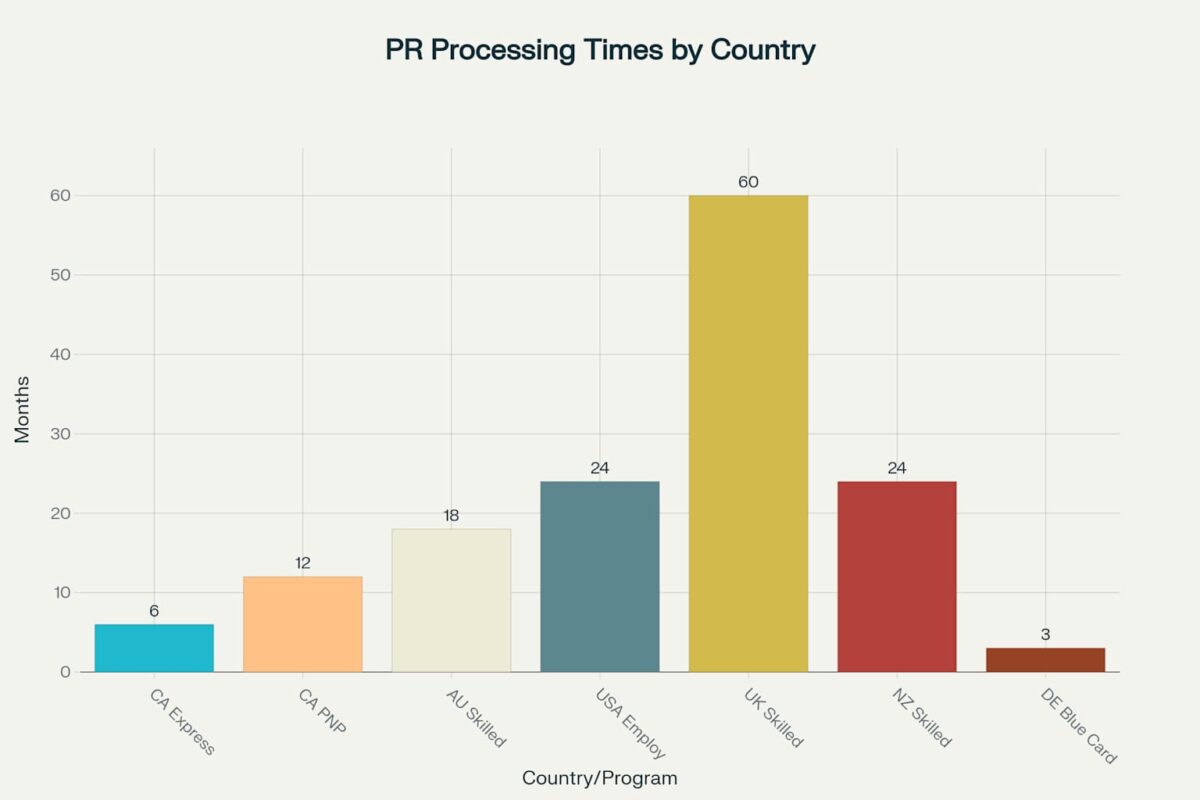
Processing times for permanent residence applications by country and program
Canada’s Express Entry system offers the fastest processing at 6 months, while the UK’s route to Indefinite Leave to Remain requires a full 5-year commitment . These timeframes don’t include the preliminary steps of gaining work experience and meeting eligibility requirements .
Factors Affecting Processing Times:
- Application completeness and accuracy
- Current immigration policy changes
- Medical examination and background check delays
- Country-specific quotas and annual limits
- Economic conditions affecting labor market assessments
Essential Documents: Your Immigration Paper Trail
Successful permanent residence applications require meticulous documentation spanning your entire academic and professional journey . Missing or expired documents are among the most common reasons for application delays or refusals .
| Document Type | Specific Document | Required For | Validity Period |
|---|---|---|---|
| Identity Documents | Valid passport (6+ months validity) | All applications | Must be valid throughout process |
| Identity Documents | Birth certificate | Family sponsorship/dependent children | No expiry |
| Identity Documents | National ID card | Some countries | Check country requirements |
| Education Documents | Official transcripts | All education-based applications | No expiry |
| Education Documents | Degree/diploma certificates | All education-based applications | No expiry |
| Education Documents | Educational Credential Assessment (ECA) | Federal skilled worker programs | 5 years from issue date |
| Language Proficiency | IELTS/CELPIP results (within 2 years) | Most permanent residence applications | 2 years from test date |
| Language Proficiency | TEF/TCF results for French (if applicable) | Quebec and francophone programs | 2 years from test date |
| Work Experience | Employment reference letters | Canadian Experience Class and skilled worker | No specific expiry |
| Work Experience | Job offer letter (if applicable) | Many provincial nominee programs | Varies by program |
| Work Experience | Work permits and contracts | Work experience verification | No specific expiry |
| Financial Documents | Bank statements (3-6 months) | Proof of settlement funds | Recent (within 6 months) |
| Financial Documents | Proof of funds | Financial self-sufficiency | Current balance requirements |
| Medical & Background | Medical examination results | Health and safety screening | 12 months from examination |
| Medical & Background | Police clearance certificates | Background verification | 12 months from issue date |
| Medical & Background | Biometrics (fingerprints and photo) | Identity verification and security | 10 years from collection |
Document validity periods are crucial to understand, as expired items can invalidate your entire application . Language test results expire after two years, medical examinations after 12 months, and police clearances after 12 months . Planning document collection and updates around these timeframes prevents costly delays.
Critical Document Management Tips:
- Start collecting documents early in your studies
- Keep both original and certified copies of all documents
- Track expiry dates and plan renewals strategically
- Ensure translations are completed by certified translators
- Store documents securely both physically and digitally
📝 Complete Checklist: From Study to Permanent Residence
Successful navigation of the student-to-PR pathway requires systematic planning and execution across multiple phases . This comprehensive checklist ensures you don’t miss critical steps that could jeopardize your immigration goals.
🎯 Phase 1: Pre-Study Planning (6-12 months before)
Research & Strategy
- Research target countries and their immigration policies
- Compare pathways: Express Entry, PNP, Skilled Migration, etc.
- Check skilled occupation lists for your field
- Assess language requirements (IELTS, CELPIP, etc.)
- Calculate total estimated costs
- Research education institutions and PGWP eligibility
Document Preparation
- Obtain/renew passport (ensure 6+ months validity)
- Gather academic transcripts and certificates
- Get Educational Credential Assessment (ECA) if required
- Take language proficiency tests
- Prepare financial documents and proof of funds
- Organize work experience letters (if applicable)
🎓 Phase 2: Student Visa Application (2-6 months)
Application Submission
- Choose eligible program at Designated Learning Institution
- Submit student visa application with all documents
- Pay application fees
- Schedule and attend biometrics appointment
- Arrange health insurance coverage
- Wait for visa approval
Pre-Departure
- Book flights and accommodation
- Register with educational institution
- Understand work limitations during studies
- Open local bank account (if possible)
📚 Phase 3: During Studies (1-4 years)
Academic Requirements
- Maintain full-time student status every semester
- Achieve good academic standing
- Complete all required courses
- Keep all academic records updated
Career Preparation
- Network with professionals in your field
- Gain relevant work experience (within allowed limits)
- Research job market and employer requirements
- Update CV/resume to local standards
- Join professional associations
Immigration Prep
- Stay updated on immigration policy changes
- Keep passport valid throughout studies
- Maintain health insurance coverage
- Document all achievements and experiences
🎯 Phase 4: Post-Graduation (1-6 months)
Work Permit Application
- Apply for Post-Graduation Work Permit within 180 days
- Submit language test results (CLB 5+ for new applicants)
- Obtain official graduation documents
- Receive work authorization
- Apply for Social Insurance Number (if applicable)
Job Search
- Start job hunting in final semester
- Target positions in eligible occupations (NOC TEER 0,1,2,3)
- Prepare for interviews
- Negotiate job offers
- Secure employment
💼 Phase 5: Work Experience (12+ months)
Employment Requirements
- Work continuously in skilled occupation
- Maintain legal status throughout employment
- Keep detailed employment records
- Obtain reference letters from employers
- Document job duties and responsibilities
Skill Development
- Gain Canadian/local work experience
- Improve language skills if needed
- Complete professional certifications
- Build professional network
- Consider additional training
🏠 Phase 6: Permanent Residence Application (6-24 months)
Eligibility Assessment
- Confirm occupation is on skilled lists
- Meet minimum work experience requirements
- Achieve required language test scores
- Calculate Comprehensive Ranking System (CRS) score
- Meet settlement funds requirements
Application Preparation
- Gather all required documents
- Complete medical examinations
- Obtain police clearance certificates
- Submit Expression of Interest (if required)
- Prepare for potential interview
Submission
- Submit complete application with fees
- Respond to any requests for additional information
- Update address and contact information
- Track application status regularly
✅ Phase 7: Final Steps
Upon Approval
- Receive Confirmation of Permanent Residence
- Complete landing procedures (if applicable)
- Apply for permanent resident card
- Update health insurance and benefits
- Register for taxes and social services
Long-term Planning
- Understand residency obligations
- Plan for citizenship application (3-5 years)
- Consider family sponsorship opportunities
- Continue professional development
🚨 Important Reminders
Critical Deadlines
- Apply for PGWP within 180 days of graduation
- Language test results valid for 2 years
- Medical exams valid for 12 months
- Police certificates valid for 12 months
- Biometrics valid for 10 years
Common Mistakes to Avoid
- Not researching program PGWP eligibility
- Missing application deadlines
- Inadequate financial planning
- Not maintaining legal status
- Insufficient work experience documentation
- Outdated language test results
- Incomplete application submissions
Emergency Contacts
- Immigration lawyer/consultant details
- Embassy/consulate information
- Educational institution international office
- Immigration department helpline
- Professional association contacts
💡 Pro Tip: Save this checklist and review it regularly throughout your journey. Immigration requirements can change, so always verify current information on official government websites.
📅 Last Updated: June 2025
🔗 Sources: Government of Canada, Australian Department of Home Affairs, USCIS, UK Gov, Immigration New Zealand
Occupation-Specific Considerations
Your field of study significantly impacts your permanent residence prospects, as most countries maintain skilled occupation lists that determine eligibility . These lists change regularly based on labor market needs and economic conditions, making ongoing research essential .
High-Demand Occupations Generally Include:
- Healthcare professionals (nurses, doctors, therapists)
- Information technology specialists
- Engineers across various disciplines
- Skilled trades workers
- Educational professionals
The Australian skilled occupation list shows registered nurses receiving the highest number of invitations, followed by secondary school teachers and software programmers . Understanding your occupation’s prospects helps inform both your study choices and career planning during the student phase.
Language Requirements: Your Key to Success
Language proficiency serves as the foundation for both academic success and immigration eligibility . Most countries have specific minimum requirements, with higher scores significantly improving your chances of selection .
Current Language Requirements by Country:
- Canada: CLB 7 for professional occupations, CLB 5 for technical roles
- Australia: IELTS 6.0+ for most skilled migration programs
- United States: English proficiency required but standards vary by program
- United Kingdom: IELTS 6.0+ for Skilled Worker visa
- New Zealand: IELTS 6.5+ for most residence categories
Test results remain valid for two years, requiring strategic timing of examinations . Many successful applicants exceed minimum requirements, as higher language scores provide significant advantages in competitive selection processes .
Common Mistakes and How to Avoid Them
Learning from others’ mistakes can save you time, money, and potential application failures . Immigration applications are complex, and seemingly minor oversights can have major consequences for your permanent residence prospects.
Critical Mistakes to Avoid:
- Choosing Ineligible Programs: Not all study programs qualify for post-graduation work permits
- Missing Application Deadlines: The 180-day PGWP deadline is absolute
- Inadequate Financial Planning: Underestimating total costs leads to financial stress
- Poor Work Experience Documentation: Insufficient employment records harm PR applications
- Ignoring Policy Changes: Immigration rules change frequently and retroactively
- Insufficient Language Preparation: Low test scores limit pathway options
- Incomplete Applications: Missing documents cause processing delays
Success Tips from Immigration Experts
Maximizing your chances of success requires understanding both the technical requirements and strategic considerations that immigration officers evaluate . Successful applicants typically demonstrate clear intention to integrate into their destination country through consistent actions and decisions.
Proven Success Strategies:
- Start Early: Begin immigration planning before starting your studies
- Choose Strategically: Select programs and institutions that maximize PR prospects
- Document Everything: Maintain detailed records of all activities and achievements
- Network Professionally: Build connections that can lead to employment opportunities
- Stay Informed: Monitor policy changes and adapt your strategy accordingly
- Seek Professional Guidance: Consider consultation for complex cases
- Maintain Legal Status: Never let visas expire or violate work restrictions
Regional and Provincial Opportunities
Many countries offer enhanced immigration opportunities through regional programs designed to address local labor shortages and demographic needs . These programs often provide faster processing, lower requirements, or additional points toward permanent residence .
Notable Regional Programs:
- Canada: Each province operates nominee programs with streams for international graduates
- Australia: Regional nominations provide additional points and pathways
- United Kingdom: Scotland and Wales offer specific graduate retention schemes
- New Zealand: Regional skill shortage lists offer priority processing
Regional programs often require commitment to live and work in specific areas for defined periods . While this may seem restrictive, these programs frequently offer the most accessible pathways to permanent residence for international students.
Future Outlook and Emerging Trends
Immigration policies continue evolving to address labor market needs, demographic changes, and economic priorities . Recent trends indicate increasing emphasis on language proficiency, in-demand skills, and regional distribution of immigrants .
Key Trends Affecting International Students:
- Increased Language Requirements: Higher proficiency standards across multiple countries
- Field-of-Study Restrictions: Limiting post-study work permits to priority occupations
- Regional Emphasis: Incentivizing settlement outside major metropolitan areas
- Skills-Based Selection: Greater focus on specific technical competencies
- Digital Processing: Streamlined online applications and tracking systems
Staying informed about these trends helps you adapt your strategy and maintain competitive positioning throughout your journey . Immigration systems will likely become more selective while remaining accessible to well-prepared international graduates.
Conclusion: Your Pathway to Permanent Residence
The journey from international student to permanent resident requires dedication, strategic planning, and persistence, but the rewards of building a new life in your chosen country make the effort worthwhile . With proper preparation and understanding of available pathways, your chances of success are excellent, particularly given the high approval rates for international graduates across major destination countries .
Success depends on early planning, strategic decision-making, and meticulous attention to detail throughout each phase of the process . The investment of time and resources is significant, but the long-term benefits of permanent residence—including work flexibility, social benefits, and eventual citizenship opportunities—provide substantial returns on your investment .
Remember that immigration policies change regularly, and staying informed through official government sources is essential for maintaining your competitive edge . Consider professional consultation for complex situations, and don’t hesitate to seek support from educational institutions and immigrant services organizations throughout your journey .
Your dream of permanent residence is achievable with the right knowledge, preparation, and persistence . Use this guide as your roadmap, but remember that each person’s journey is unique, and flexibility in your approach will serve you well as you navigate this life-changing process.
Related reading: BREAKING: Major IRCC Changes — a closer look at this topic.