
B.C. Pay Reporting Reaches 8,500 Employers in November 2026

Beginning in November 2026, B.C. employers with 50 or more employees must prepare and post annual pay transparency reports, a requirement expected to reach about 8,500 employers. For employers, the new threshold is one of the 10 British Columbia laws changes in November to know: reports are due by November 1 each year. If you employ staff in B.C., prepare a report and post it by the deadline.
Which B.C. pay-reporting rule starts in November 2026?
Quick answer: B.C. employers subject to the reporting requirement must post reports by November 1 each year.
- Who it applies to: B.C. employers with 50 or more employees, beginning in November 2026.
- What to do: Prepare and post an annual pay transparency report by November 1.
- Other dates: The Pay Transparency Act became law on May 11, 2023; the Minister of Finance must publish an annual report by June 1 based on the previous calendar year.
- Related figures: B.C.’s 2026 Quick Facts describe a $241-million investment for up to 5,000 trades training seats in 2026, across about 100 in-demand trades. The pay transparency page was last updated on August 18, 2026.
Who must report under the rule?
The reporting deadline is November 1 each year for employers required to report. This reporting requirement is one part of the Act: employers must also include expected pay or a pay range in all public job postings.
Pay transparency in B.C. explains the reporting requirement and other employer obligations.
B.C. employers with 50 or more employees must prepare and post annual pay transparency reports beginning in November 2026, a requirement expected to cover about 8,500 employers.
The earlier reporting requirement applied to approximately 700 B.C. employers with 300 or more employees, who had to prepare and post reports by November 2025.
About 64% met the requirement. Outreach and education continue to support employers in meeting their reporting obligations.
Key dates and amounts
The official figures show B.C.’s gender pay gap narrowed to 14.5% in 2025, while pay information appeared in 81% of B.C. Indeed job postings in March 2026.
| What | Figure or date | Applies to |
|---|---|---|
| Pay Transparency Act became law | May 11, 2023 | British Columbia |
| Annual employer reports due | November 1 each year | Employers above the applicable size threshold |
| Minister’s annual report due | June 1; based on the previous calendar year | Gender pay differences, trends and non-compliance reports |
| Gender pay gap | 18.4% in 2022; 14.5% in 2025 | Women and men in B.C.; women earned 85 cents per dollar in 2025 |
| Job postings with pay information | 81% in B.C.; 56% across Canada, March 2026 | Indeed postings |
| Retail trade pay gap | 9% in 2025 | Women; under-representation persisted in higher-paid middle management |
| Professional, scientific and technical services | Improved 5 percentage points; remained 18% | 2024 to 2025 |
| Sector pay-gap decreases | 10, 11 and 12 percentage points | Mining, quarrying, and oil and gas extraction; administrative and support, waste management and remediation services; agriculture, fishing and hunting, 2024 to 2025 |
| Women aged 55 and older | 83 cents per dollar in 2025; 78 cents in 2017 | Compared with men in the same age group |
| Racialized women | 74 cents per dollar in 2025; improved 2 percentage points from 2024 | Compared with non-racialized men |
| Recent newcomer women | 69 cents per dollar in 2025; gap worsened 4 percentage points | Women in Canada for 5 years or fewer, compared with Canadian-born men |
| Workforce sectors | Nearly 30% | Three sectors expected to contribute significantly to job growth over the next decade |
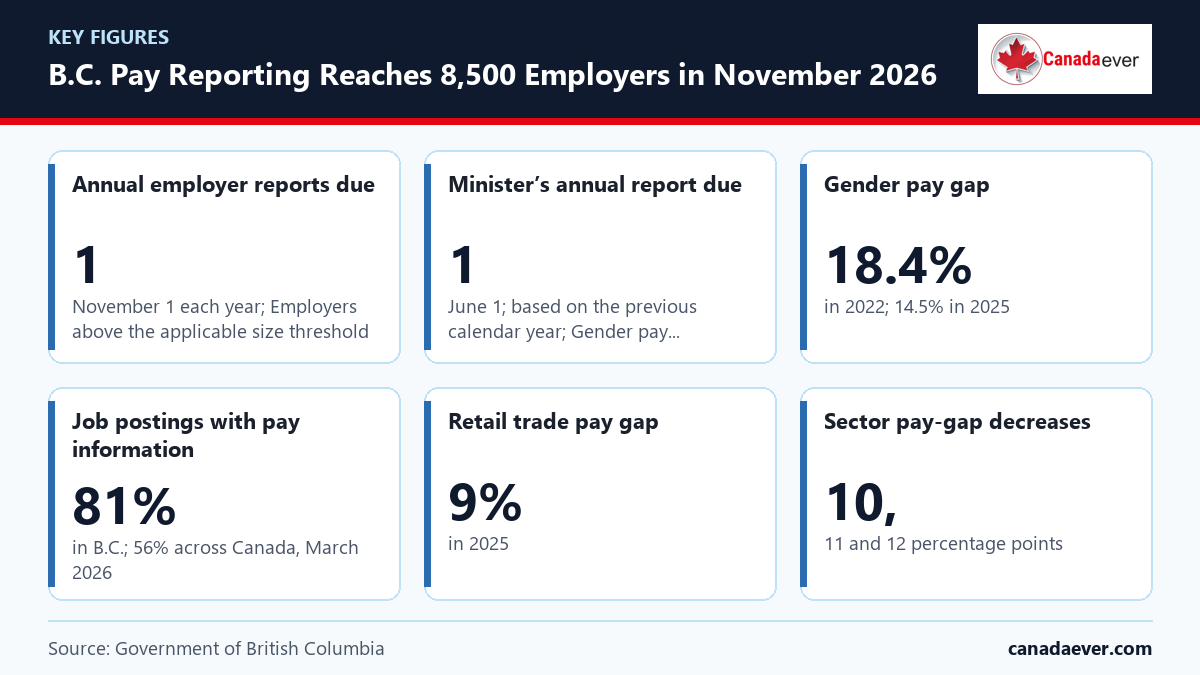
The figures point to uneven progress: some sector gaps narrowed, while the overall gap remained 14.5% in 2025. Pay information was more common in B.C. Indeed postings than across Canada in March 2026.
What should employers and workers do next?
What should employers and workers do next?
Employers need clear reporting steps, while workers may want to understand the pay protections that apply in B.C.
Read the reporting requirements. Employers can use the Pay transparency in B.C. page to review their obligations. Reports are due by November 1 each year for employers above the applicable size threshold.
Include pay in public job postings. Employers must state the expected pay or a pay range in every public job posting.
Don’t ask applicants about past pay. Employers cannot ask job applicants what previous employers paid them.
Respect employees’ pay discussions. Employers cannot dismiss, suspend, demote, discipline or harass employees for asking about or disclosing pay, or for asking about the employer’s pay transparency report.
Last checked: November 9, 2026. Rules and dates can change; confirm on Canada.ca.
Frequently Asked Questions
Can an employer ask what a job applicant earned before?
No. B.C. employers can’t ask applicants what previous employers paid them, though they may use pay-history information they already have about an employee when setting pay for a new position.
Can an employee be punished for asking about pay?
No. B.C. employers can’t dismiss, suspend, demote, discipline or harass an employee for asking about or sharing pay, or for asking about the employer’s pay transparency report.
What information must B.C. employers include in annual pay transparency reports?
Your annual report must include pay transparency information. The Minister of Finance must publish a separate annual report on gender pay differences, trends and the number of reports of non-compliance, based on the previous calendar year.
How is the 50-employee threshold calculated?
Beginning in November 2026, you must meet the reporting requirement if you employ 50 or more employees in B.C..
Related on CanadaEver:
- Canada immigration news: latest news and guides
- British Columbia Provincial Nominee Program: Complete Guide
- CRA tax changes
- Capital gains tax