COVID response extended low-wage work permits to 2 years

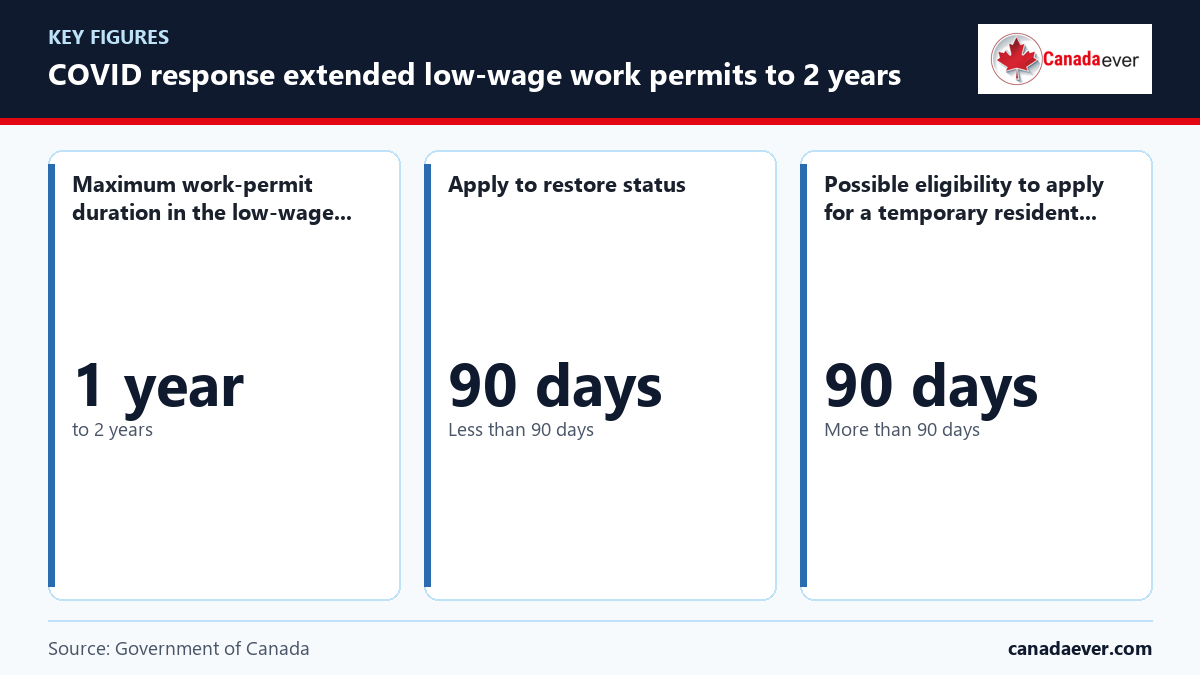
During the COVID-19 response, the maximum work-permit duration for employers hiring temporary foreign workers in the low-wage stream, including seafood-processing workers, increased from 1 year to 2 years. This meant temporary foreign workers could be employed longer under that stream, and eligible workers already in Canada could apply to extend their permits. If a permit had expired less than 90 days earlier, workers could apply to restore their status; after more than 90 days, they might be eligible to apply for a temporary resident permit.
Could temporary foreign workers be employed longer?
Quick answer: Yes. During the COVID-19 response, employers hiring workers in the low-wage stream could receive permits for up to 2 years, increased from 1 year. Seafood-processing workers were included. If you were already in Canada on a work permit, you could apply to extend it; if your permit had expired, your options depended on how long ago it expired.
- The longer maximum applied to the low-wage stream, including seafood-processing workers.
- If you were already in Canada and intended to keep working, you could apply to extend your permit if eligible.
- If your permit expired less than 90 days earlier, you could apply to restore your status; after more than 90 days, you might be eligible to apply for a temporary resident permit.
Who is affected and who is not
During the COVID-19 response, if you hired workers in the low-wage stream, including seafood-processing workers, your maximum work-permit duration increased from 1 year to 2 years.
Employers hiring temporary foreign workers in the low-wage stream, including seafood-processing workers, were affected by the longer permit option during the COVID-19 response.
If you were already in Canada on a work permit, you could apply to IRCC to extend it and remain as a temporary worker, or apply to stay as a visitor. If you planned to keep working, you might have been able to extend your permit if you were eligible. If your permit had expired less than 90 days earlier, you could apply to restore your status. If it had expired more than 90 days earlier, you might have been eligible for a temporary resident permit, which allowed you to remain in Canada with legal status.
The response also gave employers more time to hire: Labour Market Impact Assessments were valid for 9 months instead of 6 months for all employers. For agriculture and food-processing occupations, minimum recruitment requirements were removed for 6 months, until October 31, 2020, and priority processing was offered. Temporary foreign workers could travel to Canada starting March 23, 2020, if they met traveller screening measures, including a 14-day isolation period upon arrival for workers arriving from abroad.
Key dates and amounts
| Situation | Duration or time since expiry |
|---|---|
| Maximum work-permit duration in the low-wage stream | 1 year to 2 years |
| Apply to restore status | Less than 90 days |
| Possible eligibility to apply for a temporary resident permit | More than 90 days |
The latter permit allows the worker to remain in Canada with legal status.
If you’re already in Canada on a work permit, you could apply to IRCC to extend it and remain as a temporary worker, or apply to stay as a visitor. Workers who intended to keep working might be able to extend their work permits if eligible.
| Key fact | Source |
|---|---|
| The program allows you to hire temporary foreign workers for a maximum of 1 year. | Employment and Social Development Canada |
| Your LMIA application can be submitted up to 6 months before the expected job start date. | Employment and Social Development Canada |
| In 2019 (January-July), there were over 1,800 TFWs holding positions in the fish harvesting, aquaculture and seafood processing occupations (up from 65 in 2006, January-December) in Canada. | Government of Canada |
| • In 2019, fish and seafood related TFWs accounted for 1.4% of all TFWs in Canada. | Government of Canada |
| Over 99% of seafood workers worked in the processing sector, accounting for approximately 7% of total fish and seafood processing employment. | Government of Canada |
| Within the fish and seafood sector, most TFWs are employed in New Brunswick (51%), Prince Edward Island (25%), and Nova Scotia (13%). | Government of Canada |
What to do next
A temporary foreign worker in Canada who needs to keep working or address an expired permit has options to apply to IRCC.
- Apply to extend your work permit if you’re already in Canada and intend to continue working; you may be able to extend it if you’re eligible.
- Apply to stay as a visitor if you’re already in Canada on a work permit and want to remain in Canada without applying to continue working.
- Apply to restore your status if your work permit expired less than 90 days ago.
- Consider a temporary resident permit if your status expired more than 90 days ago; you might be eligible to apply, and the permit allows you to remain in Canada with legal status.
Frequently Asked Questions
Did the two-year maximum apply to every temporary foreign worker?
No, the two-year maximum applied to employers hiring workers in the low-wage stream. Seafood-processing workers were included, while the change described applies to that stream; workers in other streams aren’t identified as covered by this longer permit option.
Could a worker already in Canada apply to extend a work permit?
Yes, a temporary foreign worker already in Canada on a work permit could apply to IRCC to extend it and remain in Canada as a temporary worker. If the worker intended to continue working, they might be able to extend their permit if eligible.
What could a worker do if their work permit expired less than 90 days ago?
A worker whose permit expired less than 90 days ago could apply to restore their status.
Related on CanadaEver:
- Work permit: latest news and guides
- Temporary worker residency
- How to Change Employers on a Work Permit: Complete Process
- LMIA Process: Step-by-Step Guide for Employers and Workers
What does the official page say about On?
On May 12, 2020, Immigration, Refugees and Citizenship Canada (IRCC) announced a temporary public policy. Source: canada.ca
Sources
- canada.ca: Open Government Portal