LMIA Process: Step-by-Step Guide for Employers and Workers

The Labour Market Impact Assessment (LMIA) is Canada’s gateway for employers to hire foreign workers when Canadian citizens and permanent residents are not available to fill critical job positions. This comprehensive process ensures that hiring foreign talent will have a neutral or positive impact on Canada’s labour market while addressing genuine skill shortages across various industries.
Quick answer: A Labour Market Impact Assessment (LMIA) shows that no Canadians or permanent residents are available to do the job and that there is a need for a temporary foreign worker. IRCC says most employers need an LMIA before hiring a temporary foreign worker, but not if the worker already has an open work permit.
The Labour Market Impact Assessment (LMIA) is Canada’s gateway for employers to hire foreign workers when Canadian citizens and permanent residents are not available to fill critical job positions.
This comprehensive process ensures that hiring foreign talent will have a neutral or positive impact on Canada’s labour market while addressing genuine skill shortages across various industries.
Whether you’re an employer seeking to expand your workforce internationally or a foreign worker hoping to build your career in Canada, understanding the LMIA process is essential for success in 2025.
What is a Labour Market Impact Assessment (LMIA)?
An LMIA is an official document issued by Employment and Social Development Canada (ESDC) that grants employers permission to hire temporary foreign workers.
The assessment serves as proof that there is a genuine need for a foreign worker to fill a specific position and that no qualified Canadian worker or permanent resident is available to do the job. A positive LMIA demonstrates that hiring a foreign worker will not negatively impact job opportunities for Canadians.
The LMIA system operates under the Temporary Foreign Worker Program (TFWP) and plays a crucial role in Canada’s immigration ecosystem. Once an employer receives a positive LMIA, the foreign worker can use this document to apply for a work permit through Immigration, Refugees and Citizenship Canada (IRCC).
Key Updates for 2025
Starting January 1, 2025, new regulations have tightened LMIA requirements to prioritize sectors with unemployment rates below 6%, including healthcare, technology, and skilled trades. Employers must now provide enhanced documentation of local recruitment efforts and face increased compliance measures to ensure LMIAs are used appropriately.
Who Needs an LMIA?
LMIA Required Situations
Most Canadian employers who want to hire foreign workers under the Temporary Foreign Worker Program must obtain an LMIA. This requirement applies to:
- Employers hiring temporary foreign workers for positions lasting more than 6 months
- Businesses seeking to fill high-wage positions (at or above provincial median wages)
- Companies hiring for low-wage positions (below provincial median wages)
- Employers supporting foreign workers’ permanent residency applications
LMIA Exemptions
Not all foreign workers require an LMIA to work in Canada. Several categories are exempt from this requirement, allowing for faster work permit processing.
The exemptions cover workers under international trade agreements like NAFTA/CUSMA, intra-company transferees, and individuals providing significant benefit to Canada. Spouses of work or study permit holders, international students, and post-graduate work permit holders also don’t need an LMIA.
| Worker Category | LMIA Required | Work Permit Type | Key Requirements | Processing Time |
|---|---|---|---|---|
| International Trade Agreements (NAFTA/CUSMA) | No | Closed | NAFTA profession, Citizen of member country | 2-4 weeks |
| Intra-Company Transferees | No | Closed | Senior position, 1+ year with company abroad | 2-4 weeks |
| Significant Benefit Workers | No | Closed | Exceptional ability, Cultural/economic benefit | 2-4 weeks |
| Spouses of Work/Study Permit Holders | No | Open | Valid spouse work/study permit | 2-4 weeks |
| International Students (On-Campus) | No | Restricted | Full-time studies, On-campus only | Immediate |
| International Students (Off-Campus) | No | Open | Valid study permit, 20 hrs/week limit | 2-4 weeks |
| Post-Graduate Work Permit Holders | No | Open | Completed program, Valid PGWP | 2-4 weeks |
| Refugee Claimants | No | Open | Pending refugee claim | 2-4 weeks |
| Live-in Caregivers (Existing Program) | No | Closed | Existing caregiver in program | 2-4 weeks |
| Quebec Selected Workers | No | Closed | Quebec selection certificate | 4-6 weeks |
| Francophone Workers (Outside Quebec) | No | Open | French proficiency, Job offer outside Quebec | 2-4 weeks |
| Working Holiday Visa Holders | No | Open | Youth mobility agreement country | 2-4 weeks |
Understanding LMIA Streams and Types
As of November 8, 2024, the Canadian government has implemented a 20% increase in the minimum income threshold for various provinces and territories. These thresholds are often used to assess eligibility for immigration programs, including sponsorships and economic pathways.
The updated figures reflect adjustments to the cost of living and labor market conditions across the country.
| Province/Territory | Previous Threshold (Before Nov 8, 2024) | Current Threshold (As of Nov 8, 2024) | Increase |
|---|---|---|---|
| Alberta | $29.50 | $35.40 | 20% |
| British Columbia | $28.85 | $34.62 | 20% |
| Manitoba | $25.00 | $30.00 | 20% |
| New Brunswick | $24.04 | $28.85 | 20% |
| Newfoundland and Labrador | $26.00 | $31.20 | 20% |
| Northwest Territories | $39.24 | $47.09 | 20% |
| Nova Scotia | $24.00 | $28.80 | 20% |
| Nunavut | $35.00 | $42.00 | 20% |
| Ontario | $28.39 | $34.07 | 20% |
| Prince Edward Island | $24.00 | $28.80 | 20% |
| Quebec | $27.47 | $32.96 | 20% |
| Saskatchewan | $27.00 | $32.40 | 20% |
| Yukon | $36.00 | $43.20 | 20% |
High-Wage vs. Low-Wage Streams
The wage offered for a position determines whether employers must apply under the high-wage or low-wage stream. As of November 8, 2024, provincial wage thresholds increased by 20% across all provinces and territories.
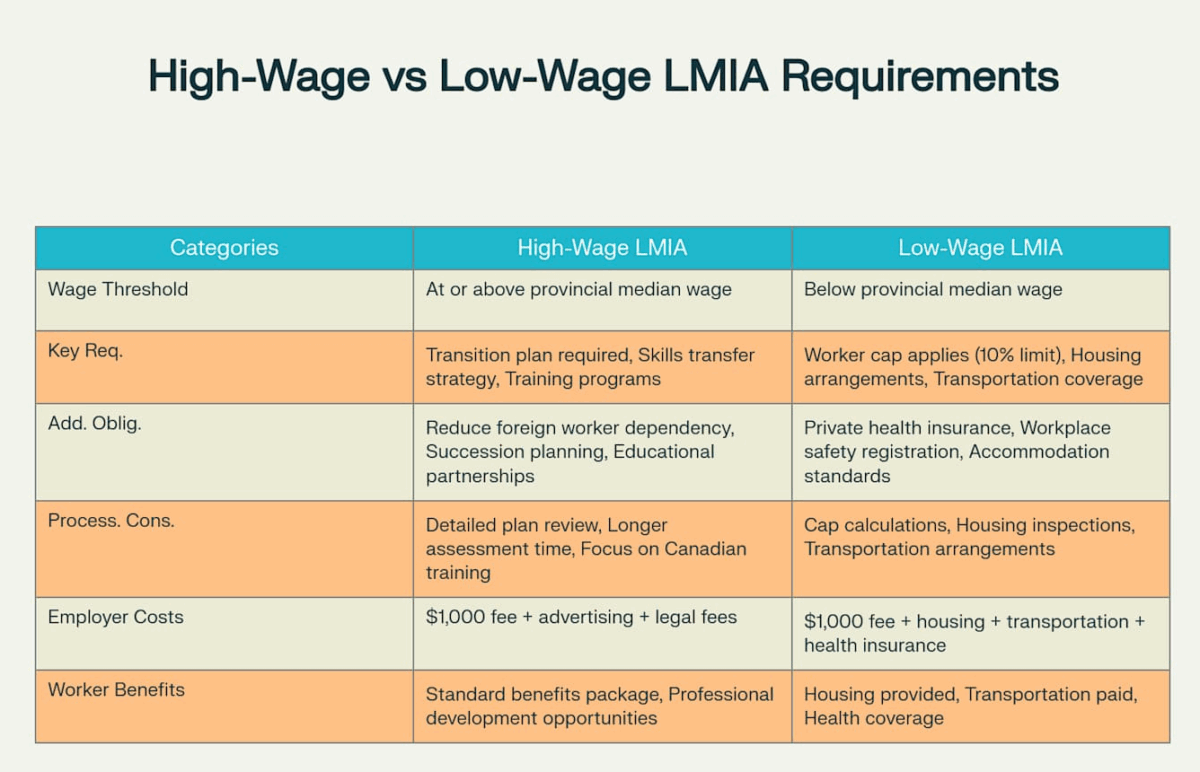

If the offered wage meets or exceeds the provincial median, it falls under the high-wage stream. Positions paying below the provincial median are classified as low-wage.
Processing Times by Stream
LMIA processing times vary significantly depending on the application stream. The Global Talent Stream offers the fastest processing, while permanent residence support streams take considerably longer.
| LMIA Stream | Processing Time (Business Days) | Typical Duration |
|---|---|---|
| Global Talent Stream | 7 | 1-2 weeks |
| Agricultural Stream | 14 | 3 weeks |
| Seasonal Agricultural Worker Program | 8 | 2 weeks |
| High-Wage Stream | 50 | 10 weeks |
| Low-Wage Stream | 50 | 10 weeks |
| Permanent Residence Stream | 235 | 47 weeks |
LMIA Application Document Checklist
✅ Essential Documents Required for All LMIA Applications
Business Documentation
- Business license or incorporation documents
- Commercial lease agreement or property ownership documents
- CRA Business Number and payroll account information
- Financial statements (latest 2 years)
- Tax documents (T4 slips, business tax returns)
- Organizational chart showing company structure
LMIA Application Forms
- Completed LMIA Application Form (ESDC EMP.5593)
- Job Bank employer account created and verified
- LMIA Online Portal access established
- Payment confirmation ($1,000 CAD per position)
Job Advertisement Requirements
- Job Bank posting (minimum 4 consecutive weeks)
- Two additional recruitment platform postings
- Screenshots of all job advertisements with dates
- Detailed recruitment plan document
- List of advertising platforms used with duration
- Proof of advertising costs and receipts
Employment Documentation
- Signed employment contract between employer and worker
- Job offer letter with complete details
- Job description aligned with NOC code
- Wage determination documentation
- Benefits package details (if applicable)
Recruitment Evidence
- Complete list of Canadian applicants
- Interview summaries and rejection reasons
- Documentation of recruitment efforts
- Proof of Job Match utilization
- Skills assessment records
Provincial Requirements (BC, MB, SK, NS)
- Provincial employer registration certificate
- Proof of provincial compliance
- Provincial exemption documentation (if applicable)
📋 Additional Requirements by Stream Type
High-Wage Positions Only
- Comprehensive transition plan (detailed strategy)
- Training and development program outline
- Skills transfer methodology
- Timeline for reducing foreign worker dependency
- Performance metrics and evaluation criteria
Low-Wage Positions Only
- Transportation cost budget and arrangements
- Private health insurance coverage proof
- Suitable housing arrangements documentation
- Workplace safety registration and compliance
- Employment agreement with specific terms
Specific Occupations
- Professional licensing requirements (if applicable)
- Union collective bargaining agreement sections
- Industry-specific certifications
- Schedule D for skilled trades (if applicable)
🔍 Supporting Documentation
Worker-Specific
- Copy of worker’s passport and identification
- Educational credentials and transcripts
- Work experience letters and references
- Language proficiency test results (if required)
- Professional certifications and licenses
Employer History
- Previous LMIA applications and outcomes
- Compliance history documentation
- Employer registration history
- Any voluntary disclosure records
⚠️ Common Missing Documents That Cause Delays
- Incomplete job advertisements – Missing wage, location, or contact details
- Unsigned employment contracts – Both parties must sign
- Insufficient recruitment proof – Lack of Canadian applicant documentation
- Outdated business documents – Expired licenses or registrations
- Missing provincial certificates – Required for BC, MB, SK, NS employers
- Incorrect NOC code alignment – Job duties don’t match selected code
- Inadequate transition plan – Generic or poorly detailed plans for high-wage positions
📝 Pre-Submission Checklist
- All documents are current and not expired
- All forms are signed by authorized personnel
- Payment method is confirmed and ready
- Provincial requirements are met
- NOC code accurately reflects job duties
- Wage meets minimum requirements for the region
- Advertising period meets 4-week minimum requirement
- All supporting documents are translated (if not in English/French)
- Documents are organized and clearly labeled
- Backup copies are maintained for records
💡 Pro Tips for Success
- Start early – Begin document collection 3-6 months before needed start date
- Use official templates – Follow Job Bank advertisement templates
- Keep detailed records – Document every step of the recruitment process
- Seek professional help – Consider hiring an immigration lawyer for complex cases
- Double-check NOC codes – Ensure perfect alignment with job duties
- Plan for delays – Processing times can vary significantly
- Maintain compliance – Keep all records for 6 years after hiring
📞 Need Help?
- LMIA Employer Contact Centre: 1-800-367-5693
- Job Bank Support: Available through employer portal
- Provincial Registration: Contact respective provincial authorities
- Legal Assistance: Consult with immigration lawyers for complex cases
Complete Step-by-Step Guide for Employers
Phase 1: Pre-Application Preparation
Step 1: Determine LMIA Requirements
Before beginning the application process, employers must confirm whether they need an LMIA for their specific hiring situation. Check if the position and worker fall under any exemption categories to avoid unnecessary applications.
Step 2: Create Job Bank Account
All employers must establish a valid Job Bank account before applying for an LMIA. This account serves two purposes: employer verification and job posting requirements. Registration typically takes one week to complete.
Step 3: Provincial Registration (If Required)
Employers in British Columbia, Manitoba, Saskatchewan, and Nova Scotia must obtain provincial employer registration certificates before applying for an LMIA. This requirement ensures compliance with provincial employment standards and worker protection laws.
Step 4: Determine NOC Code and Wage Rate
Select the appropriate National Occupational Classification (NOC) code that accurately reflects the job duties and responsibilities. Ensure the offered wage meets or exceeds the prevailing wage for the occupation in the specific region.
Phase 2: Recruitment and Advertising
Step 5: Develop Job Advertisement
Create a comprehensive job posting that includes all required elements:
- Company name and business address
- Position title and detailed job duties
- Terms of employment (permanent, temporary, project-based)
- Language requirements
- Wage range and benefits package
- Work location and contact information
- Required skills, education, and experience
Step 6: Advertise the Position
Post the job advertisement on Job Bank and at least two other platforms for a minimum of four consecutive weeks. Save screenshots of all advertisements with posting dates as proof of recruitment efforts.
Step 7: Interview Canadian Applicants
Conduct interviews with all qualified Canadian applicants and document the reasons for rejection. Maintain detailed records of the recruitment process, including the number of applicants, interview outcomes, and justifications for not hiring Canadian candidates.
Phase 3: Application Submission
Step 8: Prepare Required Documentation
Gather all necessary documents for the LMIA application.
Step 9: Complete Additional Requirements
For high-wage positions, develop a comprehensive transition plan outlining strategies to reduce reliance on foreign workers. For low-wage positions, arrange suitable housing, transportation, and health insurance coverage.
Step 10: Submit Application via LMIA Online Portal
Access the LMIA Online Portal through your Job Bank account and submit the complete application. Pay the $1,000 processing fee per position using the secure online payment system.
According to Employment and Social Development Canada, employers must pay a $1,000 processing fee for each position requested on an LMIA application.

Phase 4: Post-Application Process
Step 11: Monitor Application Status
Track your application progress through the LMIA Online Portal and respond promptly to any requests for additional information. Processing times vary by stream, ranging from 7 business days for Global Talent Stream to 235 days for Permanent Residence Stream.
Step 12: Receive LMIA Decision
Upon approval, provide the foreign worker with a copy of the positive LMIA decision letter and LMIA number. The worker will need these documents to apply for their work permit.
Step-by-Step Guide for Foreign Workers
Once an employer receives a positive LMIA, foreign workers must complete several steps to obtain their work permit and begin working in Canada.
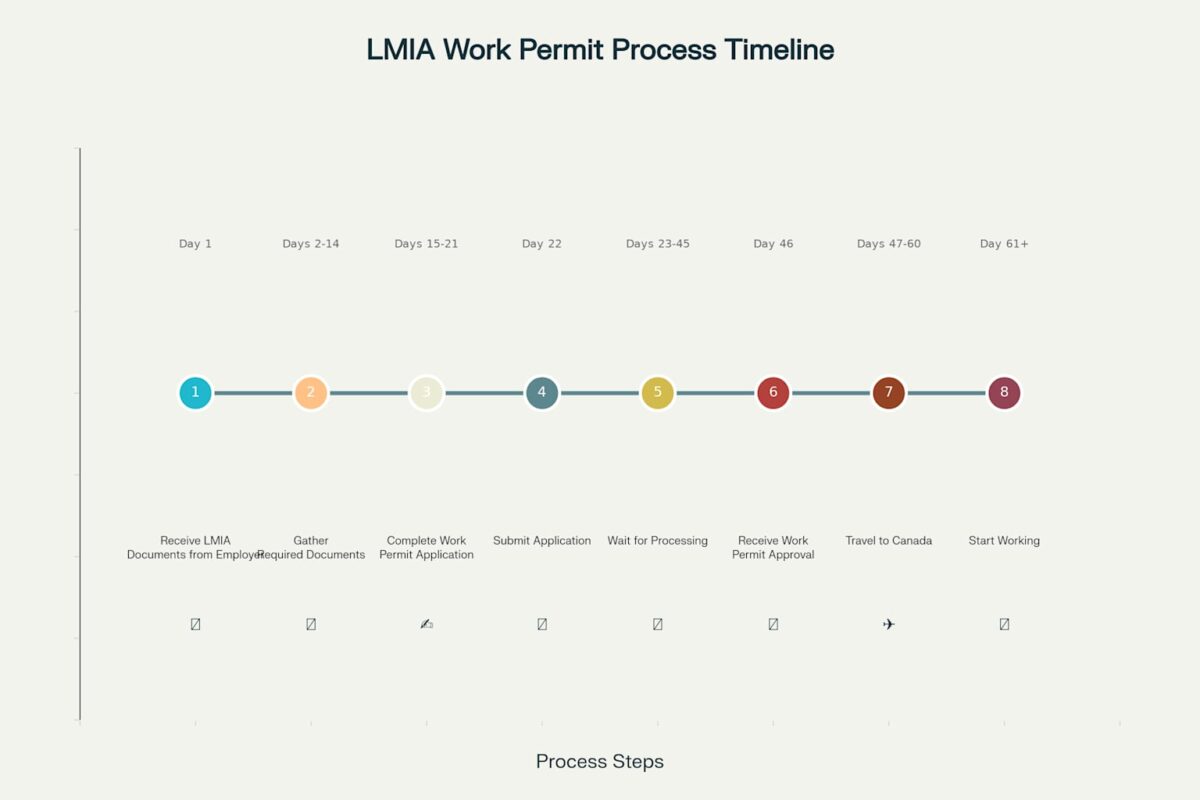
Document Preparation Phase
Foreign workers should immediately gather required documents upon receiving LMIA confirmation from their employer. Essential documents include a valid passport, educational credentials, work experience letters, and language test results if required.
Work Permit Application Process
Complete the online work permit application form (IMM 1295) through the IRCC portal. Upload all required documents and pay the application fees before submitting. Processing times for work permits typically range from 2-8 weeks depending on the applicant’s country of residence.
Arrival and Integration
After receiving work permit approval, book travel arrangements and prepare for arrival at a Canadian port of entry. Upon arrival, complete essential registrations including Social Insurance Number (SIN), provincial health card, and banking services.
Costs and Financial Considerations
| Cost Category | Estimated Cost (CAD) | Paid By | Notes |
|---|---|---|---|
| LMIA Application Fee (Per Position) | $1,000 | Employer (Required) | Non-refundable, even if refused |
| Legal/Consultant Fees | $2,000 – $5,000 | Employer (Optional) | Highly recommended for complex cases |
| Advertising Costs (3+ platforms for 4 weeks) | $500 – $2,000 | Employer (Required) | Job Bank + 2 other platforms minimum |
| Provincial Registration (BC, MB, SK, NS) | $300 – $500 | Employer (Required) | Only for specific provinces |
| Documentation and Translation | $200 – $800 | Employer (Required) | Depends on document complexity |
| Health Insurance (Low-wage workers) | $200 – $500/month | Employer (Required) | Until provincial coverage begins |
| Transportation Costs (Low-wage workers) | $500 – $2,000 | Employer (Required) | Home country to Canada and return |
| Housing Costs (Low-wage workers) | $800 – $1,500/month | Employer (Required) | Near workplace, suitable accommodation |
Employer Costs Breakdown
The LMIA process involves several mandatory and optional costs that employers must budget for.
Employers are legally required to pay all LMIA-related costs and cannot recover these expenses from foreign workers. This includes application fees, advertising costs, legal fees, and additional obligations for low-wage workers such as transportation and housing.
Worker Costs
Foreign workers are responsible for their own work permit application fees, which typically range from $155-$255 CAD depending on the permit type. Additional costs include document translation, medical examinations if required, and travel expenses to Canada.
Common Mistakes and How to Avoid Them
Top 5 LMIA Application Errors
Understanding common mistakes can significantly improve your chances of LMIA approval:
- Incomplete Job Advertisements: Missing critical details like median wage, exact location, or contact information leads to immediate rejection
- Insufficient Recruitment Documentation: Failing to provide complete proof of advertising efforts, including screenshots and dates
- Weak Transition Plans: Generic or poorly detailed transition plans for high-wage positions result in refusal
- Wage Inconsistencies: Offering wages below the prevailing rate or inconsistent contract terms
- Outdated Documentation: Using expired forms, missing signatures, or incorrect employer identification numbers
Success Tips for Employers
Well-established companies demonstrate a 95% success rate with LMIA applications when following proper procedures. Key strategies include:
- Starting the process 3-6 months before the required start date
- Using official Job Bank templates for advertisements
- Selecting the correct NOC code that precisely matches job duties
- Ensuring wage offers meet regional standards
- Maintaining detailed recruitment records
What Happens After LMIA Approval?
Employer Responsibilities
Once an LMIA is approved, employers must comply with ongoing obligations for up to six years. These include maintaining employment records, adhering to the terms outlined in the LMIA decision letter, and reporting any changes to working conditions.
Worker Integration Process
Foreign workers must apply for their work permit within six months of LMIA issuance, as the document expires after this period. Upon arrival in Canada, workers receive employer-specific work permits that restrict them to working for the sponsoring employer only.
Compliance and Monitoring
ESDC conducts regular inspections of employers who hire foreign workers to ensure compliance with program requirements. Inspections may be announced or unannounced and can occur up to six years after a worker begins employment.
Appeals and Reconsideration Options
Dealing with LMIA Refusals
If an LMIA application is refused, employers have several options for addressing the denial. The first step involves carefully reviewing the refusal letter to understand the specific reasons for rejection.
Reapplication vs. Reconsideration
Employers can choose to address the issues and submit a new application, or request reconsideration if they believe the refusal was based on incorrect information. For cases involving procedural errors, appeals to the Federal Court may be possible.
Conclusion
The LMIA process represents a critical pathway for Canadian employers to access international talent while protecting domestic job opportunities. Success requires careful preparation, thorough documentation, and strict adherence to program requirements. With processing times varying from one week for expedited streams to nearly a year for permanent residence support, early planning is essential.
For employers, the investment in obtaining an LMIA extends beyond the $1,000 application fee to include advertising costs, legal assistance, and ongoing compliance obligations. However, access to skilled foreign workers can provide significant competitive advantages and help address critical labor shortages.
Foreign workers benefit from the LMIA system through access to Canadian employment opportunities and potential pathways to permanent residence. The process requires patience and careful attention to detail, but successful applicants gain valuable work experience in one of the world’s most welcoming immigration destinations.
As Canada continues to evolve its immigration policies to meet economic needs while protecting domestic workers, staying informed about LMIA requirements and maintaining compliance remains crucial for all participants in the program. Whether you’re an employer seeking to hire internationally or a foreign worker pursuing Canadian opportunities, understanding and following the LMIA process is your key to success in Canada’s dynamic job market.
Related reading: LMIA-Exempt Work Permits: Complete List and Requirements — a closer look at this topic.
Quick answers from official sources
Do all employers need an LMIA to hire a foreign worker?
No. Most employers do, but not if the worker has an open work permit, and some hires are exempt through the International Mobility Program.
What is the Global Talent Stream?
An LMIA stream to hire uniquely skilled talent or in-demand workers to scale up and grow a business, per IRCC.
What is the employer compliance fee for LMIA-exempt hiring?
$230 in most cases, paid together with submitting an offer of employment through the Employer Portal.
Sources (checked October 27, 2026):
- canada.ca/en/immigration-refugees-citizenship/services/work-canada/hire-temporary-foreign/find-need-labour-market-impact-assessment.html
- canada.ca/en/immigration-refugees-citizenship/services/work-canada/hire-temporary-foreign/international-mobility-program/how-to-hire.html
- canada.ca/en/employment-social-development/services/foreign-workers.html