Spousal Work Permit: How to Work in Canada as a Spouse

If you’re married to or in a common-law relationship with someone working or studying in Canada, you may be eligible for a spousal open work permit that allows you to work for any employer across the country. This comprehensive guide will walk you through everything you need to know about obtaining a spousal work permit in Canada, including the significant changes that took effect in January 2025.
Quick answer: Since January 21, 2025, a spouse or common-law partner may be eligible for an open work permit if you hold a valid study permit and are in a master’s program of 16 months or longer, a doctoral program, an eligible program, or certain university professional degrees. An open work permit lets them work for almost any employer in Canada.
Canada’s spousal work permit program is designed to keep families together while contributing to the Canadian economy. Unlike employer-specific work permits, a spousal open work permit gives you the flexibility to work for any employer in Canada, change jobs freely, and gain valuable Canadian work experience.
Understanding Spousal Work Permits
What is a Spousal Open Work Permit?
A Spousal Open Work Permit (SOWP) is a special type of work authorization that allows spouses or common-law partners of certain temporary residents in Canada to work for any employer without requiring a Labour Market Impact Assessment (LMIA) or a specific job offer.
This flexibility makes it significantly easier for families to establish themselves financially in Canada while maintaining their immigration status.
Key Benefits of Spousal Work Permits
The spousal work permit offers several advantages for families immigrating to Canada:
- Employment flexibility: Work for any employer in Canada except those on the ineligible list
- No LMIA requirement: Skip the complex Labour Market Impact Assessment process
- Duration alignment: Permit validity typically matches your spouse’s work or study permit
- Career development: Gain Canadian work experience that can help with future permanent residence applications
- Financial independence: Contribute to household income and reduce financial pressure on the primary permit holder
Eligibility Requirements: Major Changes in 2025
New Rules Effective January 21, 2025
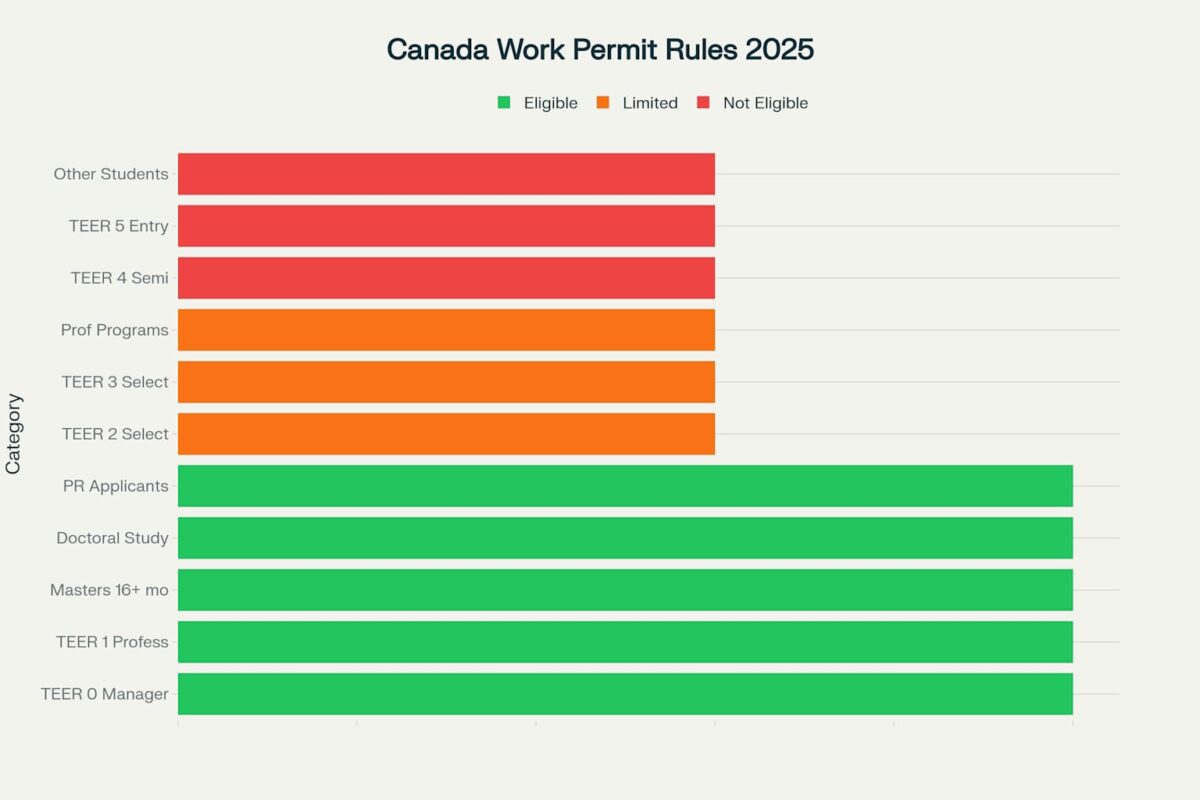
Canada implemented significant restrictions on spousal work permits to manage the growing number of temporary residents. These changes particularly affect eligibility based on the principal applicant’s occupation and education level.

Who is Still Eligible Under 2025 Rules
For Spouses of Workers:
Spouses remain eligible if the principal applicant works in:
- TEER 0 occupations: Management positions requiring extensive experience
- TEER 1 occupations: Professional roles typically requiring university degrees
- Select TEER 2 occupations: Technical roles in specific sectors including healthcare, construction, natural sciences, education, and natural resources
- Select TEER 3 occupations: Skilled trades and technical positions in approved sectors
For Spouses of Students:
Student spouses are now eligible only if enrolled in:
- Master’s degree programs that are 16 months or longer
- Doctoral (PhD) programs
- Select professional programs in high-demand fields
For Permanent Residence Applicants:
Spouses of those applying for permanent residence through economic immigration programs remain eligible, with the principal applicant requiring at least 6 months remaining on their work permit.
Who is No Longer Eligible
The 2025 changes significantly restrict eligibility for:
- Spouses of workers in TEER 4 and 5 (lower-skilled) occupations
- Spouses of students in undergraduate programs shorter than 16 months
- Spouses of students in most diploma and certificate programs
- Dependent children of foreign workers (completely removed from eligibility)
Important Timing Considerations
Applications submitted before January 21, 2025, continue to be processed under the previous, more lenient eligibility criteria. Additionally, the principal applicant must have at least 16 months remaining on their work permit when the spouse applies.
Spousal Work Permit Application Checklist
Pre-Application Assessment ✅
Eligibility Check
- Confirm spouse’s work permit/study permit status
- Verify spouse’s occupation meets TEER requirements
- Check remaining validity of spouse’s permit (16+ months for workers)
- Confirm genuine relationship status
- Verify temporary resident status in Canada (if applicable)
Document Preparation Phase
- Valid passport (with 6+ months validity)
- Marriage certificate or common-law relationship proof
- Spouse’s work permit/study permit copy
- Spouse’s employment letter or enrollment confirmation
- Proof of financial support
- Police clearance certificate (if required)
- Educational credentials assessment
- Photographs meeting IRCC specifications
Application Process ✅
Online Application Setup
- Create GC Key account or Sign-In Partner account
- Complete eligibility questionnaire
- Download and review application guide
- Gather all required forms (IMM 1295, IMM 5707, etc.)
Form Completion
- Complete IMM 1295 (Application for Work Permit)
- Complete IMM 5707 (Family Information Form)
- Complete IMM 5476 (Use of Representative – if applicable)
- Review all forms for accuracy and completeness
- Sign and date all required sections
Fee Payment
- Pay work permit fee ($155 CAD)
- Pay open work permit holder fee ($100 CAD)
- Pay biometrics fee ($85 CAD)
- Keep payment receipts for records
Application Submission
- Upload all required documents
- Submit complete application online
- Print confirmation receipt
- Note application number for tracking
Post-Submission Requirements ✅
Biometrics Appointment
- Receive biometrics instruction letter
- Book appointment at Visa Application Centre
- Attend biometrics appointment within 30 days
- Bring required documents and confirmation letter
Medical Examination (if required)
- Receive medical exam request from IRCC
- Find approved panel physician
- Schedule and complete medical examination
- Ensure results are sent directly to IRCC
Additional Documentation
- Respond to any additional document requests
- Submit requested information within specified timeframe
- Update IRCC of any changes in circumstances
Decision and Next Steps ✅
Application Processing
- Monitor application status online
- Respond promptly to IRCC communications
- Keep contact information updated
- Track processing times for your location
Upon Approval
- Receive Port of Entry Letter of Introduction
- Plan travel to Canada (if outside Canada)
- Present documents at port of entry
- Receive work permit at border
Upon Arrival in Canada
- Apply for Social Insurance Number (SIN)
- Open Canadian bank account
- Register for provincial health card
- Update address with IRCC if applicable
Important Reminders 📋
Timeline Management
- Apply before current status expires
- Allow sufficient processing time
- Consider applying for visitor record if needed
- Plan for potential delays
Common Mistakes to Avoid
- Don’t overwhelm application with unnecessary documents
- Ensure all forms are current versions
- Don’t forget signatures on all required forms
- Provide clear proof of genuine relationship
- Meet financial requirements demonstration
After Receiving Work Permit
- Understand work permit conditions
- Know expiry date and plan for renewal
- Maintain legal status throughout stay
- Keep copies of all important documents
Application Process Step-by-Step

Step-by-step flowchart for spousal work permit application process in Canada
Phase 1: Pre-Application Preparation
Eligibility Assessment
Before starting your application, conduct a thorough eligibility review:
- Verify your spouse’s occupation using the National Occupational Classification (NOC) system
- Confirm your spouse has sufficient time remaining on their permit
- Ensure you meet the genuine relationship requirements
- Check your current immigration status in Canada if already present
Phase 2: Document Collection

Official Canadian work permit application form, showing sections for applicants and their spouses or common-law partners
Gathering the correct documents is crucial for a successful application. Required documents typically include:
Personal Documents:
- Valid passport with at least 6 months remaining validity
- Recent photographs meeting IRCC specifications
- Educational credentials and diplomas
- Police clearance certificates from countries where you’ve lived for 6+ months
Relationship Evidence:
- Marriage certificate or statutory declaration of common-law relationship
- Joint bank account statements
- Photos together at significant events
- Communication records showing ongoing relationship
- Travel documents showing trips taken together
Spouse’s Documentation:
- Copy of spouse’s current work permit or study permit
- Employment letter from spouse’s employer or enrollment confirmation
- Proof of spouse’s occupation and TEER classification
Phase 3: Online Application Submission
Creating Your Account
The application must be submitted online through the IRCC portal:
- Create a GC Key account or Sign-In Partner account
- Complete the online eligibility questionnaire
- Download the most current application forms
Required Forms

Official Canadian application form for a work permit made outside of Canada, including sections for personal and spousal relationship details formspal
Key forms you’ll need to complete include:
- IMM 1295: Application for Work Permit Made Outside Canada (or IMM 5710 if applying from within Canada)
- IMM 5707: Family Information Form
- IMM 5476: Use of a Representative (if using an immigration consultant or lawyer)
Phase 4: Fee Payment and Submission
Application Fees Structure
| Fee Type | Amount (CAD) | Purpose |
|---|---|---|
| Work Permit Application Fee | $155 | Mandatory processing fee |
| Open Work Permit Holder Fee | $100 | Additional fee for open permits |
| Biometrics Fee | $85 | Fingerprints and photo |
Total fees (excluding medical examination): $340 CAD
Post-Submission Requirements
Biometrics Collection
Most applicants must provide biometrics (fingerprints and photograph) as part of their application. You have 30 days from receiving the biometrics instruction letter to complete this step at an approved Visa Application Centre.
Biometrics Exemptions:
- Canadian citizens and permanent residents
- US citizens (except for permanent residence applications)
- Children under 14 and adults over 79
- Those who provided biometrics within the last 10 years for a valid permit
Medical Examination Requirements
Medical examinations may be required depending on your intended work and travel history. You’ll need a medical exam if you:
- Plan to work in healthcare, childcare, or education
- Will work in agriculture and have lived in designated countries
- Intend to work for more than 6 months and lived in designated countries for 6+ months in the past year
Processing Times and Expectations
Processing times vary significantly based on your location and application volume:
| Application Location | Average Processing Time | Notes |
|---|---|---|
| Inside Canada | 34 months | Significantly longer wait times |
| Outside Canada (General) | 11 months | Most common processing time |
| Outside Canada (Quebec) | 47+ weeks | Additional provincial requirements |
| High-volume countries | 8-12 weeks | Countries with many applicants |
| Low-volume countries | 4-8 weeks | Faster processing possible |
Common Mistakes to Avoid
Learning from others’ experiences can significantly improve your application success rate. Common pitfalls include:
Documentation Errors:
- Submitting outdated or incorrect forms
- Providing insufficient proof of genuine relationship
- Overwhelming the application with unnecessary documents
- Missing signatures on required sections
Eligibility Misunderstandings:
- Applying without confirming spouse’s TEER occupation classification
- Not checking remaining validity on spouse’s permit
- Assuming eligibility under old rules when new 2025 restrictions apply
Process Management Issues:
- Failing to respond promptly to IRCC requests for additional information
- Not maintaining legal status while application is processed
- Insufficient financial documentation
What to Expect After Approval
Receiving Your Work Permit
Once approved, you’ll receive either a Port of Entry Letter of Introduction (if applying from outside Canada) or the actual work permit (if applying from within Canada). The work permit will specify:

An official Canadian work permit document issued by Immigration, Refugees and Citizenship Canada getincanada
- Your personal information and photo
- Validity dates (typically matching your spouse’s permit duration)
- Any specific conditions or restrictions
- Employer restrictions (if any)
Starting Work in Canada
After receiving your work permit, important next steps include:
- Applying for a Social Insurance Number (SIN) from Service Canada
- Opening a Canadian bank account
- Registering for provincial health insurance
- Understanding your tax obligations as a Canadian worker
- Familiarizing yourself with provincial employment standards
Renewal and Extension
Your spousal work permit can typically be renewed as long as your spouse maintains their valid status in Canada. Plan to apply for renewal at least 4 months before your current permit expires to avoid gaps in authorization.
Conclusion
Obtaining a spousal work permit in Canada requires careful preparation and understanding of the current eligibility requirements, especially given the significant changes implemented in 2025. While the process may seem complex, following this comprehensive guide and using the provided checklist can significantly improve your chances of success.
Remember that immigration rules and processing times can change, so always verify the most current information on the official IRCC website before submitting your application. Consider consulting with a qualified immigration professional if your situation is complex or if you’re unsure about any aspect of the application process.
With proper preparation and documentation, a spousal work permit can be your gateway to building a successful life and career in Canada while staying together as a family.
Related reading: Inland vs Outland Sponsorship: Which Option to Choose — a closer look at this topic.
Quick answers from official sources
Which students’ spouses can get an open work permit?
Those with a valid study permit studying a master’s program of 16 months or longer, a doctoral program, an eligible program, or a listed professional degree such as medicine, law or nursing.
What does an open work permit allow?
Working for any employer in Canada, except one on the list of employers who have failed to comply with conditions or that regularly offers certain adult services.
What if my spouse isn’t eligible?
They may be able to get another type of work permit, according to IRCC.
Sources (checked October 27, 2026):