
Family Class Immigration: Processing Times and Expectations
Family class immigration represents one of the most important pathways for reuniting loved ones across international borders. With millions of families separated by geography, understanding the processing times, requirements, and expectations for family-based immigration applications has become crucial for successful reunification.
This comprehensive guide will walk you through everything you need to know about family class immigration, from initial application to final decision.
Understanding Family Class Immigration
Family class immigration allows citizens and permanent residents to sponsor their eligible family members for permanent residence in their country. This category typically includes spouses, common-law partners, dependent children, parents, and grandparents. The program serves as a cornerstone of immigration policy in major destination countries, with Canada allocating nearly 24% of overall permanent resident admissions to family class in 2025.
The eligibility requirements vary by relationship type and sponsoring country, but generally require proof of genuine family relationships, financial capacity to support sponsored family members, and meeting admissibility requirements. In Canada, over 69,000 foreign nationals were admitted as permanent residents under spousal sponsorship alone in 2021, representing approximately 17% of total admissions for that year.
Current Processing Times by Country and Category
Processing times for family class immigration vary significantly depending on the destination country, relationship category, and application volume. Understanding these timeframes is essential for setting realistic expectations and planning your immigration journey.
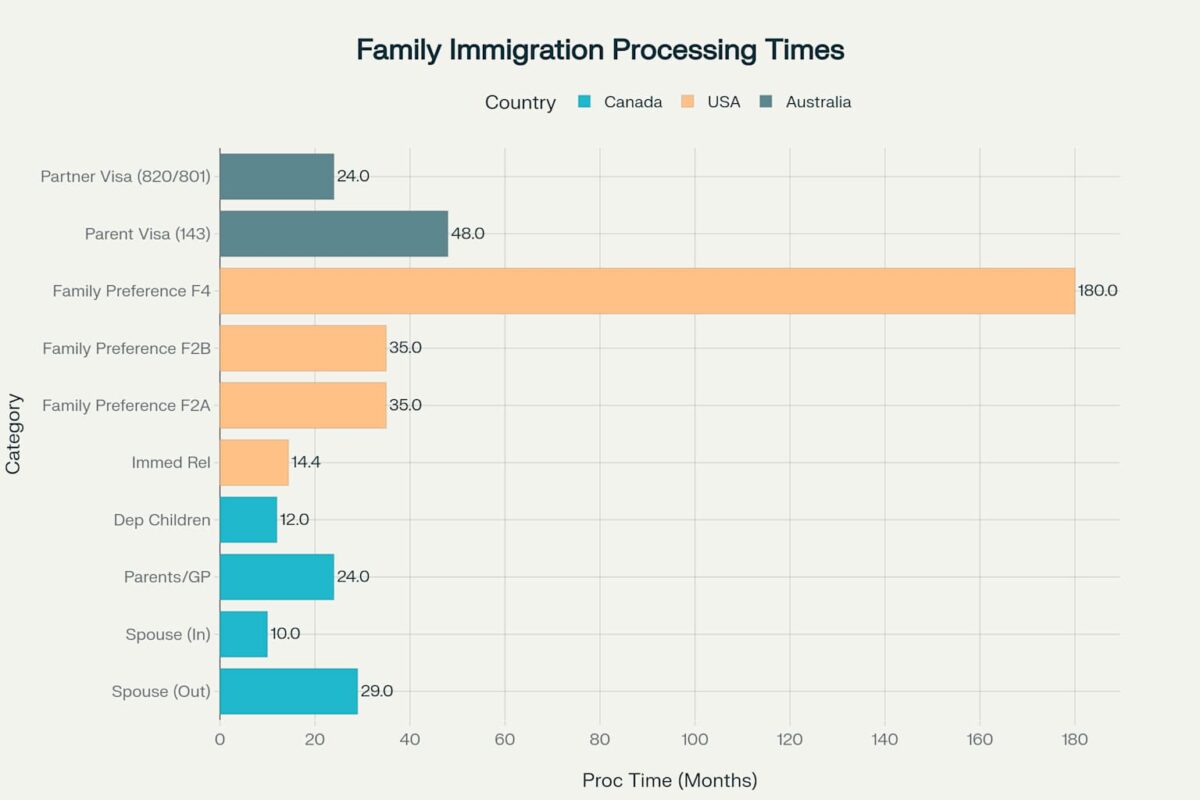

Family Class Immigration Processing Times by Country and Category (2024-2025)
Canada Processing Times (2024-2025)
Canadian family class processing times have experienced substantial changes in recent years. For spouse and partner applications:
- Inside Canada applications: 10 months average processing time
- Outside Canada applications: 29 months average processing time (increased from 10 months in June 2024)
- Parent and Grandparent Program: 24 months average processing time
- Dependent children: 12 months average processing time
The dramatic increase in processing times for outside Canada spousal applications reflects growing application volumes and processing backlogs.
United States Processing Times (2024-2025)
U.S. family-based immigration processing times vary by preference category:
- Immediate Relatives (I-130): 14.4 months for U.S. citizen sponsors
- Family Preference F2A: 35 months for permanent resident sponsors
- Family Preference F2B: 35 months for unmarried adult children
- Family Preference F4: 180 months for siblings of U.S. citizens
The I-485 adjustment of status applications for family-based cases currently process in approximately 9.2 months.
Australia Processing Times
Australian family visa processing times are among the longest globally:
- Partner visas (820/801): 24 months average processing time
- Parent visas (143): 48 months average processing time
These extended timeframes reflect Australia’s capped immigration system and high demand for family reunion visas.
The Family Class Immigration Process
Understanding the step-by-step process helps applicants prepare effectively and avoid common delays. The family class immigration process typically involves multiple phases, each with specific requirements and timeframes.

Family Class Immigration Process Flowchart Infographic
Phase 1: Pre-Application Preparation (4-8 weeks)
The preparation phase is critical for application success. Key activities include:
Eligibility Assessment (1-2 weeks)
- Review relationship requirements and sponsor qualifications
- Confirm financial capacity to support sponsored family members
- Assess any potential inadmissibility issues
Document Gathering (2-4 weeks)
- Collect identity documents, relationship evidence, and financial records
- Obtain required police clearance certificates and medical examinations
- Prepare certified translations for foreign language documents
Application Completion (1-2 weeks)
- Complete all required immigration forms using current versions
- Review applications for accuracy and completeness
- Calculate and prepare application fees
Phase 2: Application Submission and Initial Processing (3-6 months)
Once submitted, applications undergo initial review and sponsor assessment:
Application Receipt and Acknowledgment (1-2 months)
- Immigration authorities confirm receipt and assign application numbers
- Applicants receive Acknowledgment of Receipt (AOR) with tracking information
Sponsor Eligibility Assessment (2-4 months)
- Review sponsor’s legal status, financial capacity, and background
- Assess compliance with previous sponsorship obligations
- Verify relationship genuineness for spousal applications
Phase 3: Assessment and Verification (4-8 months)
This phase involves detailed review of the sponsored person’s application:
Biometrics and Background Checks (2-6 months)
- Fingerprints and photographs collected at approved locations
- Criminal record and security background verification
- Immigration history review and admissibility assessment
Medical and Police Clearances (2-4 months)
- Medical examinations by approved panel physicians
- Police clearance certificates from countries of residence
- Vaccination requirements completion
Phase 4: Final Decision and Visa Issuance (1-3 months)
The final phase culminates in application decision and visa processing:
Final Review and Interview (if required)
- Comprehensive application assessment against all criteria
- Interview scheduling for relationship verification when necessary
- Additional document requests or clarifications
Decision Notification and Visa Issuance
- Final decision communication with detailed reasoning
- Confirmation of Permanent Residence (COPR) or visa issuance for approved applications
- Landing instructions and requirements for successful applicants
Family Class Immigration Document Checklist
✅ Essential Documents for All Applicants
Identity and Civil Status Documents
- Valid Passport/Travel Document (must be valid for at least 6 months)
- Birth Certificate (long-form certificate preferred)
- National ID Card (if applicable in your country)
- Marriage Certificate (for spouse/partner applications – must be legally recognized)
- Divorce/Death Certificates (if previously married)
Relationship Evidence (Critical for Success)
- Relationship Photos spanning multiple years showing relationship development
- Communication History (emails, call logs, text messages, social media)
- Joint Financial Records (bank statements, credit cards, insurance policies)
- Cohabitation Proof (lease agreements, utility bills, joint mortgage)
- Travel Records Together (flight tickets, hotel bookings, trip photos)
Financial Documentation
- Employment Letter from current employer on company letterhead
- Pay Stubs (most recent 3 months)
- Tax Returns (past 3 years filed with revenue agency)
- Bank Statements (past 6 months)
- Proof of Assets (property ownership, investments, savings)
Background and Security Documents
- Police Clearance Certificates from all countries lived in 6+ months after age 16
- Military Records (if applicable)
- Court Records (if any criminal history)
Medical and Health Requirements
- Medical Examination by approved panel physician
- Vaccination Records as required
- Previous Medical Reports (if relevant medical history)
Immigration History
- Previous Visa Applications and decisions
- Travel History Documentation
- Immigration Status Documents (if currently in destination country)
📋 Sponsor-Specific Requirements
For Canadian Sponsors
- Proof of Canadian Status (citizenship certificate, passport, or PR card)
- Sponsorship Agreement and Undertaking (Form IMM 1344)
- Financial Evaluation documents
- Option C Printout from Canada Revenue Agency
For US Sponsors
- Proof of US Citizenship or Permanent Residence
- Affidavit of Support (Form I-864)
- Tax Transcripts from IRS
- Employment Verification Letter
🚨 Common Documentation Mistakes to Avoid
❌ Using outdated application forms – Always download latest versions from official websites
❌ Poor quality photocopies – Provide clear, legible copies
❌ Missing translations – Use certified translation services for foreign documents
❌ Incomplete financial records – Ensure all financial documents are recent and complete
❌ Insufficient relationship proof – Document your relationship timeline thoroughly
❌ Missing signatures or dates – Double-check all forms are signed and dated
📅 Timeline Reminders
Important Deadlines
- Biometrics Appointment – Must be completed within 30 days of request
- Medical Examination – Valid for 12 months from date of examination
- Police Certificates – Valid for 12 months from issue date
- Response to Additional Requests – Usually 30-60 days depending on request
Document Validity Periods
- Police Certificates: 12 months
- Medical Exams: 12 months
- Financial Documents: Prefer documents less than 3 months old
- Relationship Evidence: Recent evidence preferred, but historical documentation valuable
💡 Pro Tips for Document Preparation
- Organize Documents by Category – Use the checklist categories to organize your file
- Create a Document Index – List all documents with page numbers for easy reference
- Make Multiple Copies – Keep originals safe and submit clear copies unless originals requested
- Translation Requirements – All foreign language documents need certified English translations
- Photo Requirements – Use professional passport-style photos meeting specifications
- Digital Backups – Scan all documents and keep digital copies as backup
🔍 Before Submission Final Check
- All forms completed in ink or typed
- All required signatures present
- All dates filled in correctly
- Fees paid and receipt included
- Document checklist completed
- Application package organized logically
- Copies of all submitted documents retained
- Tracking information for submission method
Important Note: This checklist is for general guidance. Always refer to the most current official requirements from your country’s immigration authorities, as requirements can change and may vary based on your specific situation and country of application.
Last Updated: December 2024
Essential Document Requirements
Proper documentation is fundamental to family class immigration success. Missing or inadequate documents account for the majority of application delays and refusals.
Core Documentation Categories
Identity and Civil Status Documents
All applicants must provide valid identity documentation including passports, birth certificates, and marriage certificates where applicable. These documents must be current, clearly legible, and officially issued by recognized authorities.
Relationship Evidence
Proving genuine family relationships requires comprehensive documentation spanning the relationship timeline. For spousal applications, this includes communication history, joint financial records, cohabitation evidence, and photographs demonstrating relationship development.
Financial Documentation
Sponsors must demonstrate financial capacity to support sponsored family members. Required documents include employment letters, pay stubs, tax returns, and bank statements covering recent periods.
Background and Security Documents
All applicants aged 16 and older must provide police clearance certificates from countries where they have lived for six months or more. Military records and court documents are required where applicable.
Medical Requirements
Immigration medical examinations by approved panel physicians are mandatory for all family class applicants. These examinations include physical assessments, chest X-rays, and required vaccinations.
Application Costs and Fees
Understanding the financial investment required for family class immigration helps families budget appropriately. Fees vary significantly between countries and application types.
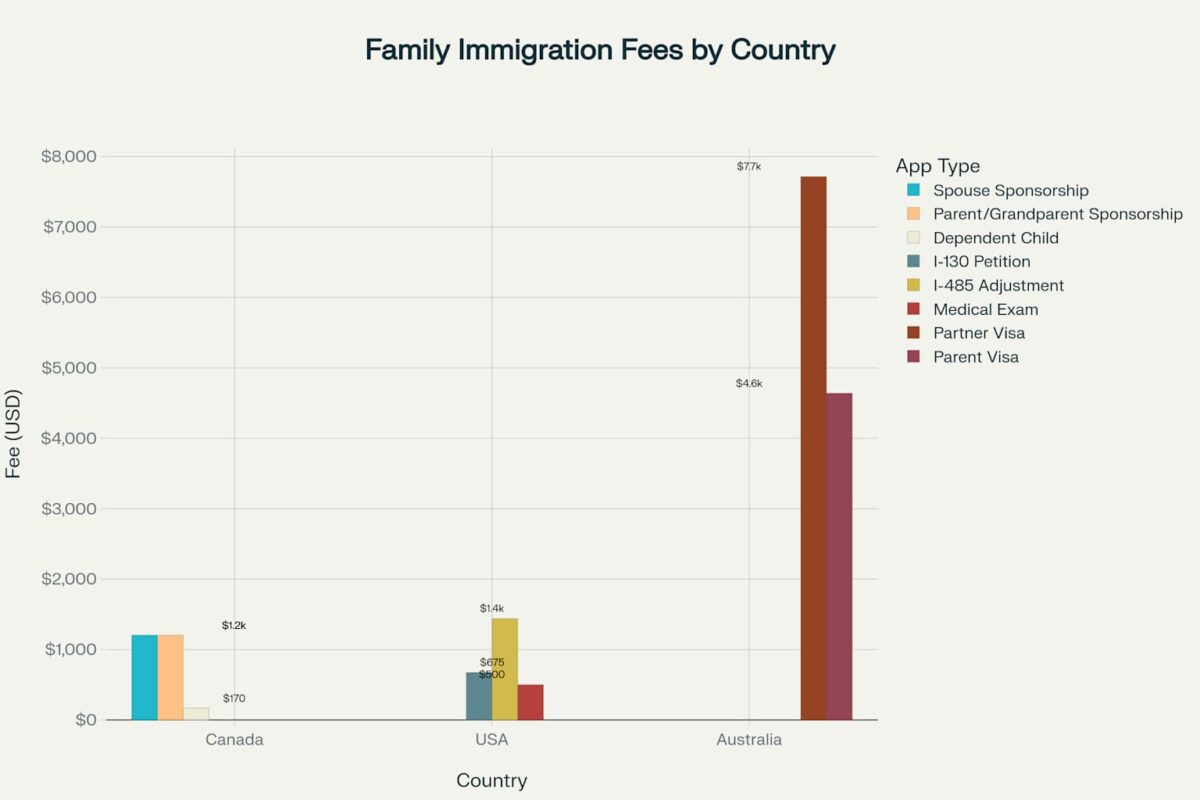
Family Immigration Application Fees by Country and Application Type (in USD)
Canadian Family Class Fees (2024-2025)
Current Canadian family sponsorship fees include:
- Spouse/Partner Sponsorship: CAD $1,205 (including sponsorship fee, processing fee, and right of permanent residence fee)
- Parent/Grandparent Sponsorship: CAD $1,205 per parent
- Dependent Child Sponsorship: CAD $170 per child
- Biometrics Fee: CAD $85 per person or CAD $170 per family
United States Family Immigration Fees
U.S. family-based immigration involves multiple fee components:
- Form I-130 Petition: USD $675
- Form I-485 Adjustment of Status: USD $1,440
- Medical Examination: USD $500-800 (varies by location)
- Biometrics Services: No fee (eliminated for most family immigration cases)
Australian Family Visa Fees
Australian family visa fees are among the highest globally:
These fees reflect Australia’s user-pays immigration system and processing costs.
Common Mistakes and How to Avoid Them
Learning from common application errors can significantly improve success rates and reduce processing delays. Immigration authorities report that preventable mistakes cause the majority of application problems.
Documentation Errors
Using Outdated Forms
Immigration forms are frequently updated, and using outdated versions results in automatic application returns. Always download the most current forms directly from official government websites immediately before submission.
Insufficient Relationship Evidence
Many applications fail due to inadequate proof of genuine relationships. Document your relationship timeline thoroughly with communication records, joint financial accounts, and photographs spanning multiple years.
Poor Quality Documentation
Illegible photocopies, missing signatures, and incomplete forms cause processing delays. Provide clear, complete copies of all documents and verify all required signatures and dates are present.
Timeline Management Issues
Missing Critical Deadlines
Immigration processes involve strict deadlines for biometrics appointments, medical examinations, and document responses. Missing these deadlines can result in application closure or refusal.
Delayed Response to Requests
Immigration authorities typically provide 30-60 days to respond to additional document requests. Prompt responses are essential to maintain application momentum.
Financial Documentation Problems
Outdated Financial Records
Financial documents should be as recent as possible, preferably within three months of submission. Outdated employment letters or bank statements may trigger additional document requests.
Insufficient Financial Evidence
Sponsors must demonstrate sustained financial capacity through comprehensive documentation including employment verification, tax returns, and asset statements.
Success Rates and Processing Trends
Understanding success rates helps set realistic expectations for family class immigration applications. Historical data shows that properly prepared applications have high approval rates across major immigration destinations.
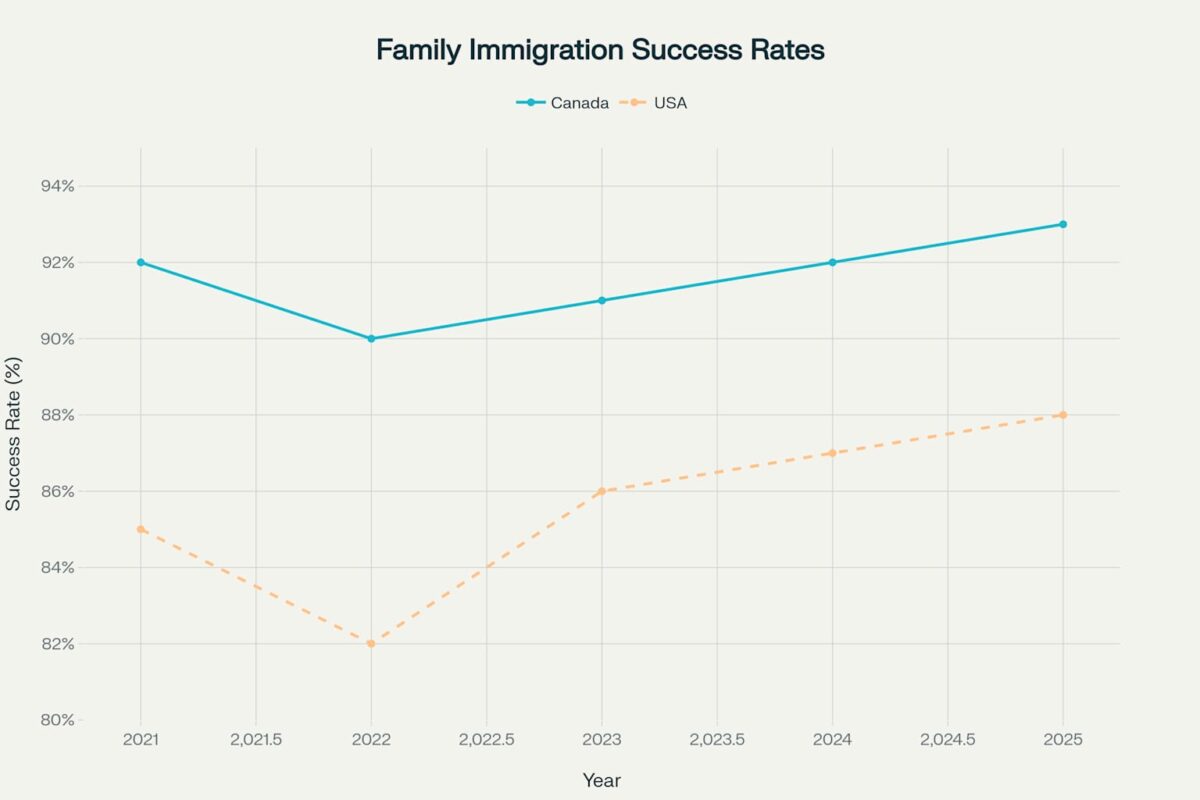
Family Immigration Success Rates Comparison: Canada vs USA (2021-2025)
Canadian Family Class Success Rates
Canada maintains high approval rates for family class applications, with 92% of family class applications approved in 2021. Spousal sponsorship applications show particularly strong success rates when relationships are well-documented and genuine.
Recent trends show:
- 2021: 92% approval rate for family class applications
- 2022-2025: Sustained approval rates between 90-93%
- Spousal Applications: Consistently high success rates with proper documentation
United States Family Immigration Success Rates
U.S. family-based immigration approval rates vary by category but generally range from 82-88% for well-prepared applications. Success rates are highest for immediate relative categories and lower for family preference categories with longer processing times.
Factors Affecting Success Rates
Relationship Genuineness
Immigration officers focus heavily on assessing whether family relationships are genuine and not entered into primarily for immigration purposes. Comprehensive relationship documentation significantly improves approval odds.
Application Completeness
Complete applications with all required documents and forms have substantially higher success rates than incomplete submissions. Taking time to prepare thoroughly reduces the risk of refusal.
Professional Assistance
Applications prepared with professional immigration assistance show higher success rates, particularly for complex cases. Immigration lawyers and consultants can help navigate requirements and avoid common pitfalls.
What to Expect During Processing
Managing expectations during the family class immigration process helps reduce stress and anxiety while maintaining realistic timelines. Understanding each phase helps applicants prepare for what lies ahead.
Communication with Immigration Authorities
Regular Status Updates
Most immigration systems now provide online portals for tracking application status. Applicants should monitor these systems regularly and respond promptly to any requests for additional information.
Document Requests
Immigration authorities may request additional documents or clarification during processing. These requests are normal parts of the assessment process and don’t necessarily indicate problems with the application.
Interview Requirements
Not all family class applications require interviews, but they may be scheduled when immigration officers need to verify relationship genuineness or clarify application details. Preparation and honesty are key to successful interviews.
Processing Delays and Complications
Factors Causing Delays
Common delay factors include incomplete applications, missing documents, background check complications, and high application volumes. Some delays are beyond applicant control, while others result from preparation issues.
Managing Extended Processing Times
When processing exceeds standard timeframes, applicants can contact immigration authorities for status updates. However, most delays reflect normal processing variations rather than application problems.
Tips for Success
Maximizing your chances of family class immigration success requires careful preparation, attention to detail, and realistic expectations. Following proven strategies can significantly improve outcomes.
Preparation Strategies
Start Early
Begin gathering documents and preparing applications well in advance of intended submission dates. Document collection, especially police clearances and medical examinations, can take several months.
Seek Professional Guidance
Consider consulting with qualified immigration lawyers or consultants, particularly for complex cases or when previous applications have been refused. Professional assistance can help navigate requirements and avoid costly mistakes.
Maintain Detailed Records
Keep comprehensive records of all communications, document submissions, and timeline milestones. This documentation proves valuable if questions arise during processing.
Relationship Documentation for Spouses and Partners
Document Your Relationship Timeline
Create a comprehensive timeline of your relationship development with supporting evidence for each phase. Include first meeting details, relationship milestones, and periods of separation if applicable.
Maintain Regular Communication Records
Save communication logs, including emails, text messages, call records, and social media interactions. Recent communication is particularly important for establishing ongoing relationships.
Establish Joint Financial and Living Arrangements
Joint bank accounts, insurance policies, lease agreements, and utility bills provide strong evidence of committed relationships. These documents demonstrate practical integration of lives beyond emotional connection.
Recent Developments and Future Outlook
Family class immigration continues evolving with policy changes, technological improvements, and shifting global migration patterns. Understanding current trends helps applicants prepare for future changes.
Digital Transformation
Immigration authorities worldwide are implementing digital processing systems to improve efficiency and transparency. Canada’s IRCC has expanded online application status trackers to additional program categories, providing applicants with real-time processing updates.
COVID-19 Impact and Recovery
The COVID-19 pandemic significantly disrupted family immigration processing, causing delays and backlogs across all major destinations. While processing has largely normalized, some residual impacts continue affecting timelines.
Policy Changes and Trends
Recent policy adjustments include:
- Canada’s reduction of permanent resident targets for 2025-2027, affecting family class allocations
- Enhanced digital processing capabilities reducing paperwork requirements
- Improved coordination between immigration offices globally
Conclusion
Family class immigration remains a vital pathway for family reunification, despite complex requirements and varying processing times. Success depends largely on thorough preparation, complete documentation, and realistic expectations about timeframes.
Key takeaways for prospective applicants include starting early, gathering comprehensive documentation, understanding country-specific requirements, and considering professional assistance for complex cases. While processing times can be lengthy, particularly for certain categories and countries, well-prepared applications have high success rates.
The investment in time, effort, and financial resources required for family class immigration is substantial, but the outcome—reuniting with loved ones—makes the journey worthwhile for millions of families worldwide. By following the guidance in this comprehensive guide and utilizing the provided checklists and resources, families can navigate the immigration process more confidently and successfully.
Remember that immigration policies and processing times change regularly, so always verify current requirements with official government sources before beginning your application. The path to family reunification may be complex, but with proper preparation and realistic expectations, it remains an achievable goal for eligible families.
Related reading: Inland vs Outland Sponsorship: Which Option to Choose — a closer look at this topic.