Study Permit Refusal: Common Reasons and How to Avoid Them

Getting your study permit application refused can be one of the most disappointing experiences in your journey to study abroad . However, understanding why refusals happen and how to prevent them can significantly improve your chances of success. This comprehensive guide will walk you through everything you need to know about study permit refusals and how to avoid them.
Getting your study permit application refused can be one of the most disappointing experiences in your journey to study abroad . However, understanding why refusals happen and how to prevent them can significantly improve your chances of success.
Understanding the Current Study Permit Landscape
Study permit refusal rates have been steadily increasing across major study destinations worldwide . The statistics paint a concerning picture for international students seeking educational opportunities abroad.
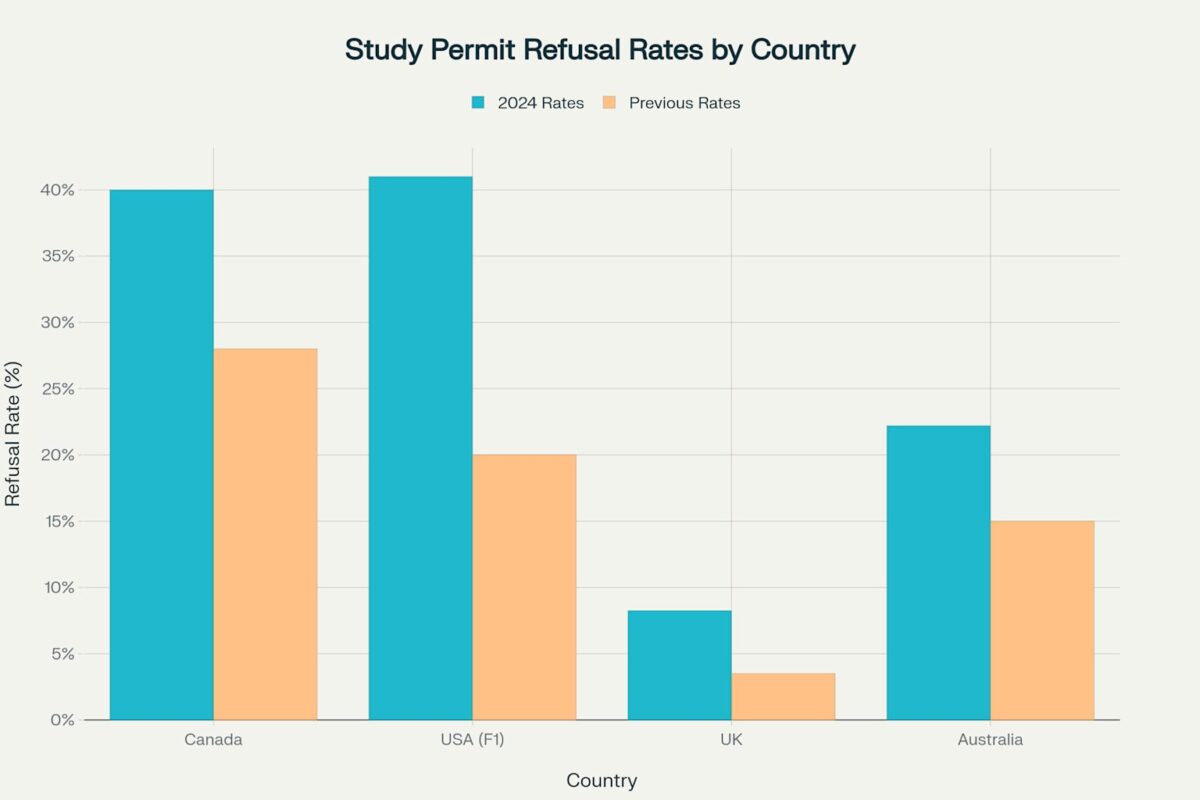

Study permit refusal rates have increased significantly across major study destinations, with the USA showing the highest current refusal rate at 41%
Recent data shows that refusal rates have reached unprecedented levels . In Canada, approximately 30-52% of study permit applications are being refused, up from 28% in 2014 .
The United States has experienced an even more dramatic increase, with F1 student visa rejections hitting a decade-high of 41% in fiscal year 2023-24 . The UK has seen its refusal rate rise from 3-4% to 8.25% , while Australia’s rate has increased to 22.2% .
Top Reasons for Study Permit Refusal
Understanding why applications get refused is the first step toward avoiding rejection . Immigration officers evaluate applications based on specific criteria, and failure to meet these requirements often leads to refusal.
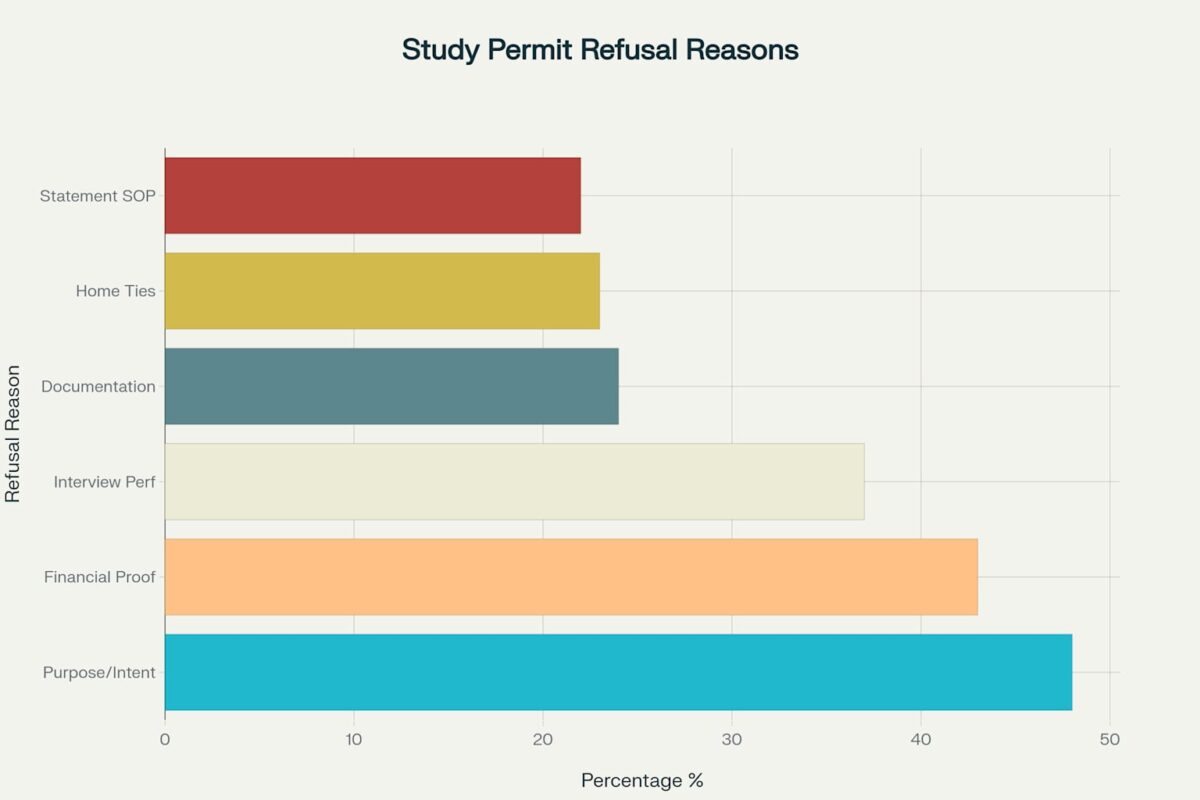
Purpose of visit and financial proof issues are the top reasons for study permit refusals globally
1. Purpose of Visit and Genuine Intent (77% of refusals in Canada)
The most common reason for study permit refusal is the inability to convince immigration officers that your primary purpose is to study and that you will leave the country after completing your studies . Officers assess whether you have genuine intentions to study rather than using the permit as a pathway to immigration.
How to demonstrate genuine intent:
- Provide a clear, detailed study plan explaining your academic goals
- Show how the program aligns with your career objectives
- Explain why you chose this specific country and institution
- Demonstrate strong ties to your home country
2. Insufficient Financial Proof (26-80% of refusals)
Financial inadequacy is consistently among the top reasons for refusal across all countries . You must prove you can financially support yourself throughout your studies without becoming a burden on the host country.
Common financial mistakes:
- Not maintaining minimum balance for required period
- Large unexplained deposits close to application date
- Insufficient funds to cover tuition and living expenses
- Poor documentation of fund sources
3. Inadequate Documentation (15-35% of refusals)
Incomplete or incorrect documentation leads to automatic refusal in many cases . Immigration officers process applications based solely on submitted documents, making completeness crucial.

A document checklist detailing required documents and proof of funds for a Canadian study permit application
4. Weak Home Country Ties (15-30% of refusals)
Immigration officers need assurance that you will return home after completing your studies . Weak ties to your home country raise concerns about potential overstaying.
Evidence of strong home country ties:
- Family relationships and obligations
- Property ownership
- Employment prospects or job offers
- Business interests or investments
- Community involvement
Complete Study Permit Application Checklist
To avoid refusal due to missing documents, use this comprehensive checklist to ensure your application is complete .
| Category | Document/Requirement | Status | Notes |
|---|---|---|---|
| Academic Documents | Letter of Acceptance from DLI | ☐ | Must be from designated learning institution |
| Academic Documents | Official Transcripts | ☐ | All grades/marks from previous studies |
| Academic Documents | Degree Certificates | ☐ | Translated if not in English/French |
| Academic Documents | Academic CV/Resume | ☐ | Include gaps in education explanation |
| Financial Documents | Bank Statements (6 months) | ☐ | Show required minimum balance for 28+ days |
| Financial Documents | Proof of Funds Letter | ☐ | From bank on official letterhead |
| Financial Documents | Scholarship Documents | ☐ | If applicable, include award letters |
| Financial Documents | Sponsor Affidavit | ☐ | If family/sponsor funding your studies |
| Personal Documents | Valid Passport | ☐ | Valid for at least 6 months |
| Personal Documents | Passport Photos | ☐ | 2 recent photos per specifications |
| Personal Documents | Birth Certificate | ☐ | Certified copy required |
| Personal Documents | Family Information Form | ☐ | Include all family members |
| Application Forms | Study Permit Application | ☐ | Complete all sections accurately |
| Application Forms | Visa Application (if required) | ☐ | If from visa-required country |
| Application Forms | Biometrics | ☐ | Book appointment after application |
| Application Forms | Application Fees | ☐ | Keep payment receipts |
| Supporting Documents | Statement of Purpose | ☐ | Address refusal reasons if reapplying |
| Supporting Documents | Travel History | ☐ | All stamps and visas |
| Supporting Documents | Employment Letters | ☐ | If currently employed |
| Supporting Documents | Property Documents | ☐ | Evidence of ties to home country |
| Language Requirements | IELTS/TOEFL Scores | ☐ | Meet minimum score requirements |
| Language Requirements | Language Proficiency Certificate | ☐ | From approved test centers |
| Health & Character | Medical Examination | ☐ | If required for your country |
| Health & Character | Police Clearance Certificate | ☐ | From all countries lived in 6+ months |
Financial Requirements and Tips
Meeting financial requirements is critical for application success . Each country has specific requirements that must be met precisely.
High-Priority Financial Tips
Before applying for a study permit, it’s crucial to prepare strong financial documentation and plan ahead. The following table outlines key tips and best practices for managing bank statements, demonstrating proof of funds, and organizing required documents. These strategies can significantly improve your chances of visa approval by ensuring your financial profile appears stable, credible, and well-documented.
| Tip Category | Tip | Priority |
|---|---|---|
| Bank Statements | Maintain minimum balance for required period without gaps | High |
| Bank Statements | Avoid large deposits close to application date | High |
| Bank Statements | Get official bank letter on letterhead | High |
| Bank Statements | Include 6+ months of transaction history | Medium |
| Proof of Funds | Show tuition + living expenses + travel costs | High |
| Proof of Funds | Include buffer amount (10-20% extra) | Medium |
| Proof of Funds | Document source of funds clearly | High |
| Proof of Funds | If sponsored, provide sponsor documentation | High |
| Documentation | Translate all documents to English/French | High |
| Documentation | Get official stamps/seals on all documents | Medium |
| Documentation | Provide explanation letters for unusual transactions | Medium |
| Documentation | Keep original documents and certified copies | High |
| Planning | Start saving early (12+ months in advance) | High |
| Planning | Consider multiple funding sources | Medium |
| Planning | Research country-specific requirements | High |
| Planning | Calculate accurate cost estimates | Medium |
Essential financial preparation steps:
- Start saving 12+ months in advance
- Maintain required balance for minimum 28 days without gaps
- Get official bank statements on letterhead
- Show 10-20% more funds than minimum required
- Document all fund sources clearly
- Avoid large deposits close to application date
Application Timeline and Process
Following a proper timeline ensures you complete all requirements without rushing .
| Timeline | Action | Key_Tasks |
|---|---|---|
| 6-12 months before | Research programs and apply to universities | University applications, IELTS/TOEFL |
| 4-6 months before | Receive acceptance letter, prepare documents | Gather financial documents, transcripts |
| 3-4 months before | Submit study permit application | Complete application forms, pay fees |
| 2-3 months before | Complete biometrics and medical exam | Book appointments, submit health documents |
| 1-2 months before | Attend visa interview (if required) | Prepare for interview questions |
| 2-4 weeks before | Receive decision and prepare for travel | Book accommodation, flights |
| 1 week before | Final preparations and travel booking | Pack documents, confirm arrival details |
| After arrival | Attend port of entry interview | Present documents to immigration officer |

Study permit application process flowchart from start to finish
Key timeline considerations:
- Apply 3-4 months before program start date
- Allow extra time for document gathering and translation
- Book biometric appointments early
- Prepare for potential interview scheduling
Interview Preparation Guide
If required, the visa interview is a critical component where many applications are decided .
An applicant being interviewed by an immigration officer for a study permit
Common Interview Questions and Preparation
| Question Category | Common Question | Key Points to Cover |
|---|---|---|
| Study Plans | Why do you want to study in [country]? | Quality education, specific programs, career goals |
| Study Plans | Why did you choose this program/university? | Research done, program relevance, university reputation |
| Study Plans | How will this program help your career? | Skills gained, career advancement, industry needs |
| Study Plans | What are your plans after graduation? | Return home, apply skills, contribute to home country |
| Financial | How are you funding your studies? | Savings, family support, scholarships, loans |
| Financial | Who is your sponsor? | Relationship, financial capacity, legal obligation |
| Financial | How much money do you have? | Specific amounts, duration it will last |
| Financial | What is the source of your funds? | Employment, family business, savings, legitimate sources |
| Ties to Home | What ties do you have to your home country? | Family, property, employment, community involvement |
| Ties to Home | Why will you return home after studying? | Career opportunities, family obligations, legal ties |
| Ties to Home | Do you have family/property in home country? | Parents, spouse, children, house, business |
| Ties to Home | What job prospects do you have at home? | Job offers, family business, professional network |
| Personal | Tell me about yourself | Background, motivation, achievements, goals |
| Personal | Have you been refused a visa before? | If yes, explain changes made, new evidence |
| Personal | Have you visited [country] before? | If yes, explain purpose, if no, explain research |
| Personal | Do you have relatives in [country]? | If yes, explain relationship and your independence |
Interview success strategies:
- Practice answers to common questions
- Prepare supporting documents in organized manner
- Dress professionally and arrive early
- Be honest and confident in responses
- Demonstrate knowledge about your program and institution
What to Do After Refusal
Receiving a refusal letter doesn’t mean the end of your dreams . There are specific steps you can take to address the issues and reapply successfully.
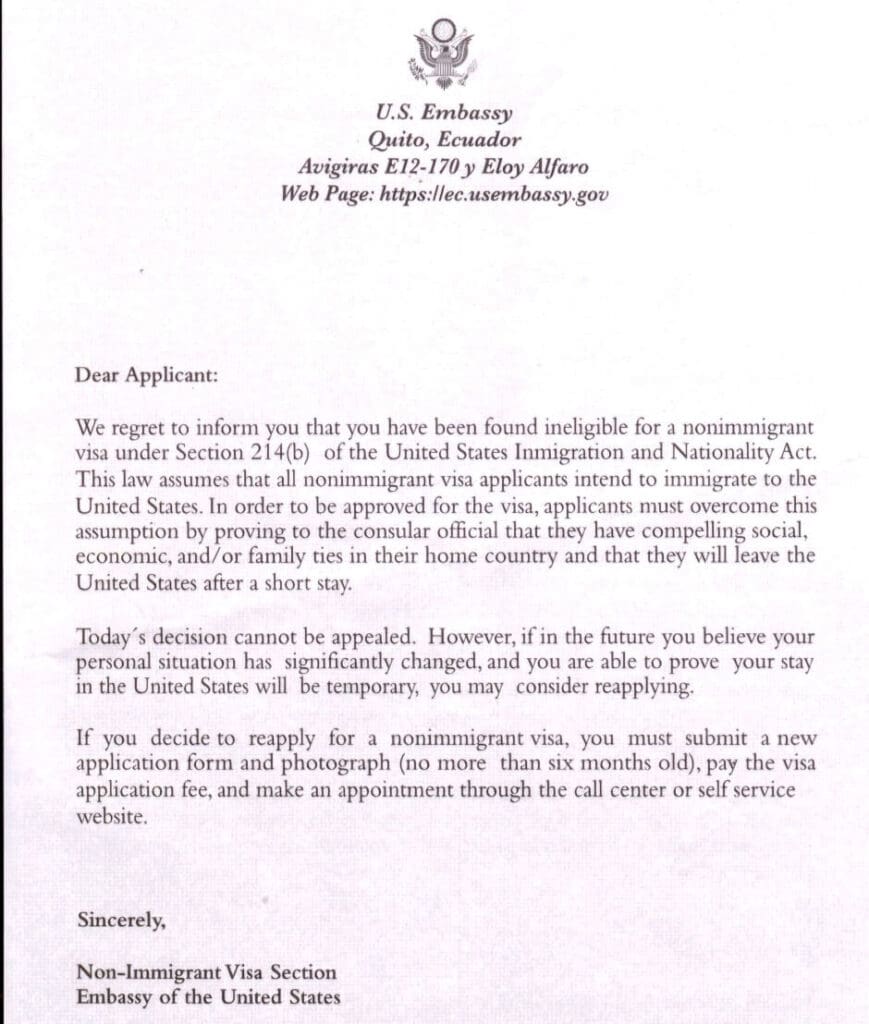
A formal U.S. Embassy letter denying a nonimmigrant visa under Section 214(b) of the United States Immigration and Nationality Act
Step-by-Step Post-Refusal Action Plan
Facing a student visa refusal can be discouraging, but it’s not the end of the road. Many students successfully reapply and receive approval after addressing the reasons for refusal. The key is to stay calm, understand what went wrong, and take clear, corrective steps.
Below is a practical, step-by-step guide to help you navigate the post-refusal process and improve your chances of success in your next attempt:
| Step | Action | Details | Timeline | Cost |
|---|---|---|---|---|
| 1 | Take time to process the news | Give yourself time to cope with disappointment. This is normal. | Immediate | Free |
| 2 | Read the refusal letter carefully | Identify specific reasons for refusal from the official letter. | Within 24 hours | Free |
| 3 | Request GCMS/case notes | Get detailed officer notes to understand the decision better. | Within 1 week | $5-15 USD |
| 4 | Notify your university | Inform your institution about the refusal and timeline changes. | Within 2-3 days | Free |
| 5 | Analyze the refusal reasons | Understand each refusal reason and how to address them. | 1-2 weeks | Free |
| 6 | Gather additional evidence | Collect documents that address the refusal reasons. | 2-4 weeks | Varies |
| 7 | Decide: Reapply or Appeal | Most countries allow reapplication; few have appeal processes. | 1 week | Free |
| 8 | Prepare stronger application | Address every refusal reason with strong evidence. | 3-6 weeks | Document costs |
| 9 | Submit new application | Ensure PAL/acceptance letter is still valid before submitting. | Before PAL expires | Application fee |
| 10 | Monitor application status | Track processing times and respond to any requests promptly. | Ongoing | Free |
Country-Specific Reapplication Rules
After a student visa refusal, it’s essential to understand your options based on your study destination. Each country has its own rules for reapplying, appeal processes, and processing times. The table below provides a quick comparison of key factors to help you decide whether to reapply or appeal, and how to prepare accordingly.
| Country | Can Reapply | Waiting Period | Appeal Process | Reapplication Fee | Key Requirement | Success Rate Reapplication | Processing Time |
|---|---|---|---|---|---|---|---|
| Canada | Yes | None | No formal appeal | Same as original | PAL must be valid | 40-60% | 9-12 weeks |
| USA | Yes | None | No | Same as original | Address refusal reasons | 30-50% | 4-8 weeks |
| UK | Yes | None | Administrative Review | Same as original | New evidence required | 50-70% | 3-8 weeks |
| Australia | Yes | None | AAT Appeal | Same as original | Genuine Student requirement | 45-65% | 4-12 weeks |
| New Zealand | Yes | None | Immigration Tribunal | Same as original | Address refusal reasons | 40-60% | 6-10 weeks |
| Germany | Yes | None | No | Same as original | Address refusal reasons | 35-55% | 6-16 weeks |
Common Reapplication Mistakes to Avoid
Many applicants make critical errors when reapplying after refusal . Understanding these mistakes can significantly improve your chances of success.
| Mistake Category | Common Mistake | How to Avoid | Impact Level |
|---|---|---|---|
| Documentation | Submitting same documents without changes | Provide new/additional evidence for each refusal reason | High |
| Documentation | Not addressing refusal reasons | Directly address each point raised in refusal letter | High |
| Documentation | Poor quality translations | Use certified professional translation services | Medium |
| Documentation | Missing supporting documents | Follow updated checklists and requirements | High |
| Financial | Using same old bank statements | Get fresh bank statements with required balance period | High |
| Financial | Not explaining source of new funds | Provide detailed explanation of fund sources | High |
| Financial | Insufficient proof of funds | Show more funds than minimum required | High |
| Financial | Not showing financial stability | Demonstrate consistent financial history | Medium |
| SOP/Letter | Not mentioning previous refusal | Acknowledge refusal and explain changes made | High |
| SOP/Letter | Same SOP without addressing issues | Write new SOP addressing specific refusal reasons | High |
| SOP/Letter | Generic statements without specifics | Provide detailed, personalized explanations | Medium |
| SOP/Letter | Not explaining ties to home country | Strengthen evidence of home country connections | High |
| Application | Rushing the reapplication | Take time to prepare a strong application | High |
| Application | Not getting professional help | Consider hiring immigration consultant/lawyer | Medium |
| Application | Applying too close to program start | Apply with sufficient time for processing | Medium |
| Application | Not checking PAL validity | Confirm acceptance letter is still valid | High |
High-impact mistakes to avoid:
- Submitting identical documents without addressing refusal reasons
- Using old bank statements instead of fresh financial evidence
- Not acknowledging the previous refusal in your new application
- Rushing the reapplication process
- Failing to provide additional evidence for each refusal reason
Success Factors for Reapplication
If you need to reapply after refusal, focus on these critical success factors .
| Success Factor | Importance Level | Description | Tips |
|---|---|---|---|
| Strong Financial Documentation | Critical | Comprehensive financial proof exceeding minimum requirements | Show 20% more funds than required, maintain balance 28+ days |
| Clear Statement of Purpose | Critical | Well-written SOP addressing all refusal reasons specifically | Address each refusal reason, explain changes made |
| Demonstrable Home Country Ties | High | Strong evidence of family, employment, property ties | Include family photos, property deeds, employment letters |
| Academic Preparedness | High | Relevant academic background and English proficiency | Show academic progression, relevant work experience |
| Genuine Study Intent | Critical | Clear explanation of study goals and career plans | Connect program to career goals, explain return plans |
| Professional Application | Medium | Error-free application with professional presentation | Double-check all forms, use professional services if needed |
| Timely Submission | High | Submit well before deadlines with valid documents | Apply 3+ months before program start date |
| Complete Documentation | Critical | All required documents included with proper certifications | Use official checklists, get documents certified |
Country-Specific Considerations
Canada
- Provincial Attestation Letter (PAL) must be valid
- Address officer concerns about temporary residence intent
- Strong emphasis on returning home after studies
United States
- Section 214(b) is most common refusal reason
- Demonstrate non-immigrant intent
- Show strong ties to home country
United Kingdom
- Financial evidence is primary concern
- 28-day bank statement rule strictly enforced
- Credibility interview may be required
Australia
- Genuine Student (GS) requirement implementation
- Focus on authentic study intentions
- Health insurance requirement included in costs
Expert Tips for Success
Based on immigration lawyer recommendations and successful applicant experiences :
Professional application strategies:
- Consider hiring qualified immigration consultant for complex cases
- Get documents professionally translated by certified translators
- Use official government checklists as primary reference
- Double-check all information for accuracy before submission
- Keep detailed records of all application materials
Financial documentation best practices:
- Provide bank statements showing consistent income sources
- Include letters from employers confirming job security
- Document any scholarships or financial aid thoroughly
- Show multiple funding sources if available
Final Checklist Before Submission
Before submitting your application, complete this final verification:
✓ Document Verification:
- All forms completed accurately and signed
- Required photos meet specifications
- Documents translated by certified translators
- All supporting evidence included
✓ Financial Verification:
- Bank balance maintained for required period
- Fund sources clearly documented
- Total funds exceed minimum requirements
- Fresh bank statements obtained
✓ Academic Verification:
- Acceptance letter valid and from designated institution
- Academic progression logical and explained
- Language proficiency scores meet requirements
- Statement of purpose addresses all requirements
✓ Final Review:
- All refusal reasons addressed (if reapplying)
- Application submitted well before deadlines
- Biometric appointment scheduled
- Interview preparation completed (if required)
Conclusion
Study permit refusal rates are increasing globally, but understanding the reasons behind refusals and taking proactive steps can significantly improve your chances of success . The key is thorough preparation, complete documentation, and demonstrating genuine study intent while maintaining strong ties to your home country.
Remember that refusal is not the end of your study abroad dreams . Many students successfully obtain permits after addressing refusal reasons and submitting stronger applications. Take time to understand why your application was refused, gather additional evidence, and prepare a comprehensive reapplication that addresses all concerns raised by immigration officers.
With proper preparation, attention to detail, and understanding of requirements, you can navigate the study permit process successfully and achieve your goal of studying abroad. Stay persistent, follow the guidelines outlined in this comprehensive guide, and don’t hesitate to seek professional help when needed.
Related reading: How to Apply — a closer look at this topic.