Work Permit Extension Guide: Process, Requirements, and Timeline

Extending your work permit is a crucial step that allows you to continue working legally in your host country without interruption. Whether you’re in Canada, the United States, the United Kingdom, Australia, Germany, or Sweden, understanding the extension process early can save you from potential gaps in your work authorization and help maintain your legal status.
This comprehensive guide will walk you through every aspect of the work permit extension process, from initial planning to final approval, ensuring you have all the tools and knowledge needed for a successful application.
Understanding Work Permit Extensions
What is a Work Permit Extension?
A work permit extension allows foreign workers to legally continue their employment beyond the expiration date of their current work permit. This process is essential for maintaining continuous work authorization and avoiding situations where you might be unable to work legally.
The extension essentially renews your permission to work, often under the same conditions as your original permit, though some changes to employment terms may be possible.
Why Timing Matters
Starting your extension application at the right time is absolutely critical for maintaining your legal work status. Most countries require you to apply at least 30 days before your current permit expires, though some jurisdictions recommend starting the process much earlier.
If you apply before your permit expires, you can often continue working under “implied status” or “maintained status” while your application is being processed.
Person filling out an online application form on a laptop, illustrating the digital submission process alamy
Work Permit Extension Complete Checklist
📋 Pre-Application Preparation (3-6 Months Before Expiry)
✅ Eligibility Assessment
- Verify current work permit is still valid
- Confirm compliance with all permit conditions
- Check if job/employer meets extension requirements
- Review country-specific eligibility criteria
- Calculate minimum advance notice period for your country
✅ Employer Requirements
- Confirm employer is approved/licensed to sponsor workers
- Obtain new job offer letter or contract extension
- Secure Labour Market Impact Assessment (LMIA) if required
- Get employer compliance verification documents
- Ensure salary meets minimum requirements
📄 Document Collection (2-3 Months Before Expiry)
✅ Personal Documents
- Valid passport (must cover entire extension period)
- 2-4 recent passport-size photos (white background)
- Birth certificate (if required)
- Marriage certificate (if applicable)
- National ID card or equivalent
✅ Employment Documents
- Current work permit (copy)
- Job offer letter from employer
- Updated employment contract
- Recent pay stubs (last 2-3 months)
- Employment verification letter
- LMIA or exemption documents
✅ Financial Documents
- Bank statements (last 3-6 months)
- Tax returns (previous 1-2 years)
- Proof of sufficient funds
- Financial support documentation
✅ Immigration Documents
- Previous visas and permits
- Immigration history documents
- Application forms (completed and signed)
- Legal status maintenance proof
💰 Financial Preparation
✅ Fee Calculation
- Application processing fee (varies by country)
- Biometrics fee (if required)
- Open work permit holder fee (if applicable)
- Express processing fee (if available)
- Legal consultation fees (if using lawyer)
✅ Payment Methods
- Online payment setup
- Credit/debit card ready
- Bank draft or money order (if required)
- Receipt storage system
📝 Application Submission (30-90 Days Before Expiry)
✅ Application Preparation
- Complete application form accurately
- Review all documents for completeness
- Make copies of all original documents
- Organize documents as per checklist
- Double-check application for errors
✅ Submission Process
- Submit application online (preferred) or by mail
- Pay all required fees
- Save confirmation/receipt number
- Print application confirmation
- Set up application tracking
🕐 Post-Submission Activities
✅ Immediate Actions
- Save receipt notice (I-797C for US, equivalent for other countries)
- Set up case status checking
- Inform employer of application submission
- Update address if moving during processing
- Keep all confirmation documents safe
✅ Biometrics (If Required)
- Wait for biometrics appointment notice
- Schedule appointment within required timeframe
- Attend biometrics appointment
- Bring required documents to appointment
- Keep biometrics confirmation receipt
✅ Status Monitoring
- Check application status regularly
- Respond to any requests for additional documents
- Update employer on application progress
- Maintain implied status documentation
- Keep employment records current
⚠️ Important Reminders
✅ Timing Critical Points
- Apply at least 30 days before current permit expires
- Don’t travel outside country during processing (unless permitted)
- Maintain current job and employer during processing
- Keep copies of all submitted documents
- Update provincial/territorial documents before permit expires
✅ While Application is Pending
- Continue working under same conditions (implied status)
- Don’t change employers (unless open work permit)
- Keep employment records updated
- Maintain legal status and address
- Respond promptly to any government requests
📞 Emergency Contacts & Resources
✅ Important Contacts
- Immigration lawyer/consultant contact info
- Employer HR department contact
- Government immigration helpline numbers
- Embassy/consulate contact information
- Legal aid organizations
✅ Backup Plans
- Know restoration of status procedures
- Understand appeal processes
- Have emergency funds available
- Know temporary work authorization options
- Understand consequences of refusal
🎯 Final Verification
✅ Before Submission
- All documents collected and verified
- Application form completely filled
- Fees calculated and payment ready
- Deadline compliance confirmed
- Backup copies made
✅ Application Quality Check
- No blank fields in application
- All signatures in place
- Correct photographs attached
- Fee payment confirmed
- Supporting documents complete
Remember: Requirements vary by country. Always check with official government sources and consider consulting an immigration professional for complex cases.
When to Start Your Extension Process
Recommended Timeline
The ideal time to begin your work permit extension varies by country, but general best practices suggest starting the process 3-6 months before your current permit expires. This timeline allows sufficient time for document gathering, employer requirements, and potential delays in processing. Here’s a breakdown of when to start different phases of the process:
- 3-6 months before expiry: Initial eligibility assessment and planning
- 2-3 months before expiry: Document collection and employer coordination
- 30-90 days before expiry: Application submission
Country-Specific Advance Notice Requirements
Different countries have varying requirements for how far in advance you must apply. For example, the United States allows applications up to 240 days before expiration, while Canada recommends at least 30 days. The United Kingdom requires applications at least 28 days before expiry, and Germany suggests starting 90 days in advance.
Eligibility Requirements
Basic Eligibility Criteria
To be eligible for a work permit extension, you must meet several fundamental requirements. First, you must have a valid work permit at the time of application, though some countries allow restoration of status if your permit has expired within a specific timeframe. You must also have complied with all conditions of your current permit, including working for the specified employer and in the designated location.
Employment-Specific Requirements
For employer-specific work permits, your eligibility often depends on maintaining the same employment relationship. This includes working for the same employer, in the same occupation code, and often at the same salary level or higher. If you’re changing employers or job roles, you may need additional documentation such as a new Labour Market Impact Assessment (LMIA) or updated job offer.
Financial Requirements
Most countries require proof that you can financially support yourself during the extension period. The specific amount varies by country – for example, Canada requires proof of $1,270 CAD in available funds, while the UK requires £1,270. You’ll typically need to show this money has been available for at least 28 days before applying.
Step-by-Step Extension Process
Step 1: Eligibility Assessment
Begin by thoroughly reviewing your current work permit conditions and ensuring you still meet all requirements. Check that your job continues to qualify under the same classification and that your employer remains approved to sponsor foreign workers. Verify that you haven’t violated any conditions of your current permit, as this could affect your extension eligibility .
Step 2: Employer Coordination
Work closely with your employer to ensure they complete their required steps. This may include obtaining a new LMIA, providing updated job offer letters, or confirming their continued sponsorship. Your employer must also verify that they remain compliant with all sponsorship requirements and that your position still meets the necessary criteria.
Step 3: Document Preparation
Gather all required documents well in advance of your application deadline. This includes personal documents like your passport and photos, employment documents such as contracts and pay stubs, and financial proof including bank statements and tax returns. Ensure all documents are current and meet the specific requirements of your destination country.


Canadian work permit application form for applicants outside Canada showing required personal and family information fields dochub
Step 4: Application Submission
Most countries now prefer or require online applications for work permit extensions. Complete your application carefully, ensuring all information is accurate and all required documents are properly uploaded. Pay the required fees and save your confirmation receipt, as this will be important for tracking your application and proving implied status.
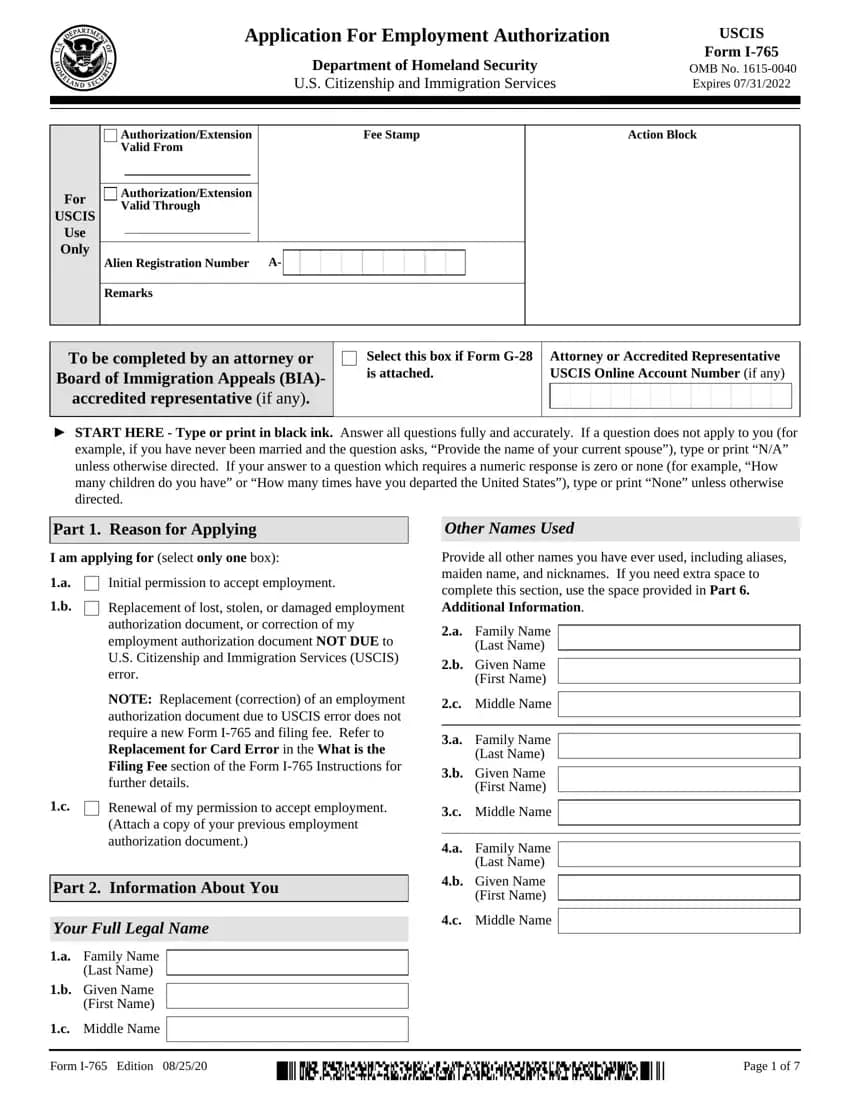
Page 1 of the USCIS Form I-765, Application for Employment Authorization, which includes options for work permit renewal formspal
Step 5: Biometrics and Additional Requirements
Many countries require biometric information as part of the extension process. You’ll typically receive instructions for scheduling your biometrics appointment after submitting your application. Attend your appointment promptly and bring all required documents.
Step 6: Processing and Follow-up
Monitor your application status regularly and respond promptly to any requests for additional information. Keep your employer informed of your application progress and maintain all required employment records. If your permit expires while your application is pending, ensure you understand your rights under implied status.
Required Documents Checklist
| Document Category | Required Document | Mandatory | Notes |
|---|---|---|---|
| Personal Documents | Valid Passport | Yes | Must be valid for entire permit period |
| Personal Documents | Passport Photos | Yes | 2-4 recent passport-size photos with white background |
| Personal Documents | Birth Certificate | Sometimes | Required for some countries/situations |
| Personal Documents | Marriage Certificate (if applicable) | Sometimes | If status change due to marriage |
| Employment Documents | Job Offer Letter | Yes | Must be from approved employer |
| Employment Documents | Employment Contract | Yes | Updated contract with extension details |
| Employment Documents | Labour Market Impact Assessment (LMIA) | Country Specific | Required in Canada for certain positions |
| Employment Documents | Pay Stubs/Salary Proof | Yes | Recent 2-3 months of employment proof |
| Financial Documents | Bank Statements | Yes | Last 3-6 months showing sufficient funds |
| Financial Documents | Tax Returns | Sometimes | Previous 1-2 years if requested |
| Financial Documents | Proof of Funds | Country Specific | Amount varies by country ($1,270 CAD for Canada) |
| Immigration Documents | Current Work Permit | Yes | Copy of current valid permit |
| Immigration Documents | Previous Immigration Documents | Yes | Any previous visas, permits, or immigration history |
| Immigration Documents | Visa Application Form | Yes | Completed and signed application form |
| Additional Documents | Medical Examination | Country Specific | Health check if required by specific country |
| Additional Documents | Police Clearance Certificate | Country Specific | Criminal background check from home country |
| Additional Documents | Educational Credentials | Sometimes | Degree/diploma verification if job requires |
Personal Documents
Every work permit extension requires specific personal documentation. Your passport must be valid for the entire requested extension period, and you’ll need recent passport-sized photographs with a white background. Depending on your situation and destination country, you may also need birth certificates, marriage certificates, or national identification cards.
Employment Documentation
Employment-related documents form the core of your extension application. You’ll need a current job offer letter or contract extension from your employer, recent pay stubs proving your employment, and potentially a new LMIA or exemption documentation. Your employer may also need to provide compliance verification documents.
Financial Proof
Financial documentation demonstrates your ability to support yourself during the extension period. Bank statements from the last 3-6 months are typically required, along with proof of sufficient funds as specified by your destination country. Some countries may also request tax returns from previous years.
Immigration History
Provide complete documentation of your immigration history, including copies of all previous visas and permits. Your current work permit and any previous immigration documents help establish your compliance history and eligibility for extension.
Processing Times and Costs by Country
Comparative Analysis
Work permit extension costs and processing times vary significantly between countries, making it important to plan accordingly. Understanding these differences can help you budget appropriately and plan your application timeline.

Country-Specific Details
Canada offers one of the most cost-effective extension processes at $155 CAD, with processing times typically ranging from 8-12 weeks. The country also provides implied status, allowing continued work while applications are processed.
United States applications cost significantly more at $460 USD and can take 3-6 months to process. However, the US provides a substantial 540-day automatic extension for certain categories of Employment Authorization Documents.
United Kingdom has the highest application fees at £885 for extensions, but processing times are relatively quick at around 8 weeks. The UK does not provide implied status, making timing crucial.
Australia charges approximately $630 USD for extensions with processing times ranging from 2-6 months. The Australian system requires careful attention to timing as there’s no automatic work authorization while applications are pending.
Germany and Sweden offer moderate pricing at $350 and $270 USD respectively, with processing times of 8-12 weeks and 6-8 weeks.
Common Mistakes to Avoid
Timing Errors
One of the most critical mistakes is waiting too long to submit your extension application. Applying too close to your permit’s expiration date can result in gaps in work authorization or even denial of your application. Start the process early and allow extra time for unexpected delays.
Incomplete Documentation
Submitting incomplete applications is a leading cause of delays and rejections. Missing documents, incorrect forms, or outdated information can significantly impact your application’s success. Use comprehensive checklists and double-check all requirements before submission.
Employer-Related Issues
Failing to coordinate properly with your employer can create significant problems. Ensure your employer completes all required steps, such as obtaining new LMIAs or providing updated job offers, well before your application deadline.
Status Maintenance
Not understanding or properly maintaining your legal status while your application is pending can lead to serious consequences. Learn about implied status rules and ensure you continue working only under permitted conditions.
Tips for a Successful Extension
Start Early and Plan Ahead
The key to a successful work permit extension is early planning and preparation. Create a timeline working backward from your permit expiration date and build in buffer time for unexpected delays. Gather documents gradually rather than rushing at the last minute.
Maintain Detailed Records
Keep comprehensive records of all your employment history, immigration documents, and correspondence with government agencies. This documentation can be invaluable if questions arise during processing or if you need to prove your compliance history.
Professional Assistance
Consider consulting with an immigration lawyer or consultant, especially if your situation is complex or if you’ve had previous immigration issues. Professional guidance can help you navigate complex requirements and avoid costly mistakes.
Communication with Employer
Maintain open communication with your employer throughout the extension process. Ensure they understand their responsibilities and timelines, and keep them informed of your application progress.
What to Do While Your Application is Pending
Understanding Implied Status
If you submit your extension application before your current permit expires, you typically gain “implied status” or “maintained status”. This allows you to continue working under the same conditions as your original permit while your application is processed.

First page of the Government of Canada’s “Application for Work Permit Made Outside of Canada” form (IMM 1295), detailing personal information sections formspal
Work Restrictions
While on implied status, you must continue working under the exact same conditions as your original permit. For employer-specific permits, this means you cannot change employers or job roles until your new permit is approved. Open work permit holders typically retain more flexibility.
Status Monitoring
Regularly check your application status and respond promptly to any requests for additional information. Keep your contact information current and inform the immigration authorities of any address changes.
Provincial and Federal Document Updates
If your work permit expires while your application is pending, you may not be able to renew provincial documents like driver’s licenses or health cards. Plan to update these documents before your current permit expires.
Process Flow and Timeline
Understanding the complete work permit extension process helps ensure you don’t miss critical steps or deadlines. The process typically involves eight main stages, each with specific timing requirements and key actions.
| Step | Process | Timeline | Key_Actions |
|---|---|---|---|
| 1 | Check Eligibility | 3-6 months before expiry | Review permit conditions, job requirements, and legal status |
| 2 | Gather Documents | 2-3 months before expiry | Passport, photos, employment documents, financial proof |
| 3 | Employer Requirements | 2-3 months before expiry | LMIA, job offer letter, employer compliance verification |
| 4 | Submit Application | 30-90 days before expiry | Online/paper application with all supporting documents |
| 5 | Pay Fees | At time of submission | Application fee payment (varies by country) |
| 6 | Biometrics (if required) | Within 30 days of submission | Fingerprints and photos at designated centers |
| 7 | Wait for Processing | Processing period varies | Maintain implied status, track application progress |
| 8 | Receive Decision | Final step | New permit issued or application refused with reasons |
Conclusion
Successfully extending your work permit requires careful planning, attention to detail, and adherence to specific timelines. By starting early, gathering all required documents, and understanding your country’s specific requirements, you can navigate this process smoothly and maintain continuous work authorization.
Remember that requirements vary significantly between countries, so always verify current information with official government sources and consider professional assistance for complex situations. With proper preparation and the tools provided in this guide, you’ll be well-equipped to successfully extend your work permit and continue building your career abroad.
Related reading: Study Permit Extension: How to Renew Your Student — a closer look at this topic.