
80% of New Study Permits Processed in 28 Days by Feb. 28

As of February 28, 2026, 80% of new study permit applications were processed in 28 days or less, against a 60-day service standard. These figures concern study permits, so they don’t give a new work permit processing time or show whether work permit wait times rose. Study permit extensions were processed in 90 days or less, against a 120-day standard.
Did work permit wait times rise in the latest IRCC figures?
Quick answer: No. The figures do not give a work permit processing time or show whether those waits rose. As of February 28, 2026, 80% of new study permit applications were processed in 28 days or less, against a 60-day standard. Study permit extensions took 90 days or less, against a 120-day standard.
- New study permits: 28 days or less for 80% of applications; the service standard was 60 days as of February 28, 2026.
- Study permit extensions: 90 days or less; the service standard was 120 days as of February 28, 2026.
- These figures apply to study permits, not work permits.
- If you need an estimate for your application, select your specific stream in IRCC’s Processing Times Tool.
Processing times by program
The published study-permit figures pair a processing time with a service standard for each application type.
The comparison is for February 28, 2026:
| Program | Processing time | Service standard |
|---|---|---|
| New study permits | 28 days or less for 80% of applications | 60 days |
| Study permit extensions | 90 days or less | 120 days |
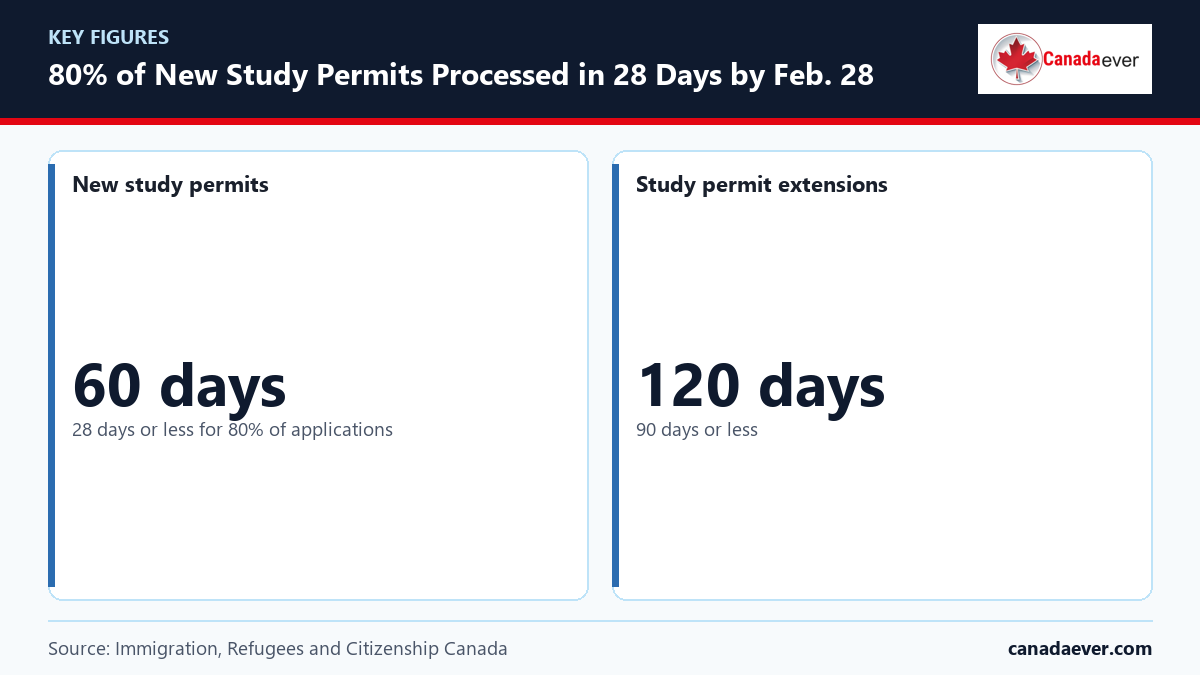
The new-permit figure measures the time in which 80% of applications were processed. The extension figure is reported as a processing time, with its own service standard. These figures don’t establish a change from an earlier period or a rise in work permit wait times.
What changed since the last update
How IRCC measures processing times
The reported processing time and the service standard are separate measures.
IRCC’s Processing Times Tool gives estimates for specific application streams, using historical or forward-looking data. That means the estimate is tied to the stream you select, rather than being a single wait time for every application.
Processing times can change with application volume and case complexity. IRCC also identifies immigration targets and how quickly applicants respond to requests for information as factors that affect processing times. You may therefore wait longer or less time than the estimate, depending on your application and how quickly you respond to requests.
What to do if your application is over the time
Use IRCC’s Processing Times Tool to find estimated processing times for specific application streams.
Select your application stream. IRCC’s tool gives estimated processing times for specific streams, using historical or forward-looking data.
Use the estimate as a guide. Actual processing times may vary with application volume and the complexity of cases.
Respond promptly to information requests. How quickly you reply can affect processing time, along with immigration targets and the complexity of your case.
| Key fact | Source |
|---|---|
| Permanent Resident: Processing times refer to the time in which 80% of complete applications were finalized by IRCC in the past 6 months from the date indicated. | Immigration, Refugees and Citizenship Canada |
| Temporary Resident: Processing times refer to the time in which 80% of complete applications were finalized by IRCC in the previous 8 weeks from the date indicated. | Immigration, Refugees and Citizenship Canada |
| Immigration, Refugees and Citizenship Canada (IRCC) remains committed to processing 80% of applications within service standards and increasing transparency around application processing. | Immigration, Refugees and Citizenship Canada |
| IRCC received 3% fewer enquiries in January to September 2025 than in the same time last year (which represents a decrease of over 179K enquiries). | Immigration, Refugees and Citizenship Canada |
| The Client Support Centre has maintained a call answer rate of 41% from January to September 2025, which exceeds the 30% service standard we are funded to provide. | Immigration, Refugees and Citizenship Canada |
| This was reduced by 43K at the end of September, representing an inventory decrease of 61%. | Immigration, Refugees and Citizenship Canada |
Frequently Asked Questions
SEO title: Work permit wait times rise study: what IRCC’s figures show
What IRCC’s processing figures show
IRCC’s figures concern study permits and don’t show whether work permit waits rose.
What affects processing times
IRCC says actual processing times can vary with application volume and case complexity.
Use the estimate for your stream as a guide, since your application may take longer or less time.
What to do next
If your application is past the estimate, check the Processing Times Tool for your specific application stream. Reply promptly to requests for information, since how quickly you respond can affect processing times.
How do I find my application stream in IRCC’s Processing Times Tool?
Select your specific application stream in IRCC’s Processing Times Tool to see its estimated processing time. The tool uses historical or forward-looking data, and the estimate may differ from your actual wait.
If my case is more complex, can I expect longer than 28 days?
IRCC says case complexity can affect actual processing times.
What happens if IRCC requests additional documents or information during processing?
How quickly you respond to a request for information can affect your processing time. Respond promptly, and use the estimate for your application stream as a guide.
Last checked: November 13, 2026. Rules and dates can change; confirm on Canada.ca.
Sources
- canada.ca: Processing Times and Service Delivery