BREAKING: Major IRCC Changes 2026-2026 – Essential Updates Every Immigrant Needs to Know

Canada’s immigration landscape is undergoing its most significant transformation in decades. Immigration, Refugees and Citizenship Canada (IRCC) has announced sweeping changes for 2025-2026 that will impact nearly every immigration pathway.
Quick answer: IRCC’s levels plan projects a decrease in overall permanent resident admissions to 395,000 in 2025, 380,000 in 2026 and 365,000 in 2027. Since January 22, 2024, most new post-secondary international students must also provide a provincial attestation letter (PAL) with their study permit application.
Whether you’re planning to study, work, or immigrate permanently to Canada, these changes will directly affect your journey.
🚨 Key Takeaway:
Canada is dramatically reducing immigration numbers across all categories, with permanent residency targets cut by 21% and provincial nominee allocations slashed by 50%.
1. Permanent Residency Targets: Historic 21% Reduction
Canada has announced its most significant reduction in permanent residency targets in recent history, marking a shift toward more controlled immigration growth.
The Numbers:
- 2025: 395,000 new permanent residents (down from 485,000 in 2024)
- 2026: 380,000 new permanent residents
- 2027: 365,000 new permanent residents
The IRCC 2025-2027 Immigration Levels Plan projects 395,000 permanent resident admissions in 2025, 380,000 in 2026 and 365,000 in 2027.
This represents a 21% decrease from 2024 levels, with the government citing housing shortages, infrastructure pressures, and the need for sustainable growth.


Canada’s permanent residency targets showing dramatic 21% reduction from 2024 to 2025
What This Means for You:
- Longer processing times due to increased competition
- Higher CRS scores required for Express Entry
- More selective invitation rounds across all programs
- Priority given to candidates already in Canada (40%+ of admissions)
2. Provincial Nominee Program: Devastating 50% Cuts
Perhaps the most shocking change is the 50% reduction in Provincial Nominee Program (PNP) allocations across all provinces.
2025 PNP Allocation Cuts:
- Ontario: 21,500 → 10,750 (50% cut)
- British Columbia: ~15,100 → 7,586 (50% cut)
- Alberta: 9,942 → 4,971 (50% cut)
- Manitoba: 9,540 → 4,750 (50% cut)
- Saskatchewan: 7,250 → 3,625 (50% cut)
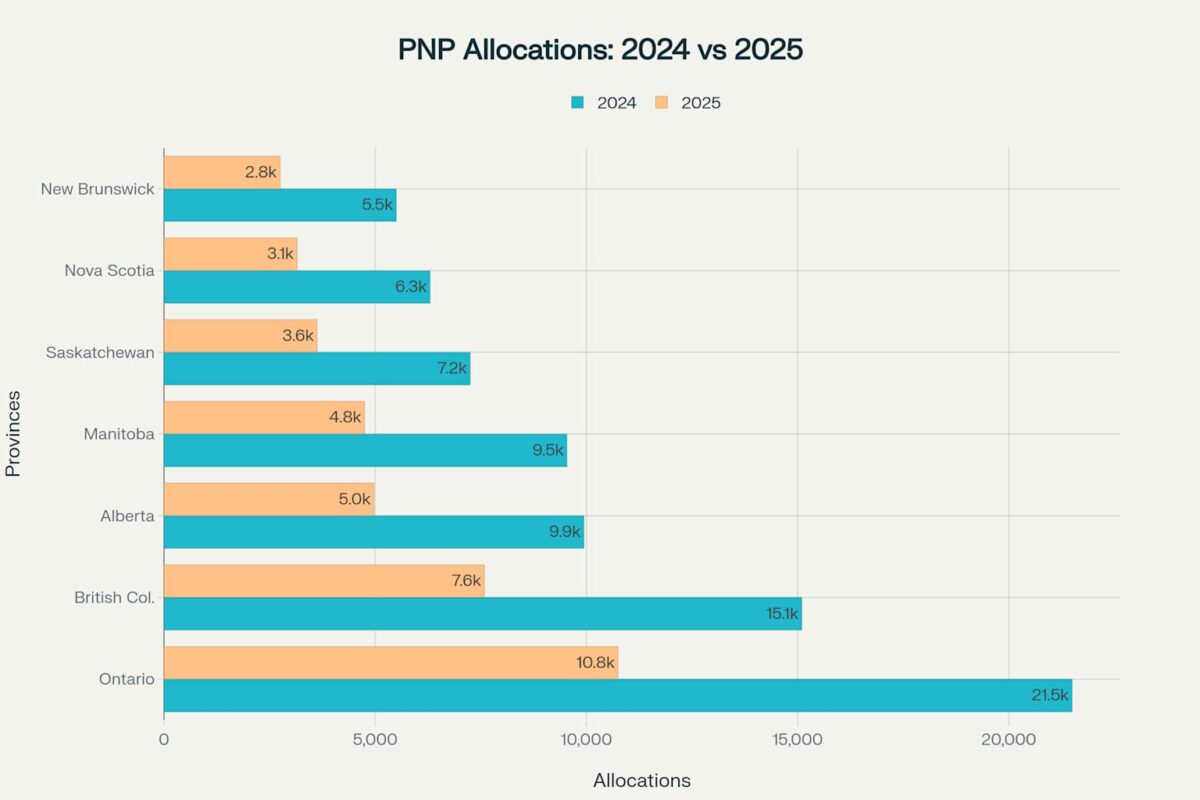
Comparison of Provincial Nominee Program allocations showing dramatic 50% cuts across all major provinces
Impact on Applicants:
- Significantly longer wait times for PNP processing
- More competitive selection criteria
- Provinces prioritizing candidates already in Canada
- Some streams may temporarily close due to limited allocations
3. Express Entry System: End of All-Program Draws
Express Entry has undergone its most dramatic change since launch, completely eliminating general all-program draws in favor of targeted category-based selections.
Major Changes:
- No all-program draws for the first time since 2015
- Category-based draws only targeting specific occupations
- Job offer points eliminated (effective March 25, 2025)
- Higher CRS score requirements due to reduced invitations
Priority Categories:
- French-speaking candidates (CRS scores as low as 379)
- Healthcare workers (CRS around 510)
- Skilled trades professionals
- STEM workers
- Education and childcare workers (CRS around 479)
- Candidates with Canadian work experience
What You Need to Do:
- Focus on French language skills for better chances
- Gain Canadian work experience if possible
- Target in-demand occupations in healthcare, trades, or education
- Improve other CRS factors since job offers no longer provide points
4. International Students: 10% Reduction in Study Permits
The international student sector faces continued restrictions with a 10% reduction in study permits for 2025.
2025 Study Permit Caps:
- Total permits: 437,000 (down from 485,000 in 2024)
- PAL-required students: 316,276 permits
- Graduate students: 73,282 permits (reserved allocation)
According to IRCC, Canada plans to issue a total of 437,000 study permits in 2025, a 10% decrease from the 2024 cap.
Key Requirements:
- Provincial Attestation Letter (PAL) required for most programs
- Enhanced language requirements for certain programs
- Stricter financial proof requirements
- Focus on programs aligned with labor market needs
5. Post-Graduation Work Permits: Major Field Changes
IRCC has completely overhauled eligible fields of study for Post-Graduation Work Permits (PGWPs), affecting thousands of international students.
Effective June 25, 2025:
- 119 new fields added (healthcare, social services, education, trades)
- 178 fields removed (agriculture, transportation, some STEM programs)
- Total eligible fields: 920
Grandfathering Rules:
- Students who applied for study permits before June 25, 2025 remain eligible under old rules
- Changes only apply to non-degree programs (certificates, diplomas)
- Bachelor’s, Master’s, and PhD programs remain unaffected
New Priority Areas:
- Healthcare and social services
- Education and teaching
- Skilled trades and construction
- Agri-food sector (limited agriculture programs)
6. Spousal Open Work Permits: Significant Restrictions
Major changes to Spousal Open Work Permit (SOWP) eligibility took effect January 21, 2025.
Who Still Qualifies:
For International Student Spouses:
- Graduate students (Master’s 16+ months, PhD programs)
- Select professional degrees: Medicine (MD), Dentistry (DDS), Law (LLB/JD), Optometry (OD), Pharmacy, Veterinary Medicine (DVM), Nursing (BScN), Education (BEd), Engineering (BEng)
For Foreign Worker Spouses:
- TEER 0, 1, 2, or 3 occupations only
- Healthcare, education, and trades workers
Who No Longer Qualifies:
- Spouses of undergraduate students (except professional programs)
- Spouses of college/diploma students
- Spouses of workers in lower-skilled positions
7. Temporary Foreign Workers: Reduced LMIA Numbers
The Temporary Foreign Worker Program faces significant cuts, with LMIA-based work permits reduced to 80,000-84,000 annually (down from 184,000 in 2023).
New LMIA Restrictions:
- No processing in areas with 6%+ unemployment
- Stricter wage requirements
- Enhanced compliance monitoring
- Sector-specific freezes in Quebec and BC
Affected Areas (High Unemployment):
- Toronto, Ontario (8.6% unemployment)
- Windsor, Ontario (9.3% unemployment)
- Edmonton, Alberta (7.3% unemployment)
- Calgary, Alberta (7.8% unemployment)
8. Additional Important Changes
Super Visa Improvements
- International insurance providers now accepted (effective January 28, 2025)
- More affordable options for parents and grandparents
- OSFI-approved providers required
Processing Fee Increases
- Citizenship fees: $630 → $649.75 (effective March 31, 2025)
- Various temporary resident fees increased December 1, 2024
French Language Priority
- Enhanced selection for French speakers in Express Entry
- Target: 8.5% of PR admissions outside Quebec to be French speakers
- Lower CRS scores for French-proficient candidates
Digital Transformation
- New online portal rolling out for all IRCC clients
- Improved processing systems to reduce backlogs
- Enhanced digital services for applications
🎯 Action Steps for Immigrants
If You’re Planning to Apply:
- Submit applications immediately before further restrictions
- Improve French language skills for better Express Entry chances
- Consider studying in high-demand fields (healthcare, trades, education)
- Target provinces with labor shortages despite reduced PNP allocations
If You’re Already in Canada:
- Apply for permanent residency ASAP – priority given to inland candidates
- Maintain legal status – don’t let permits expire
- Gain Canadian work experience in high-demand sectors
- Improve language scores for better CRS ranking
If You’re an International Student:
- Check PGWP eligibility for your program immediately
- Consider switching programs if your field was removed
- Plan spouse’s work permit options under new rules
- Focus on networking and job search in eligible sectors
📊 Complete Overview of Changes
| Category | Key Changes 2025-2026 | Impact Level | Effective Date |
|---|---|---|---|
| Permanent Residency Targets | 21% reduction: 395,000 (2025) → 380,000 (2026) → 365,000 (2027) | High | January 2025 |
| Provincial Nominee Program | 50% allocation cuts across all provinces | Very High | January 2025 |
| Express Entry System | No all-program draws; category-based draws only | High | Ongoing 2025 |
| International Students | 10% study permit reduction: 437,000 permits in 2025 | High | January 2025 |
| Post-Graduation Work Permits | 119 new eligible fields added, 178 fields removed | Medium | June 25, 2025 |
| Spousal Open Work Permits | Restricted to graduate students and select professional programs | High | January 21, 2025 |
| Temporary Foreign Workers | Reduced to 80,000-84,000 LMIA-based permits annually | Medium | 2025-2026 |
| Super Visa | International insurance providers now accepted | Low | January 28, 2025 |
| Processing Fees | Citizenship fee increased from $630 to $649.75 | Low | March 31, 2025 |
| Express Entry Job Offers | Job offer points eliminated (March 2025) | Medium | March 25, 2025 |
| French Language Priority | Enhanced priority for French speakers in Express Entry | Medium | Ongoing 2025 |
| Digital Transformation | New online portal rollout for all IRCC clients | Medium | 2025-2026 |
🔍 What’s Next?
These changes represent Canada’s most significant immigration policy shift in decades. The government aims to balance economic needs with infrastructure capacity while maintaining Canada’s commitment to immigration.
Expected Timeline:
- 2025: Full implementation of new rules
- 2026: Further reductions in PR targets
- 2027: Stabilization at lower immigration levels
Key Monitoring Points:
- Express Entry draw patterns and CRS score trends
- Provincial responses to reduced PNP allocations
- Labor market impacts in key sectors
- Processing time changes due to reduced volumes
📞 Get Professional Help
Given the complexity and impact of these changes, consulting with a licensed immigration professional is more crucial than ever. These sweeping reforms affect nearly every immigration pathway and require careful planning to navigate successfully.
Remember: Immigration laws change frequently. Always verify current requirements with IRCC’s official website or a licensed immigration consultant before making important decisions.
Related reading: Discover 2025’s Key Canada Immigration Policy Changes & — a closer look at this topic.
Quick answers from official sources
What are the permanent resident targets in the levels plan?
395,000 in 2025, 380,000 in 2026 and 365,000 in 2027, according to IRCC.
Do international students need a provincial attestation letter?
Most new post-secondary students at the college or undergraduate level do, unless exempt.
Does entering Express Entry guarantee an invitation?
No. IRCC says entering the pool doesn’t guarantee an invitation to apply.
Sources (checked October 27, 2026):
- canada.ca/en/immigration-refugees-citizenship/news/notices/supplementary-immigration-levels-2025-2027.html
- canada.ca/en/immigration-refugees-citizenship/news/notices/international-student-program-reform-more-information.html
- canada.ca/en/immigration-refugees-citizenship/services/immigrate-canada/express-entry/create-profile.html