Express Entry Documents Checklist: Everything You Need to Know

Canada’s Express Entry system is the primary pathway for skilled workers to obtain permanent residence, managing applications for three federal economic immigration programs: the Federal Skilled Worker Program (FSWP), Canadian Experience Class (CEC), and Federal Skilled Trades Program (FSTP) 12.
Successfully navigating this system requires careful preparation and a comprehensive understanding of all document requirements, which can vary significantly depending on your specific program and personal circumstances 34.
This comprehensive guide will walk you through every document you need for a successful Express Entry application, from the initial profile creation to receiving your Confirmation of Permanent Residence (COPR). Whether you’re just starting your immigration journey or preparing for your Invitation to Apply (ITA), this checklist ensures you won’t miss any critical documentation.
Understanding the Express Entry System
Express Entry operates as a points-based system using the Comprehensive Ranking System (CRS), where candidates are ranked based on factors including age, education, language proficiency, work experience, and other qualifying factors. The system conducts regular draws, typically every two weeks, inviting the highest-scoring candidates to apply for permanent residence.
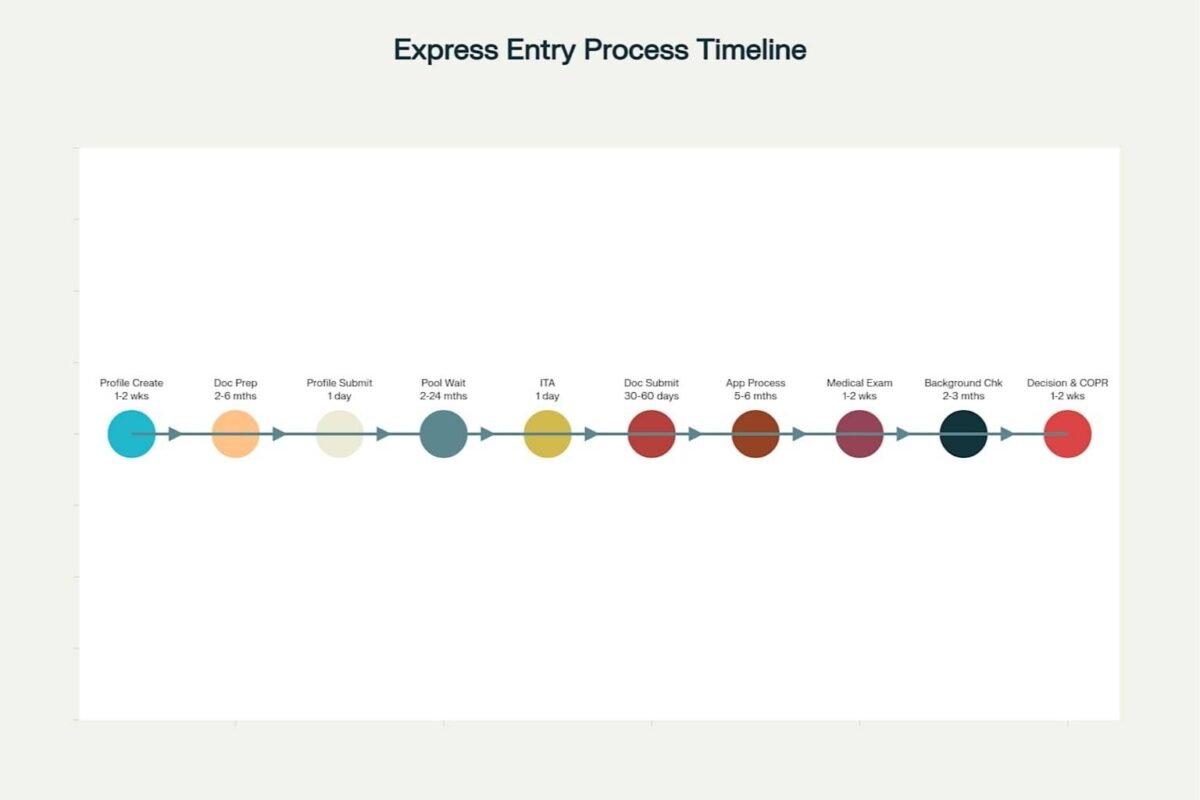

Express Entry Process Timeline: Step-by-step Guide from Profile to Permanent Residence
The Express Entry process involves two main phases: creating your initial profile for the Express Entry pool, and submitting your complete application after receiving an ITA. Each phase has distinct document requirements, and understanding these phases is crucial for proper preparation.
✅ Pre-Application Checklist
Phase 1: Essential Documents for Profile Creation
🆔 Identity Documents
- Valid passport (must not expire within 6 months of application)
- Birth certificate (certified copy)
- National identity card (if applicable)
- Name change documents (if applicable)
🗣️ Language Tests (Choose One)
- IELTS General Training – Valid for 2 years
- Reading: Min 6.0 (FSWP), 4.0-6.0 (CEC), 5.0 (FSTP)
- Writing: Min 6.0 (FSWP), 5.0-6.0 (CEC), 3.5 (FSTP)
- Speaking: Min 6.0 (FSWP), 5.0-6.0 (CEC), 4.0 (FSTP)
- Listening: Min 6.0 (FSWP), 5.0-6.0 (CEC), 5.0 (FSTP)
- CELPIP General – Valid for 2 years
- All skills: Min 7 (FSWP/CEC TEER 0-1), 5 (CEC TEER 2-3), 4-5 (FSTP)
- TEF Canada/TCF Canada (For French)
- Equivalent CLB 7 for FSWP, CLB 5-7 for CEC
🎓 Education Documents
- Educational certificates/diplomas (all levels)
- Official transcripts
- Educational Credential Assessment (ECA) – Required for foreign education
- WES (World Education Services) – Most popular
- ICAS, IQAS, CES, ICES (Other approved organizations)
- Medical Council of Canada (for doctors)
- Pharmacy Examining Board (for pharmacists)
💼 Work Experience Documents
- Employment reference letters (must include specific format)
- Work contracts
- Pay stubs or tax documents
- Professional licenses (if applicable)
Phase 2: Additional Documents for Specific Situations
💰 Proof of Funds (FSWP & FSTP Only)
2025 Requirements:
- 1 person: CAD $14,690
- 2 people: CAD $18,288
- 3 people: CAD $22,483
- 4 people: CAD $27,297
- 5 people: CAD $30,690
- 6 people: CAD $34,917
- 7+ people: CAD $38,875 + $3,958 per additional member
Required Documents:
- Bank statements (6 months)
- Official bank letter on letterhead
- Investment certificates
- Fixed deposits proof
🏆 Optional Enhancement Documents
- Provincial Nomination Certificate (if applicable)
- Valid job offer letter from Canadian employer
- Trade qualification certificate
- Canadian work/study experience documents
✅ Post-ITA Checklist (After Receiving Invitation)
⏰ Deadline: 60 Days to Submit
📋 Additional Required Documents
🏥 Medical Examination
- Medical exam by IRCC-approved panel physician
- eMedical information sheet
- Chest X-ray
- Blood tests (HIV, syphilis, etc.)
- Urine tests
- Note: Valid for 12 months from exam date
🚔 Police Clearance Certificates
Required for:
- You and family members 18+ years old
- Every country where you lived 6+ months since age 18
- Must be issued within 6 months of application
Common Countries Process:
- Home country police certificate
- Canada (if lived there 6+ months)
- Any other countries of residence
👨👩👧👦 Family Documents
- Marriage certificate (if married)
- Divorce/separation documents (if applicable)
- Birth certificates of dependent children
- Adoption documents (if applicable)
- Common-law union form (if applicable)
📸 Photos & Forms
- Digital photographs (passport style)
- Use of Representative form (if using consultant)
- Statutory Declaration of Common-law Union (if applicable)
📋 Employment Reference Letter Requirements
Must Include:
- Company letterhead
- Contact information (address, phone, email)
- Your job title and duties
- Employment dates (start and end)
- Number of hours worked per week
- Annual salary and benefits
- Supervisor’s name, title, and signature
Alternative Options:
- Letter from HR department
- Letter from colleague + supporting documents
- Self-employment documentation (for business owners)
💡 Pro Tips & Timeline
Before Creating Profile:
- ✅ Get language test results first (takes 2-4 weeks)
- ✅ Start ECA process early (takes 2-8 weeks)
- ✅ Gather all employment letters
- ✅ Ensure passport validity (renew if expires within 6 months)
After Profile Submission:
- ✅ Update profile if circumstances change
- ✅ Monitor CRS score improvements
- ✅ Prepare post-ITA documents in advance
After Receiving ITA:
- ✅ Accept invitation immediately
- ✅ Upload all documents within 60 days
- ✅ Ensure document translations are certified
- ✅ Pay application fees: CAD $1,365 (principal) + CAD $1,365 (spouse) + CAD $230 (child under 22)
⚠️ Common Mistakes to Avoid
- Document Expiry: Language tests and ECAs expire after 2 years
- Incomplete Reference Letters: Missing required information leads to rejection
- Police Certificates: Getting them from wrong authorities
- Proof of Funds: Borrowed money or gifts are not acceptable
- Document Translation: Using uncertified translators
- Medical Exam: Taking exam too early (valid for 12 months only)
📞 Important Resources
- IRCC Official Website: canada.ca/express-entry
- Document Requirements: canada.ca/express-entry/documents
- Panel Physicians: secure.cic.gc.ca/PanelPhysicianMedecinDesigne
- Police Certificates: canada.ca/police-certificates
📊 Quick Reference Summary
| Document Category | Timeline to Obtain | Validity Period |
|---|---|---|
| Language Tests | 2-4 weeks | 2 years |
| ECA Report | 2-8 weeks | 5 years |
| Police Certificates | 2-12 weeks | 6 months |
| Medical Exam | 1-2 weeks | 12 months |
| Employment Letters | 1-4 weeks | No expiry |
| Proof of Funds | 1 week | Current |
Disclaimer: This checklist is for guidance only. Always refer to the official IRCC website for the most current requirements as immigration policies may change.
Complete Express Entry Documents Checklist

Phase 1: Profile Creation Documents
Creating your Express Entry profile requires basic information from several key documents, though you don’t need to upload the actual documents at this stage 14. However, having these documents ready ensures accuracy in your profile and faster processing when you receive an ITA.
Identity and Civil Status Documents
Your passport or travel document serves as the foundation of your application and must be valid for at least six months beyond your intended application date. If your passport expires within this timeframe, you should renew it before proceeding, and Venezuelan passport holders may need to complete additional steps during the application process 12.
Additional identity documents include your birth certificate, which provides essential biographical information for verification purposes. If you’ve legally changed your name through marriage, divorce, or other legal processes, you’ll need official documentation proving these changes.
Language Proficiency Requirements
Language test results are mandatory for all Express Entry applicants and must demonstrate proficiency in English, French, or both official languages. These results must be less than two years old at the time of application and come from IRCC-approved testing organizations.
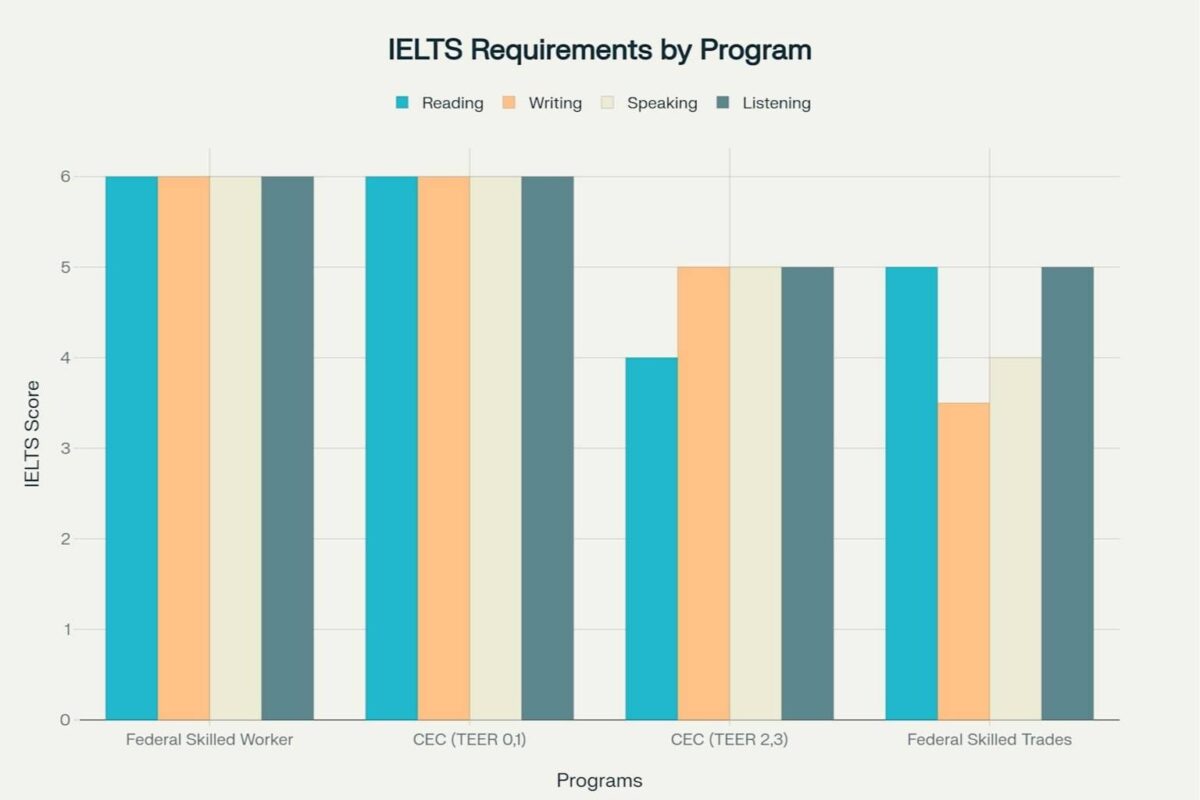
For English proficiency, you can choose between IELTS General Training, CELPIP General, or PTE Core, with specific minimum score requirements varying by program. The Federal Skilled Worker Program requires CLB 7 (IELTS 6.0 in all skills), while the Canadian Experience Class requirements depend on your occupation’s TEER level.
French language proficiency can be demonstrated through TEF Canada or TCF Canada tests, and bilingual candidates may earn additional CRS points for strong proficiency in both official languages. These test results not only determine your eligibility but significantly impact your CRS score and chances of receiving an ITA.
Educational Credentials and Assessment
Educational documentation requirements depend on where you completed your studies and which Express Entry program you’re applying under. If you completed your education in Canada, you’ll need your certificates, diplomas, or degrees along with official transcripts.
For education completed outside Canada, an Educational Credential Assessment (ECA) is mandatory for the Federal Skilled Worker Program and recommended for other programs to maximize CRS points. The ECA process compares your foreign education to Canadian standards and can take 2-8 weeks depending on the chosen organization.
World Education Services (WES) is the most popular ECA provider due to efficient processing times, though other designated organizations include ICAS, IQAS, CES, and ICES. Medical professionals must use specific organizations: the Medical Council of Canada for doctors and the Pharmacy Examining Board of Canada for pharmacists.
Work Experience Documentation
Employment reference letters form the backbone of your work experience claims and must follow specific formatting requirements established by IRCC. Each letter must be printed on company letterhead and include comprehensive details about your employment, including job title, duties, employment dates, hours worked per week, and annual salary.
These letters must be signed by your supervisor, HR representative, or company official, and include their contact information for verification purposes. If you cannot obtain a letter from your employer, alternative documentation from colleagues, combined with supporting evidence like contracts and pay stubs, may be acceptable.
Phase 2: Program-Specific Requirements
Proof of Funds Requirements
Proof of funds is mandatory for Federal Skilled Worker Program and Federal Skilled Trades Program applicants, demonstrating your ability to support yourself and your family upon arrival in Canada. The Canadian Experience Class and applicants with valid job offers are exempt from this requirement.
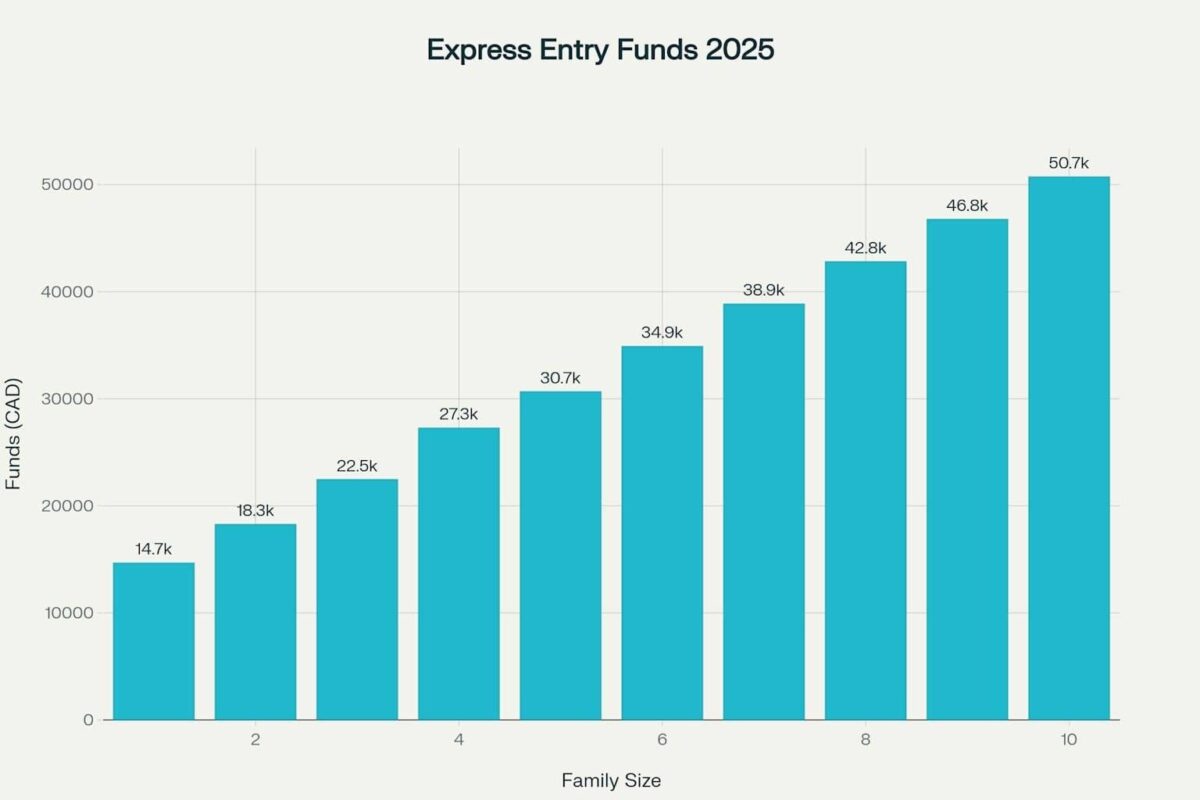
The required amounts are updated annually by IRCC and based on 50% of Statistics Canada’s low-income cut-off figures. For 2025, a single applicant must demonstrate CAD $14,690, while a family of four requires CAD $27,297.
Acceptable proof includes official bank letters on institutional letterhead, bank statements covering six months, and liquid investments or deposits. The funds must be readily available, not borrowed, and free from liens or encumbrances. Real estate equity, borrowed funds, or gifts are not acceptable forms of proof.
Post-ITA Document Requirements
After receiving your Invitation to Apply, you have exactly 60 days to submit your complete application with all supporting documents. This phase requires significantly more documentation and includes several new requirements not needed for profile creation.
Medical Examinations
All permanent residence applicants, including accompanying family members, must undergo medical examinations by IRCC-approved panel physicians. These examinations include physical assessments, chest X-rays, blood tests for communicable diseases, and urine analysis.
The medical examination results are typically valid for 12 months from the examination date, and IRCC no longer requires upfront medical examinations as of October 2023. The eMedical system automatically transmits results to IRCC, though you’ll receive an information sheet for your records.
Police Clearance Certificates
Police certificates are required for you and all family members aged 18 or older, from every country where you’ve lived for six months or more consecutively since turning 18. These certificates must be issued within six months of your application submission and demonstrate your criminal history or lack thereof.
An example of a Canadian Police Certificate from the Royal Canadian Mounted Police (RCMP), a key document for immigration purposes
The process for obtaining police certificates varies significantly by country and can take anywhere from a few weeks to several months. Some countries require you to be physically present, while others accept mail-in applications or third-party requests.
Family and Relationship Documentation
Marriage certificates are required for married applicants, while those in common-law relationships must provide a Statutory Declaration of Common-law Union. Divorced applicants need divorce decrees or legal separation agreements, and birth certificates are required for all dependent children regardless of whether they’re accompanying you to Canada 34.
Language Test Score Requirements by Program
Understanding the specific language requirements for each Express Entry program is crucial for proper preparation and achieving competitive CRS scores. The requirements vary not only by program but also by occupation level within programs.
The Federal Skilled Worker Program maintains the highest language standards, requiring CLB 7 (equivalent to IELTS 6.0 in all skills) for both first and second official languages if claiming points for bilingualism. This translates to CELPIP scores of 7 in all four language abilities: reading, writing, listening, and speaking.
Canadian Experience Class requirements depend on your occupation’s Training, Education, Experience, and Responsibilities (TEER) classification. TEER 0 and 1 occupations (management and professional roles) require CLB 7, while TEER 2 and 3 occupations (technical and skilled trades) accept CLB 5, equivalent to IELTS scores of 4.0-5.0 depending on the skill.
Proof of Funds Requirements for 2025
IRCC updates proof of funds amounts annually based on Statistics Canada’s low-income cut-off data, with the 2025 requirements reflecting current economic conditions. These amounts represent the minimum funds required, and applicants with higher balances should report their full available funds.
Family size calculation includes yourself, your spouse or common-law partner, and all dependent children, regardless of whether they’re Canadian citizens, permanent residents, or accompanying you to Canada. This inclusive approach ensures you can support all family members upon arrival.
Banks must provide official letters on institutional letterhead detailing account information, including account numbers, opening dates, current balances, and average balances over the past six months. The letter must also disclose any outstanding debts, loans, or credit obligations that might affect your available funds.
| Family Size | Required Funds (CAD) | Required Funds (USD) | Required Funds (EUR) |
|---|---|---|---|
| 1 | 14690 | 10834 | 10394 |
| 2 | 18288 | 13490 | 12941 |
| 3 | 22483 | 16581 | 15903 |
| 4 | 27297 | 20138 | 19309 |
| 5 | 30690 | 22634 | 21714 |
| 6 | 34917 | 25745 | 24691 |
| 7 | 38875 | 28673 | 27505 |
| 8 | 42833 | 31601 | 30319 |
| 9 | 46791 | 34529 | 33133 |
| 10 | 50749 | 37457 | 35947 |
Express Entry Process Timeline
Understanding the typical timeline for Express Entry helps with proper planning and document preparation. The process can be divided into distinct phases, each with its own timeframe and requirements.
Document preparation often takes the longest time before profile submission, particularly for applicants needing ECAs or those gathering employment references from multiple employers. Language tests typically require 2-4 weeks from registration to results, while ECA reports can take 2-8 weeks depending on the organization and complexity of your educational background.
The pool waiting period varies dramatically based on your CRS score and the frequency of draws for your program. Recent draws have shown CRS scores ranging from the high 400s to over 500 points, with program-specific draws sometimes having different thresholds.
After receiving an ITA, the 60-day submission deadline is firm, making advance preparation crucial. Application processing by IRCC typically takes 5-6 months, though this can vary based on application volume, completeness of documentation, and the need for additional verification.
| Step | Timeline | Description |
|---|---|---|
| Profile Creation | 1-2 weeks | Create Express Entry profile with basic information |
| Document Preparation | 2-6 months | Gather all required documents before submission |
| Profile Submission | 1 day | Submit completed profile to Express Entry pool |
| Pool Waiting Period | 2-24 months | Wait for invitation based on CRS score |
| Invitation to Apply (ITA) | 1 day | Receive invitation and accept within timeline |
| Document Submission | 30-60 days | Upload all supporting documents within 60 days |
| Application Processing | 5-6 months | IRCC processes application and reviews documents |
| Medical Exam | 1-2 weeks | Complete medical examination with panel physician |
| Background Check | 2-3 months | IRCC conducts security and background verification |
| Decision & COPR | 1-2 weeks | Receive Confirmation of Permanent Residence |
Employment Reference Letter Requirements
Employment reference letters are among the most scrutinized documents in Express Entry applications and must meet specific IRCC standards to avoid rejection. These letters serve as primary evidence of your claimed work experience and directly impact your CRS points and program eligibility.
Each letter must be printed on official company letterhead and include comprehensive company contact information, including physical address, phone number, and email address. The letter must clearly state your job title, provide detailed descriptions of your main duties and responsibilities, and specify your employment dates with start and end dates.
Additionally, the letter must indicate the number of hours you worked per week, your annual salary including any benefits, and be signed by your immediate supervisor, HR representative, or company official. The signatory’s name, title, and contact information must be clearly stated for IRCC verification purposes.
For self-employed individuals or those unable to obtain employer letters, alternative documentation including business registration, tax returns, client testimonials, and contracts may be acceptable when combined with a detailed letter of explanation.
Common Mistakes to Avoid
Document-related errors are among the leading causes of Express Entry application delays and rejections. Understanding these common pitfalls can save significant time and prevent frustrating setbacks in your immigration journey.
Language test and ECA expiry dates frequently catch applicants off-guard, as both have validity periods of two years from the test date or report issuance. Planning your application timeline around these expiry dates is crucial, particularly if you’re waiting in the Express Entry pool for extended periods.
Incomplete or improperly formatted employment reference letters represent another major source of application issues. Letters missing required information such as job duties, salary details, or proper signatory information often result in requests for additional documentation, potentially delaying processing.
Police certificate requirements frequently confuse applicants, particularly regarding which countries require certificates and which authorities issue them. Obtaining certificates from incorrect agencies or failing to account for all periods of residence can significantly delay your application.
Proof of funds documentation must demonstrate that funds are readily available and not borrowed or encumbered. Gift funds, real estate equity, or borrowed money do not qualify as acceptable proof, regardless of the amount.
Essential Tips for Success
Successful Express Entry applications require strategic planning and attention to detail throughout the entire process. Starting document collection early, particularly for items requiring significant processing time, prevents last-minute rushes and potential deadline issues.
Language test preparation should be prioritized since these scores significantly impact your CRS ranking and are required for profile creation. Consider taking practice tests and, if necessary, language improvement courses before your official examination.
Maintain organized digital copies of all documents throughout the process, ensuring you have both original language versions and certified translations where required. This organization becomes particularly important during the 60-day post-ITA submission period.
Consider professional assistance for complex situations such as self-employment documentation, unique educational credentials, or complicated immigration histories. Immigration lawyers or regulated consultants can provide valuable guidance for challenging cases.
Interactive Document Tracker
To help you stay organized throughout your Express Entry journey, I’ve created an interactive document tracking application that provides personalized checklists based on your specific program and family situation. This tool helps you monitor your progress, understand requirements, and ensure you don’t miss any critical deadlines.
The application includes features such as program-specific requirements, progress tracking, timeline calculations, and exportable checklists for offline reference. You can access this tool to create your personalized Express Entry document checklist and track your preparation progress.
Conclusion
Successfully navigating the Express Entry system requires thorough preparation, attention to detail, and a comprehensive understanding of all document requirements 12. This checklist provides the foundation for your application preparation, but remember that immigration requirements can change, and individual circumstances may require additional documentation.
The key to success lies in early preparation, particularly for time-sensitive documents like language tests and ECAs. Starting your document collection process well before creating your Express Entry profile ensures you’re ready to submit a complete application when you receive your ITA.
Remember that Express Entry is highly competitive, with successful applicants typically having strong language scores, relevant work experience, and proper documentation. Taking time to prepare thoroughly and potentially improve your CRS score through additional language testing or education can significantly improve your chances of success.
For the most current requirements and any updates to the Express Entry system, always consult the official IRCC website at canada.ca/express-entry, as immigration policies and requirements can change without notice. Good luck with your Canadian immigration journey!