
EI Insurable Earnings Cap Rises to $70,800 in 2027

Canada employment insurance rules effective January take effect January 1, 2027, when the maximum insurable earnings cap rises to $70,800 from $68,900 in 2026. Employees pay EI premiums on earnings up to the cap at a rate of $1.64 per $100 until the maximum annual premium is reached. Employers seeking a premium reduction must wait for Service Canada’s entitlement decision and assigned rate before applying it.
What are Canada’s employment insurance rules effective January 2027?
Quick answer: The new maximum insurable earnings cap applies from January 1, 2027, and is $70,800, up from $68,900 in 2026. Employees pay $1.64 per $100 of insurable earnings, up to the $1,161.12 annual maximum. If you’re seeking a reduced employer rate, wait for Service Canada’s entitlement decision and assigned rate before applying it.
- Employees: For someone earning $75,000 a year, premiums apply only to the first $70,800 in 2027.
- Employee rate: It’s $1.64 per $100 in 2027, compared with $1.63 per $100 in 2026.
- Potential reduction: An acceptable Category 2 plan can have a 2027 reduced rate of 1.146 and maximum annual savings of $294.93 per employee.
- Employer action: After receiving an assigned reduced rate, recalculate employer premiums already paid retroactive to January 1 using that rate.
What changed and when it starts
For an employee earning $75,000 a year, EI premiums in 2027 apply only to the first $70,800 of earnings. The 2027 maximum insurable earnings page sets that cap from January 1, 2027, up from $68,900 in 2026.
Employers deduct $1.64 for every $100 an employee is paid, until the maximum annual employee premium is reached. The employee rate is $1.64 per $100 in 2027, compared with $1.63 per $100 in 2026; the maximum annual employee premium is $1,161.12 in 2027, compared with $1,123.07 in 2026.
The change also raises the maximum weekly EI benefit rate to $749 in 2027, from $729 in 2026. For extended parental benefits, the maximum weekly rate is $449 in 2027, up from $437 in 2026. Since December 18, 2022, the maximum duration of EI sickness benefits has been 26 weeks, up from 15 weeks.
Employers with a qualifying short-term disability plan may pay EI premiums at a rate below the standard employer rate of 1.4 times employees’ EI premiums. To qualify, a plan must provide at least 15 weeks of benefits, match or exceed EI benefit levels, pay benefits within 8 days of illness or injury after an elimination period of no more than 7 consecutive days, be available within 3 months of hiring, and cover employees 24 hours a day. The basic requirements for an employer premium reduction remain unchanged despite the increase in the maximum EI sickness-benefit period.
Who is affected and who is not
Employees whose earnings are subject to EI premiums are affected, and employers that deduct or remit those premiums must apply the relevant rules. Employers may qualify for a lower rate through the EI Premium Reduction Program if they provide a short-term disability plan that meets its requirements.
Employers must also show their commitment to provide the plan and agree to return five-twelfths of the savings to covered employees. The program includes these plan categories:
- Category 1: Cumulative paid sick leave that accrues by at least 1 day per month, to a total of at least 75 days.
- Category 2: Enhanced cumulative paid sick leave that accrues by at least one and two-third days per month, to a total of at least 125 days.
- Category 3: Weekly indemnity benefits for at least 15 weeks.
- Category 4: Weekly indemnity benefits for at least 52 weeks, available only to public and para-public employers of a province.
Rates are established for each of four categories, with a distinct rate for each category. Category 4 is limited by employer type, even when the plan meets its benefit-period requirement.
The separate figures of $1.29 per $100 and $913.32 in 2027 are not tied here to a specific contributor group.
Key dates and amounts
Canada employment insurance rules effective January 1, 2027, set the maximum insurable earnings at $70,800, up from $68,900 in 2026.
| Figure | 2027 | 2026 |
|---|---|---|
| Maximum insurable earnings | $70,800 | $68,900 |
| Earnings subject to premiums for an employee earning $75,000 a year | First $70,800 | Not listed |
| Employee EI rate per $100 | $1.64 | $1.63 |
| Maximum annual employee EI premium | $1,161.12 | $1,123.07 |
| Other stated EI rate per $100 | $1.29 | $1.30 |
| Other stated maximum annual premium | $913.32 | $895.70 |
| Maximum weekly EI benefit | $749 | $729 |
| Maximum weekly extended parental benefit | $449 | $437 |
| Maximum sickness-benefit weeks | 26 since December 18, 2022, up from 15 | Not listed |
| Category 2 reduced rate | 1.146 | Not listed |
| Category 2 maximum annual savings per employee | $294.93 | Not listed |
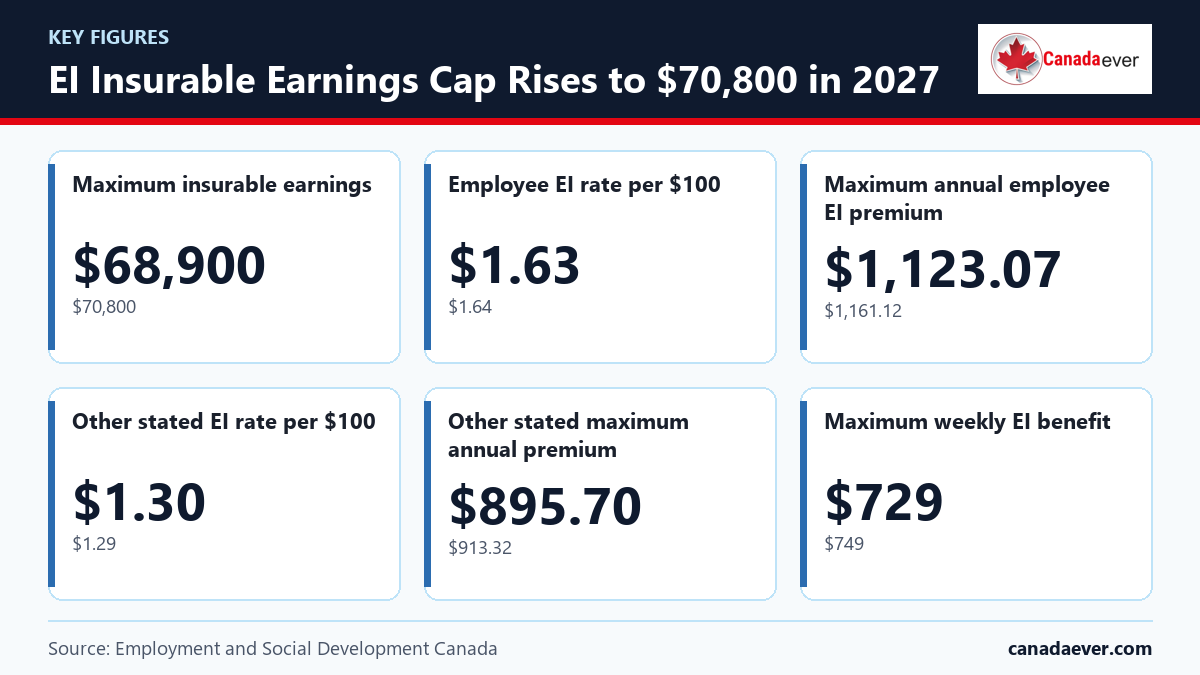
The separate rate and premium figures are stated without identifying a contributor group.
For employers, the Category 2 rate applies to an acceptable enhanced cumulative paid sick leave plan, and its maximum savings are per employee per year. The EI Premium Reduction Program also offers eligible employers a lower rate than the standard employer rate of 1.4 times employees’ EI premiums.
What should employers do next
Your problem is deciding whether your short-term disability plan qualifies and when you can apply a reduced EI rate.
Compare your plan with the requirements. It must provide at least 15 weeks of benefits at least equal to EI benefits, pay within 8 days of illness or injury after an elimination period of no more than 7 consecutive days, be available within 3 months of hiring and cover employees 24 hours a day. You must also commit to providing the plan and returning five-twelfths of the savings to covered employees.
Identify the plan category. Category 1 requires at least 1 day of paid sick leave to accumulate monthly and at least 75 days in total; Category 2 requires at least one and two-third days monthly and at least 125 days in total. For 2027, the best reduced rate available to all employers is 1.146 for an acceptable Category 2 plan. Category 4 is a weekly indemnity plan with benefits for at least 52 weeks, available only to public and para-public employers of a province.
Apply or update your registration. Use the application form to apply, modify or replace a registered plan, or change authorized contacts. You can submit the form and supporting documents online through the EI Premium Reduction Web Portal. Provide missing documents within 30 days of a request.
Wait for Service Canada’s entitlement decision before using a reduced rate. Employers cannot use a reduced rate until they receive an entitlement decision from Service Canada.
Read the EI Premium Reduction Program for employers. For related information, see benefits in Canada and employer job offers.
Frequently Asked Questions
How do I confirm my employer used the correct 2027 EI maximum?
Compare your insurable earnings subject to premiums with the 2027 maximum of $70,800 and the employee rate of $1.64 per $100.
What does the official page say about Employment Insurance?
Employment Insurance – Important notice about maximum insurable earnings for 2027. Source: canada.ca
How much is the maximum insurable earnings?
The maximum insurable earnings is $70,800 ($68,900 in 2026). Source: canada.ca
What does the official page say about For example?
For example, if an employee earns $75,000 per year, premiums must be paid only on the first $70,800. Source: canada.ca