LMIA-Exempt Work Permits: Complete List and Requirements

Canada offers numerous pathways for foreign workers to obtain work permits without the need for a Labour Market Impact Assessment (LMIA), making the immigration process faster and more accessible for qualified individuals. Understanding these LMIA-exempt categories can significantly streamline your journey to working in Canada, whether you’re a skilled professional, recent graduate, or entrepreneur looking to contribute to Canada’s economy.
Quick answer: Some foreign workers can be hired without an LMIA through the International Mobility Program. In most cases the employer must pay the $230 employer compliance fee and submit an offer of employment through the Employer Portal. Examples include French-speaking or bilingual workers outside Quebec and overnight camp counsellors.
Canada offers numerous pathways for foreign workers to obtain work permits without the need for a Labour Market Impact Assessment (LMIA), making the immigration process faster and more accessible for qualified individuals.
Understanding these LMIA-exempt categories can significantly streamline your journey to working in Canada, whether you’re a skilled professional, recent graduate, or entrepreneur looking to contribute to Canada’s economy.
What Are LMIA-Exempt Work Permits?
LMIA-exempt work permits are issued under Canada’s International Mobility Program (IMP), which allows employers to hire foreign workers without requiring a Labour Market Impact Assessment.
Unlike the Temporary Foreign Worker Program that requires employers to prove no Canadian workers are available for the position, the IMP focuses on broader economic, cultural, and social benefits to Canada.
The key advantage of LMIA-exempt permits is the elimination of the lengthy and costly LMIA process, which can take 10-120 business days depending on the stream. This exemption does not mean you’re exempt from obtaining a work permit altogether – you still need to apply for and receive a valid work permit before working in Canada.
Complete List of LMIA-Exempt Categories
Canada recognizes over 20 distinct categories of LMIA-exempt work permits, each with specific requirements and exemption codes. These categories are designed to support Canada’s international agreements, attract skilled workers, and promote cultural and economic exchanges.
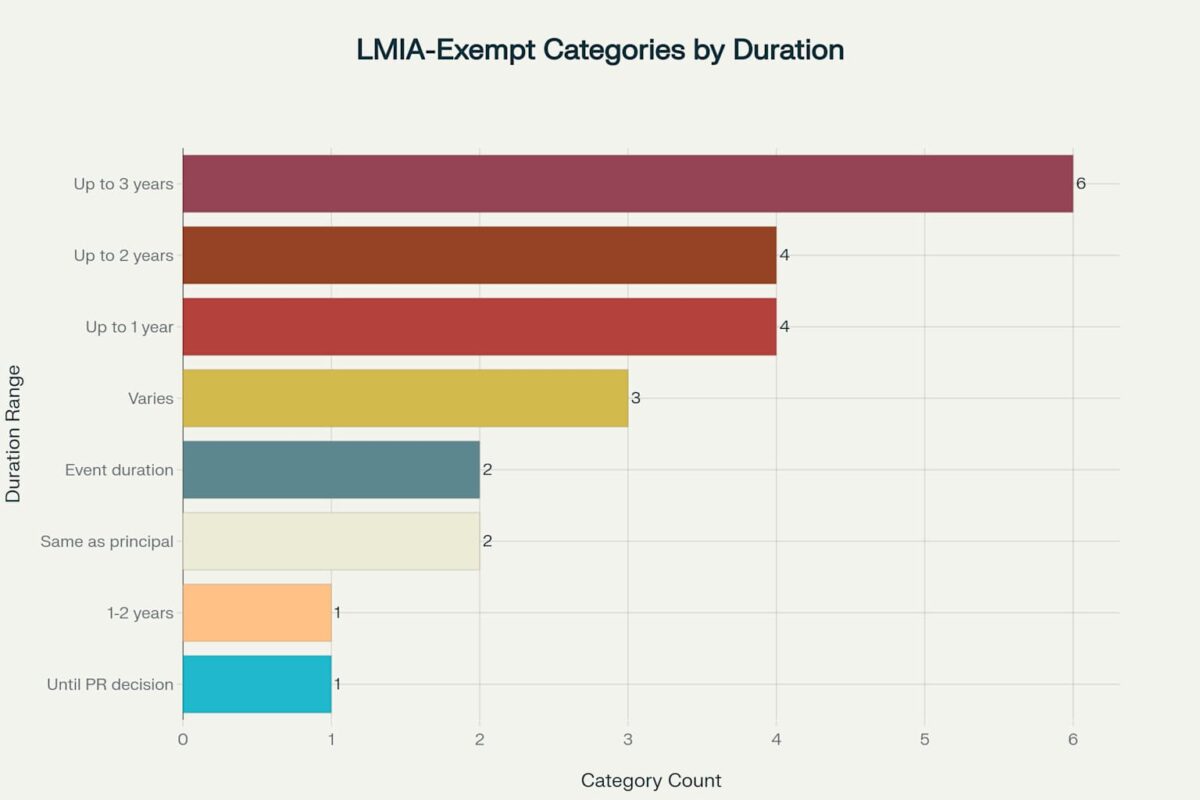

The distribution of work permit durations varies significantly across categories, with most permits offering substantial validity periods that align with Canada’s economic and immigration objectives.
Free Trade Agreement Categories
CUSMA (Canada-United States-Mexico Agreement)
- CUSMA Professionals (T13): For citizens of the US and Mexico working in specific professional occupations
- CUSMA Intra-Company Transferees (T12): Employees transferring within multinational companies
- CUSMA Investors (T16): Individuals making substantial investments in Canadian businesses
- CUSMA Traders (T14): Those engaged in substantial trade between member countries
Other Free Trade Agreements
- CETA (T23): Canada-European Union Comprehensive Economic and Trade Agreement
- CPTPP (T24): Comprehensive and Progressive Trans-Pacific Partnership
These agreements facilitate the movement of professionals, making it easier for qualified individuals to work temporarily in Canada without the traditional labor market testing requirements.
International Mobility Categories
Intra-Company Transfers (T13)
Companies with parent, subsidiary, branch, or affiliate relationships can transfer key personnel to Canada. Eligible employees must have worked for the company for at least one year in the three years preceding their application and be transferring to executive, managerial, or specialized knowledge positions.
Significant Benefit (C10)
This category is for foreign workers whose employment provides significant economic, social, or cultural benefits to Canada. Applicants typically need extensive experience (often 10+ years), professional achievements, and a detailed plan demonstrating their contribution to Canada.
Post-Graduation Work Permit (PGWP) (C43)
International graduates from eligible Canadian institutions can obtain open work permits to gain valuable Canadian work experience. Recent changes effective November 1, 2024, require language proficiency testing: CLB 7 for university graduates and CLB 5 for college graduates.
Family-Based Categories
Spousal Open Work Permits
Significant restrictions took effect January 21, 2025, limiting eligibility to spouses of high-skilled workers in TEER categories 0-3 with work permits valid for at least 16 months. Spouses of international students are now only eligible if the student is enrolled in master’s, doctoral, or select professional programs.

The job offer requirements vary significantly across categories, with approximately 61% requiring a formal job offer while others offer more flexibility.
Youth Mobility Programs
International Experience Canada (IEC)
This program offers three streams for youth aged 18-35 from eligible countries:
- Working Holiday (C20): Open work permits for 1-2 years without job offer requirements
- Young Professionals (C21): Requires job offers in NOC skill levels 0, A, or B
- International Co-op (C22): For students completing internships in Canada
Specialized Categories
Francophone Mobility (C16)
This pathway prioritizes French-speaking workers destined for provinces outside Quebec, requiring intermediate French language skills (NCLC 5 or higher) and job offers in most TEER categories.
Bridging Open Work Permit (BOWP) (A75)
Available to permanent residence applicants whose work permits are expiring while their PR applications are being processed.
Academic and Research Exemptions
- Guest lecturers and visiting professors for short-term engagements
- Self-funded researchers conducting studies for less than six months
Provincial Nominee Programs (A70)
Workers nominated by provinces for permanent residence can often obtain work permits while their applications are processed.
LMIA-Exempt Work Permit Quick Reference Checklist
✅ Pre-Application Checklist
Step 1: Determine Your Category
- Review the 23+ LMIA-exempt categories
- Identify which exemption code applies to you
- Confirm your nationality/citizenship eligibility
- Check if your occupation qualifies
Step 2: Essential Documents
Always Required:
- Valid passport (6+ months validity)
- Digital photo (passport specification)
- Completed IMM 1295 form
- Proof of funds ($10,000+ CAD recommended)
- Application fees ($155 + additional fees)
- Category-specific supporting documents
The IRCC fee list sets the work permit fee (including extensions) at CAD $155 per person.
Usually Required:
- Educational credentials/diplomas
- Proof of work experience
- Job offer letter (if applicable)
Sometimes Required:
- Language test results (IELTS/CELPIP/TEF)
- Medical examination results
- Police clearance certificate
- Employer Portal submission number
🎯 Category-Specific Requirements
Free Trade Agreements (CUSMA/CETA/CPTPP)
- Citizenship verification (US/Mexico for CUSMA)
- Professional qualifications documentation
- Job offer in qualifying occupation
- Degree/credential recognition
Post-Graduation Work Permit (PGWP)
- Valid study permit at time of application
- Graduation from designated learning institution (DLI)
- Language test results (CLB 7 university, CLB 5 college) Since Nov 2024
- Apply within 180 days of graduation
- 50%+ in-person study completion in Canada
Intra-Company Transfer
- 1+ years employment with transferring company
- Executive/Manager/Specialized knowledge role
- Parent/branch/subsidiary/affiliate relationship proof
- Qualifying relationship documentation
Significant Benefit (C10)
- Detailed business plan
- Proof of economic/social/cultural benefit to Canada
- 10+ years relevant experience
- Professional achievements/awards documentation
- Investment funds proof
Spousal Open Work Permit (Recent Changes)
New Restrictions (Jan 21, 2025):
- Spouse works in TEER 0-1 OR specific TEER 2-3 occupations
- Principal applicant’s work permit valid 16+ months
- Marriage/common-law relationship proof
- ⚠️ Note: Dependent children no longer eligible
International Experience Canada (IEC)
- Age 18-35 (varies by country)
- Eligible country citizenship
- Selected through random draw system
- Category-specific requirements:
- Working Holiday: No job offer needed
- Young Professionals: Job offer required (NOC 0/A/B)
- International Co-op: Student enrollment + internship arrangement
📅 Application Timeline Planning
Phase 1: Preparation (1-4 weeks)
- Document gathering
- Job search (if required)
- Language testing (if required)
- Medical exam scheduling (if required)
Phase 2: Submission (1-2 weeks)
- Employer portal submission (if applicable)
- Online application completion
- Fee payment
- Document upload
Phase 3: Processing (2-16 weeks)
- Biometrics appointment (if requested)
- Additional document requests (if any)
- Application tracking
- Decision notification
⚠️ 2024-2025 Important Updates
Recent Changes to Remember:
- PGWP Language Requirements (Nov 1, 2024): New language proficiency requirements
- Spousal Work Permit Restrictions (Jan 21, 2025): Limited to high-skilled worker spouses only
- Business Legitimacy (Oct 28, 2024): No more lawyer/accountant attestations
- High-Wage Threshold (Nov 8, 2024): 20% increase in required wages
- Low-Wage LMIA Moratorium (Sep 26, 2024): Stopped processing in high unemployment areas
💰 Fee Structure
Standard Fees:
- Work permit fee: $155 CAD
- Open work permit holder fee: $100 CAD (if applicable)
- Employer compliance fee: $230 CAD (paid by employer)
- Biometrics fee: $85 CAD (if required)
Additional Possible Fees:
- Medical exam: $200-500 CAD
- Language testing: $300-400 CAD
- Document translation/notarization: Varies
- Police certificates: Varies by country
🚫 Common Mistakes to Avoid
- Applying in wrong category
- Incomplete or incorrect forms
- Missing supporting documents
- Expired documents
- Insufficient proof of funds
- Late application (PGWP 180-day deadline)
- Not checking recent policy changes
- Assuming eligibility without verification
📞 Resources and Support
Official Government Resources:
- IRCC website: canada.ca
- Processing times tool
- Document checklists
- Exemption code database
Professional Support:
- Regulated immigration consultants (RCIC)
- Immigration lawyers
- Employer immigration departments
- University international student services
Last Updated: June 2025
Note: Immigration policies change frequently. Always verify current requirements on the official IRCC website before applying.
Application Process and Requirements
The application process varies depending on your category, but generally follows a structured approach that can take 2-16 weeks for processing.
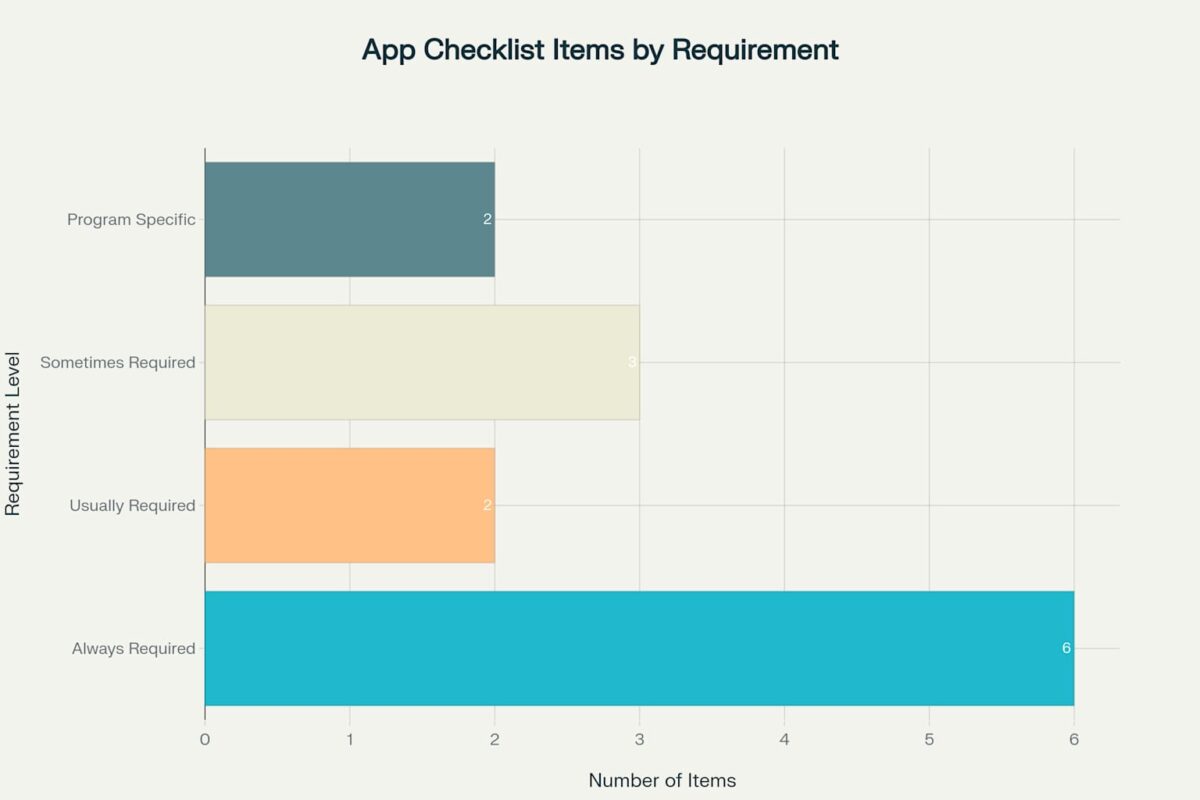
Document requirements are categorized by necessity level, helping applicants prioritize their preparation efforts. Essential documents include a valid passport, completed application form (IMM 1295), proof of funds, and category-specific supporting documentation.
Recent Policy Changes (2024-2025)
Canada has implemented significant changes to work permit policies to better align with labor market needs and reduce temporary resident populations.
Key changes include enhanced language requirements for PGWP applicants, restricted spousal work permit eligibility, increased wage thresholds for high-skilled positions, and business legitimacy verification improvements. These changes reflect Canada’s commitment to ensuring temporary foreign workers contribute meaningfully to the economy while protecting opportunities for Canadian workers.
Application Fees and Processing Times
Standard fees include a $155 CAD work permit fee, with additional costs for open work permit holders ($100 CAD), employer compliance fees ($230 CAD), and biometrics ($85 CAD) when required. Processing times vary significantly by category and application location, typically ranging from 2-16 weeks.
Additional costs may include medical examinations ($200-500 CAD), language testing ($300-400 CAD), and document translation services. Applicants should budget for these additional expenses when planning their immigration journey.
Common Mistakes to Avoid
Many applications face delays or rejections due to preventable errors. Common mistakes include applying under the wrong category, submitting incomplete documentation, missing application deadlines (particularly the 180-day PGWP deadline), and failing to stay updated on recent policy changes.
Applicants should verify their eligibility carefully, ensure all documents are current and properly translated, and consider consulting with regulated immigration consultants or lawyers for complex cases.
Professional Support and Resources
Immigration law is complex and constantly evolving, making professional guidance valuable for many applicants. Resources include Immigration, Refugees and Citizenship Canada (IRCC) official website, regulated immigration consultants (RCIC), immigration lawyers, and employer immigration departments.
University international student services can provide specialized support for graduates applying for PGWP, while employer immigration teams often assist with corporate transfers and significant benefit applications.
Conclusion
LMIA-exempt work permits offer valuable pathways for foreign workers to contribute to Canada’s economy while gaining international experience. With over 20 categories available, there are opportunities for skilled professionals, recent graduates, entrepreneurs, and family members of workers and students.
Success requires understanding the specific requirements for your category, staying informed about recent policy changes, and preparing a complete, accurate application. While the process can seem complex, the elimination of LMIA requirements makes these permits significantly more accessible than traditional work permit streams.
The key to success lies in careful preparation, accurate documentation, and staying current with Canada’s evolving immigration policies. Whether you’re a recent graduate, skilled professional, or entrepreneur, Canada’s LMIA-exempt work permit categories provide valuable opportunities to build your career while contributing to one of the world’s most welcoming countries for immigrants.
Remember to always verify current requirements on the official IRCC website, as immigration policies change frequently and individual circumstances may require specific considerations not covered in general guidance.
Related reading: LMIA Process: Step-by-Step Guide — a closer look at this topic.
Quick answers from official sources
What does an employer pay to hire an LMIA-exempt worker?
In most cases the $230 employer compliance fee, plus an offer of employment submitted through the Employer Portal.
Can I hire a French-speaking worker outside Quebec without an LMIA?
Yes, if the worker has moderate French proficiency in speaking and listening and will live and work outside Quebec.
Do open work permit holders need an LMIA?
No. IRCC says you do not need an LMIA if the worker has an open work permit.
Sources (checked October 27, 2026):