Canada’s 2026 federal tax brackets and rates set

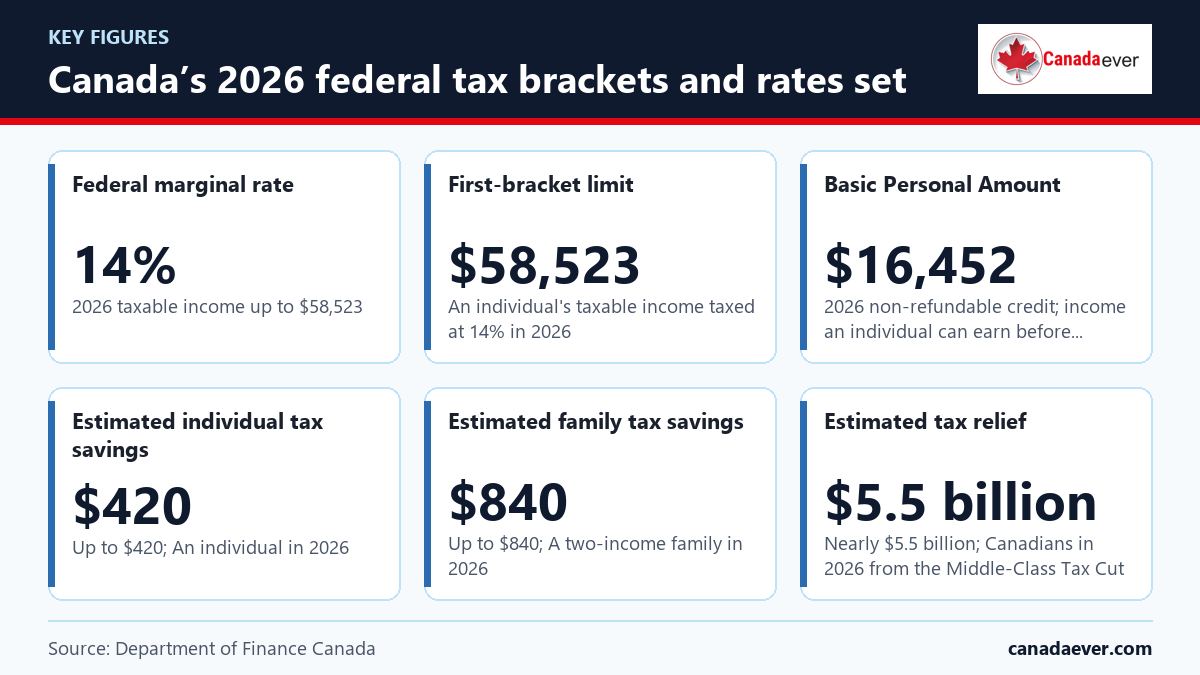
Canada’s 2026 federal tax brackets set a lowest marginal rate of 14% on the first $58,523 of an individual’s taxable income for the 2026 taxation year. If you’re searching to find out whether Canada income tax brackets 2027 are out, the official report gives 2026 figures only; it does not state 2027 thresholds or rates. For now, use the 2026 brackets when considering 2026 taxable income, and don’t treat them as 2027 figures.
Are Canada’s 2027 income tax brackets out?
Quick answer: No. The official report gives federal brackets for the 2026 taxation year, not 2027, so it doesn’t state 2027 thresholds or rates. For 2026, the lowest federal rate is 14% on the first $58,523 of an individual’s taxable income. Use that figure for 2026 only; the report says annual bracket threshold increases take effect on January 1.
- 2026 brackets apply to taxable income for the 2026 taxation year.
- The 2026 rates are 14%, 20.5%, 26%, 29% and 33%, across brackets from $58,523 up to $258,482 and over.
- Bill C-4 received Royal Assent on March 12, 2026.
What changed and when it starts
Bill C-4 lowered the lowest federal marginal tax rate from 15% in 2024 and earlier to 14.5% for 2025 and 14% for 2026 and subsequent taxation years.
The change took effect across these taxation years:
- 2024 and earlier: 15%
- 2025: 14.5%
- 2026 and subsequent taxation years: 14%
Federal tax bracket thresholds are indexed to inflation.
These include the GST credit, Canada child benefit and Child disability benefit.
Who is affected and who is not
The 2026 Middle-Class Tax Cut is expected to generate tax savings for nearly 22 million Canadians.
The groups affected include:
- People with federal tax payable: Non-refundable tax credits can reduce the federal tax they owe.
- People who owe no federal tax: Most non-refundable credits don’t provide a benefit once a person owes no tax.
- Recipients of income-tested benefits: Increases to the GST credit, Canada child benefit and Child disability benefit take effect on July 1 to coincide with the start of the benefits’ program year.
The report estimates the tax cut will save an individual up to $420 and a two-income family up to $840 in 2026. These are estimated savings for the 2026 taxation year, not guaranteed amounts for every taxpayer.
The 2026 Basic Personal Amount is a $16,452 non-refundable tax credit that allows an individual to earn up to that amount before owing federal income tax. Its value depends on whether the person owes tax: most non-refundable credits reduce tax only until no tax remains payable.
Key dates and amounts
The official page gives 2026 federal tax brackets, not confirmed thresholds or rates for 2027.
| What | Figure or date | Applies to |
|---|---|---|
| Federal marginal rate | 14% | 2026 taxable income up to $58,523 |
| Federal marginal rate | 20.5% | 2026 taxable income from $58,523 to $117,045 |
| Federal marginal rate | 26% | 2026 taxable income from $117,045 to $181,440 |
| Federal marginal rate | 29% | 2026 taxable income from $181,440 to $258,482 |
| Federal marginal rate | 33% | 2026 taxable income of $258,482 and over |
| First-bracket limit | $58,523 | An individual’s taxable income taxed at 14% in 2026 |
| Basic Personal Amount | $16,452 | 2026 non-refundable credit; income an individual can earn before owing federal income tax |
| Estimated individual tax savings | Up to $420 | An individual in 2026 |
| Estimated family tax savings | Up to $840 | A two-income family in 2026 |
| Estimated tax relief | Nearly $5.5 billion | Canadians in 2026 from the Middle-Class Tax Cut |
| Estimated reach | Nearly 22 million | Canadians expected to receive tax savings |
| Annual increases take effect | January 1 | Tax bracket thresholds and amounts relating to non-refundable credits |
A marginal rate applies to income within its bracket; the table does not assign one rate to all your taxable income. The Basic Personal Amount is a non-refundable credit, and the report estimates the savings figures rather than setting them as guaranteed amounts for each taxpayer.
What to do next
Use the figures for the right tax year. The report gives 2026 federal brackets, so use them as 2026 figures, not as confirmed 2027 thresholds.
Keep the 2026 rate change tied to its tax year. Bill C-4 reduced the lowest federal marginal rate from 15% to 14.5% for the 2025 taxation year and to 14% for 2026 and subsequent taxation years. The 2026 rate applies to the first $58,523 of an individual’s taxable income.
Use official pages for tax-benefit amounts. The Canada Revenue Agency’s personal income tax and benefit amounts page is the official place to check those amounts. For related background, see CanadaEver’s Canada tax brackets and taxation pages.
Frequently Asked Questions
How do the 2026 brackets affect my paycheck withholding and taxes owed?
The rates are 14% up to $58,523, then 20.5%, 26%, 29% and 33% across the higher brackets.
Do provincial tax rates change with these federal bracket updates?
No, the report gives federal rates and doesn’t state that provincial tax rates change with them. Its 2026 figures apply to federal taxable income, with rates from 14% to 33%.
How is taxable income calculated for the 2026 federal brackets?
For 2026, the federal rates apply to taxable income, with 14% applying to the first $58,523.
Will the Middle-Class Tax Cut apply automatically or require filing changes?
The report estimates that the 2026 tax cut will save individuals up to $420 and two-income families up to $840, but it doesn’t say whether you need to make filing changes. Its 2026 Basic Personal Amount is a $16,452 non-refundable tax credit, which reduces federal tax owed only until you no longer owe tax.