How to Meet Residency Obligations as a PR: Your Complete Guide

Maintaining your permanent resident (PR) status is crucial for preserving your right to live, work, and build a future in your chosen country. Understanding and fulfilling residency obligations can be complex, but this comprehensive guide will help you navigate the requirements with confidence.
Whether you’re a new permanent resident or need to review your current compliance, this article covers everything you need to know to protect your status.
Understanding Permanent Resident Obligations
Permanent residency comes with significant benefits, but also important responsibilities that must be maintained to preserve your status . The fundamental principle underlying all PR obligations is demonstrating your commitment to making the country your permanent home .
This means more than just holding a valid PR card or Green Card – it requires active compliance with specific residency requirements.
Key Components of PR Obligations:
- Physical presence requirements – spending minimum time in the country
- Documentation maintenance – keeping proper records and valid documents
- Financial compliance – filing taxes and maintaining economic ties
- Legal adherence – avoiding criminal activities and reporting changes
- Administrative responsibilities – updating addresses and renewing documents as required
The consequences of failing to meet these obligations can be severe, including loss of PR status, removal proceedings, and permanent inadmissibility .
Country-Specific Residency Requirements
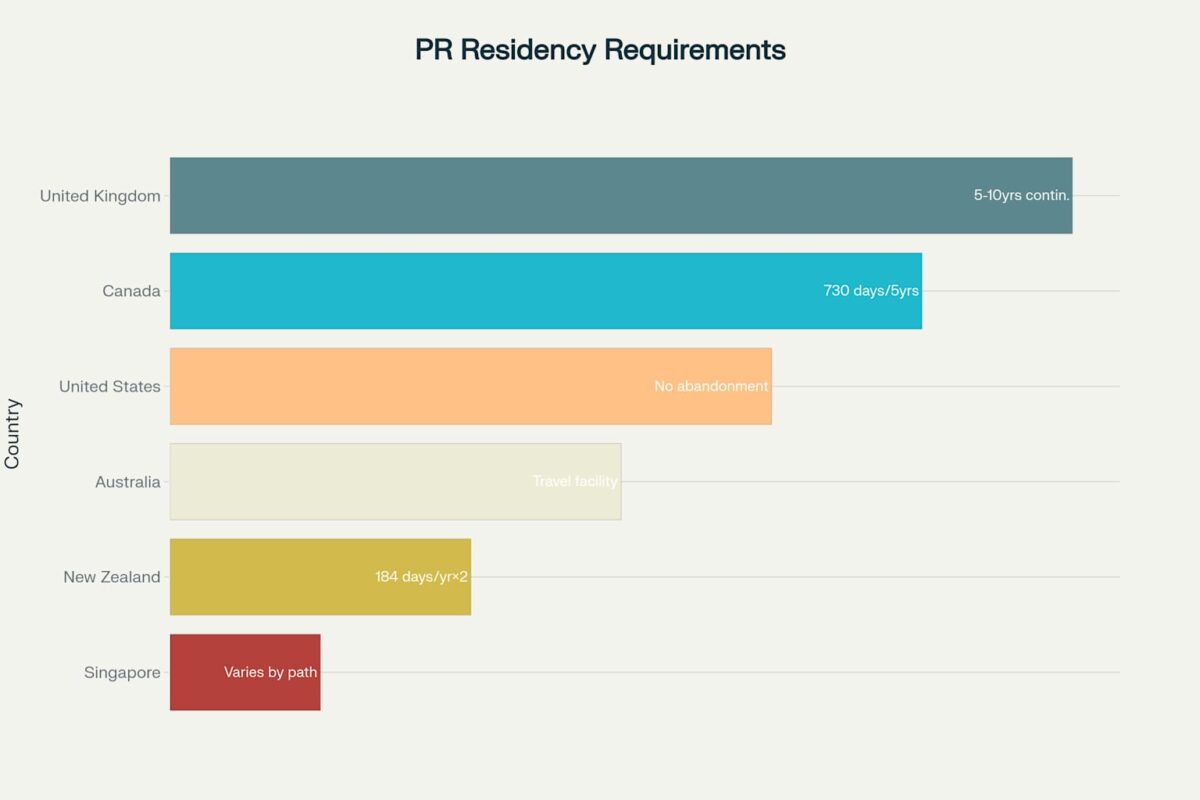

Permanent Residency Obligations Comparison Across Major Immigration Countries
Different countries have varying approaches to permanent residency obligations, and understanding your specific requirements is essential for compliance .
| Country | Requirement Type | Specific Requirement | Grace Period/Flexibility | Consequences of Non-Compliance |
|---|---|---|---|---|
| Canada | Physical Presence | 730 days in any 5-year period | Up to 3 years outside Canada allowed | Loss of PR status, removal order possible |
| Canada | Documentation | Keep travel records, passport stamps, boarding passes | Humanitarian exceptions possible | Difficulty renewing PR card |
| United States | Physical Presence | No abandonment of residence intention | Re-entry permit allows up to 2 years absence | Presumed abandonment, removal proceedings |
| United States | Documentation | File annual tax returns, maintain employment/family ties | US government service exceptions | Complications with naturalization |
| Australia | Physical Presence | Valid travel facility for re-entry | 5-year travel facility renewable | Cannot return without new visa |
| Australia | Documentation | Maintain proof of ties to Australia | Strong ties can excuse short absences | Secondary inspection, delays |
| United Kingdom | Physical Presence | 5-10 years continuous residence (varies by visa) | 180 days/year travel allowed | Refusal of ILR application |
| United Kingdom | Documentation | Pass Life in UK test, English language requirement | Exceptions for certain circumstances | Extended waiting periods |
| New Zealand | Physical Presence | 184 days/year for 2 years minimum | Tax residence route more flexible | Cannot obtain permanent resident visa |
| New Zealand | Documentation | Tax residence confirmation from Inland Revenue | Various commitment criteria available | Need to restart residency period |
Canada: The 730-Day Rule
Canada requires permanent residents to be physically present for at least 730 days (2 years) within any rolling five-year period . This calculation is continuous, meaning every day counts toward your obligation from the moment you become a permanent resident .
What Counts Toward Canadian Residency:
- Days physically present in Canada
- Time accompanying a Canadian citizen spouse outside Canada
- Employment with a Canadian business while abroad
- Accompanying a Canadian citizen parent (for children under 19)
United States: Avoiding Abandonment
The U.S. system focuses on avoiding “abandonment” of permanent residence rather than strict day counting . Generally, absences of more than one year raise presumptions of abandonment, though shorter trips can also be problematic if they demonstrate lack of intent to maintain permanent residence .
Critical U.S. Requirements:
- File annual tax returns as a resident
- Maintain employment, family, and community ties
- Apply for re-entry permits for extended absences
- Avoid continuous absences exceeding 365 days without proper documentation
Australia: Travel Facility Management
Australia’s system revolves around maintaining a valid travel facility attached to your permanent visa . Initially granted for five years, this facility must be renewed if you wish to return to Australia after traveling abroad .
United Kingdom: Continuous Residence Pathway
The UK requires 5-10 years of continuous residence depending on your visa category, with strict limits on time spent outside the country . Most routes allow no more than 180 days abroad in any 12-month period .
New Zealand: Commitment-Based System
New Zealand uses a unique “commitment to New Zealand” approach, requiring 184 days of presence per year for two consecutive years, or alternative demonstrations of commitment such as tax residency status .
Essential Documentation and Record Keeping
Proper documentation is the foundation of meeting PR obligations and proving compliance when required .

Illustrations of various immigration stamps from different countries and airports, used to document international travel history
Critical Documents to Maintain:
Travel Records
- Passport stamps – photograph each stamp received at border crossings
- Boarding passes and tickets – keep physical or digital copies
- Hotel receipts and itineraries – document your presence in specific locations
- Employment letters for business travel – justify work-related absences
Financial Documentation
- Tax returns filed as a resident in your PR country
- Bank statements showing ongoing financial activity
- Employment records including pay stubs and contracts
- Property ownership or rental agreements
Legal Documentation
- Current PR card or Green Card – ensure it remains valid
- Valid passport from your country of citizenship
- Marriage certificates and family documents if relevant for exemptions
Travel Planning and Compliance Strategies
Strategic travel planning is essential for maintaining PR status while meeting personal and professional needs .
Before You Travel
Pre-Departure Checklist:
- Calculate current residency compliance status
- Determine maximum allowable absence period
- Apply for re-entry permits if planning extended absence
- Ensure all documents are current and valid
- Plan return dates to maintain compliance
During Extended Absences
If circumstances require extended time abroad, take these protective measures :
- Maintain U.S./Canadian ties through continued employment, family connections, or property ownership
- File taxes as a resident in your PR country
- Keep detailed records of reasons for extended absence
- Return periodically if possible to demonstrate ongoing ties
- Consult legal counsel for complex situations
Re-Entry Considerations
Upon return from travel, be prepared for potential questioning by border officials :
- Present all required documentation promptly
- Be honest about travel purposes and duration
- Provide evidence of ongoing ties if requested
- Understand that secondary inspection may occur
Comprehensive PR Maintenance Checklist
This detailed checklist helps ensure ongoing compliance with all aspects of PR obligations .
| Category | Task | Priority | Frequency |
|---|---|---|---|
| Documentation | Keep original PR card/Green card current and valid | High | As needed |
| Documentation | Maintain current passport from country of citizenship | High | As needed |
| Documentation | Keep detailed travel records (entry/exit dates, boarding passes) | High | Every trip |
| Documentation | Store copies of important documents (employment letters, leases, etc.) | Medium | Annual |
| Documentation | Take photos of passport stamps at border crossings | Medium | Every trip |
| Travel Planning | Calculate residency days before planning extended travel | High | Before travel |
| Travel Planning | Apply for re-entry permit if planning 1+ year absence (US) | High | If needed |
| Travel Planning | Ensure travel facility is valid before leaving (Australia) | High | Before travel |
| Travel Planning | Plan return trips to meet residency requirements | High | Ongoing |
| Financial Obligations | File annual tax returns as resident | High | Annual |
| Financial Obligations | Maintain bank accounts in PR country | Medium | Ongoing |
| Financial Obligations | Keep employment/business records current | Medium | Ongoing |
| Legal Compliance | Avoid criminal activities that could affect status | Critical | Always |
| Legal Compliance | Report address changes as required | Medium | When moving |
| Legal Compliance | Comply with military service obligations if applicable | Low | If applicable |
| Regular Monitoring | Track days spent in/out of country using calendar/app | High | Daily |
| Regular Monitoring | Review residency compliance every 6 months | Medium | Semi-annual |
| Regular Monitoring | Consult immigration lawyer if uncertain about compliance | Medium | As needed |
High Priority Tasks (Critical for Status Maintenance)
Documentation Management:
- ✅ Keep PR card/Green Card current and accessible
- ✅ Maintain valid passport from country of citizenship
- ✅ Document all international travel with dates and purposes
Travel Planning:
- ✅ Calculate residency days before planning extended trips
- ✅ Apply for re-entry permits when necessary
- ✅ Plan return dates to meet residency requirements
Financial Compliance:
Legal Adherence:
Medium Priority Tasks (Important for Long-term Success)
- ✅ Store copies of important documents securely
- ✅ Maintain bank accounts and financial ties
- ✅ Keep employment records current
- ✅ Report address changes as required
- ✅ Review compliance status every six months
Common Mistakes and How to Avoid Them
Understanding frequent compliance errors can help you avoid jeopardizing your PR status .
| Violation | Immediate Consequence | Long-term Impact | Prevention Strategy |
|---|---|---|---|
| Failure to meet residency obligation | PR status review initiated | Loss of PR status | Track days carefully, plan travel wisely |
| Extended absence without proper documentation | Secondary inspection at border | Difficulty re-entering country | Apply for re-entry permits, maintain ties |
| Criminal conviction | Deportation proceedings possible | Permanent inadmissibility | Avoid all criminal activities |
| Tax non-compliance | IRS penalties and interest | Affects naturalization eligibility | File taxes annually as resident |
| Fraudulent documentation | Application denial/status revocation | Immigration fraud record | Always provide truthful information |
Most Serious Violations
Failure to Meet Residency Obligations
- Mistake: Not tracking days carefully or assuming flexibility exists
- Prevention: Use digital tools or calendars to track every day spent in/out of country
- Consequence: Loss of PR status and potential removal proceedings
Extended Absence Without Proper Documentation
- Mistake: Traveling for over six months without re-entry permits or proof of ties
- Prevention: Apply for permits in advance and maintain evidence of ongoing connections
- Consequence: Secondary inspection, removal proceedings, or denial of re-entry
Criminal Convictions
- Mistake: Underestimating immigration consequences of criminal charges
- Prevention: Avoid all criminal activities and seek legal counsel immediately if charged
- Consequence: Deportation proceedings and permanent inadmissibility
Administrative Oversights
Tax Non-Compliance
- Mistake: Failing to file annual returns or claiming non-resident status
- Prevention: File taxes annually as a resident and maintain proper records
- Consequence: IRS penalties and complications with naturalization eligibility
Fraudulent Documentation
- Mistake: Providing false information or forged documents
- Prevention: Always provide truthful, accurate information
- Consequence: Application denials and permanent immigration fraud records
When to Seek Professional Help
Certain situations require professional immigration assistance to navigate successfully .
Critical Situations Requiring Legal Counsel
Immediate Legal Consultation Needed:
- You’ve exceeded maximum absence periods
- Criminal charges have been filed against you
- Immigration officials have questioned your residency
- You’re facing removal proceedings
- Complex family or employment situations affect your status
Preventive Legal Guidance
Proactive Consultation Recommended:
- Planning extended absences for family emergencies
- Starting a business or changing employment significantly
- Marriage or divorce affecting your status
- Preparing for naturalization applications
- Understanding country-specific requirements if moving between PR systems
Emergency Situations and Exceptions
Life circumstances sometimes make strict compliance challenging, but options exist for legitimate hardships .
Humanitarian and Compassionate Considerations
Most countries provide exceptions for genuine emergencies :
Qualifying Circumstances:
- Serious illness preventing travel
- Family emergencies requiring extended care
- Natural disasters or political instability
- Employment with government agencies abroad
Documentation for Exceptions
When claiming hardship exceptions, comprehensive documentation is essential :
- Medical records for health-related absences
- Death certificates or medical reports for family emergencies
- Employment letters for official government service
- News reports or official statements about emergency conditions
Technology Tools for Compliance Management
Modern tools can significantly simplify residency obligation tracking and management .
Digital Tracking Solutions
Recommended Apps and Tools:
- Immigration-specific tracking applications for day counting
- Cloud storage for document backup and organization
- Calendar applications with detailed travel notation capabilities
- Receipt and document scanning apps for real-time record keeping
Data Security Considerations
Protect sensitive immigration information through secure practices :
- Use encrypted cloud storage for document backup
- Maintain both digital and physical copies of critical documents
- Regular backup of tracking data to prevent loss
- Password protection for all immigration-related files
Building Long-term Compliance Habits
Successful PR maintenance requires consistent, ongoing attention rather than reactive crisis management .
Monthly Routine
Establish Regular Habits:
- Review travel calendar and calculate compliance status
- Update digital tracking tools with recent travel
- Organize and file new documentation
- Check expiration dates on critical documents
Annual Review Process
Comprehensive Year-End Assessment:
- Calculate total days in/out of country for the calendar year
- Review five-year rolling compliance (for countries using this system)
- Assess upcoming travel needs and plan accordingly
- Update emergency contact information and legal documentation
- Consider naturalization eligibility and timeline
Conclusion
Meeting permanent resident obligations requires diligent attention to detail, strategic planning, and consistent compliance with both the letter and spirit of immigration requirements . While the specific requirements vary by country, the fundamental principles remain consistent: demonstrate genuine commitment to making your PR country your permanent home through physical presence, financial integration, and legal compliance .
Success in maintaining PR status depends heavily on proactive management rather than reactive responses to problems . By implementing the strategies, checklists, and monitoring systems outlined in this guide, you can confidently maintain your permanent residency while pursuing your personal and professional goals .
Remember that immigration law is complex and constantly evolving, making professional guidance valuable for navigating challenging situations or major life changes . When in doubt, consult with qualified immigration professionals who can provide personalized advice based on your specific circumstances and the latest legal requirements .
Your permanent residency represents a significant investment in your future – protect it through informed, consistent compliance with all applicable obligations .
Related reading: From PR to Citizen: Complete Timeline and Process — a closer look at this topic.