
Discover Ontario Minimum Wage 2026: See New Rates Now

Ontario workers will see a boost in their paychecks starting October 1, 2025, when the province’s minimum wage increases across all worker categories. This comprehensive guide covers everything you need to know about the upcoming changes, including new rates, who’s affected, and what employers need to do to stay compliant.
Quick answer: Ontario’s general minimum wage is $17.95 an hour, in effect since October 1, 2026, according to Ontario’s official Employment Standards Act guide. If the rate changes, Ontario says the new rate is published on or before April 1 and takes effect on October 1.
- What changed: Ontario’s general minimum wage is $17.95 an hour since October 1, 2026.
- Who is affected: Workers and employers covered by Ontario’s Employment Standards Act.
- What to do: Pay at least $17.95 an hour for general employees; check Ontario’s guide for special categories.
What’s Changing: Key Details at a Glance
The Ontario government announced on April 1, 2025, that minimum wage rates will increase by 2.4% based on the Ontario Consumer Price Index (CPI). This adjustment reflects the province’s commitment to helping workers keep pace with the rising cost of living.
Key Information:
- Effective Date: October 1, 2025
- General Minimum Wage: $17.60 per hour (up from $17.20)
- Increase Basis: 2.4% increase based on Ontario CPI
- Next Review: October 1, 2026
New Minimum Wage Rates for 2025
General Workers
The standard minimum wage that applies to most employees increases from $17.20 to $17.60 per hour. This rate affects the majority of Ontario workers, including:
- Full-time and part-time employees
- Retail workers
- Restaurant servers and bartenders
- Administrative staff
- Construction workers
- Healthcare support workers
Special Categories
Ontario recognizes that certain types of work require different minimum wage rates:
Students (Under 18 Years)
- New Rate: $16.60 per hour (up from $16.20)
- Applies to: Students under 18 who work 28 hours or less per week during school sessions, or during school breaks and summer holidays
Homeworkers
- New Rate: $19.35 per hour (up from $18.90)
- Applies to: Employees who do paid work from their own homes for an employer
- Important: Students of any age employed as homeworkers must receive this higher rate
Hunting, Fishing, and Wilderness Guides
- Less than 5 hours: $88.05 per day (up from $86.00)
- 5 or more hours: $176.15 per day (up from $172.05)
- Applies to: Professional guides regardless of whether hours are consecutive


Ontario Minimum Wage Rates by Worker Category: 2024 vs 2025
Historical Context: How We Got Here
Understanding the recent trajectory of Ontario’s minimum wage helps put the 2025 increase in perspective. The province has seen significant growth in minimum wage rates over the past five years.
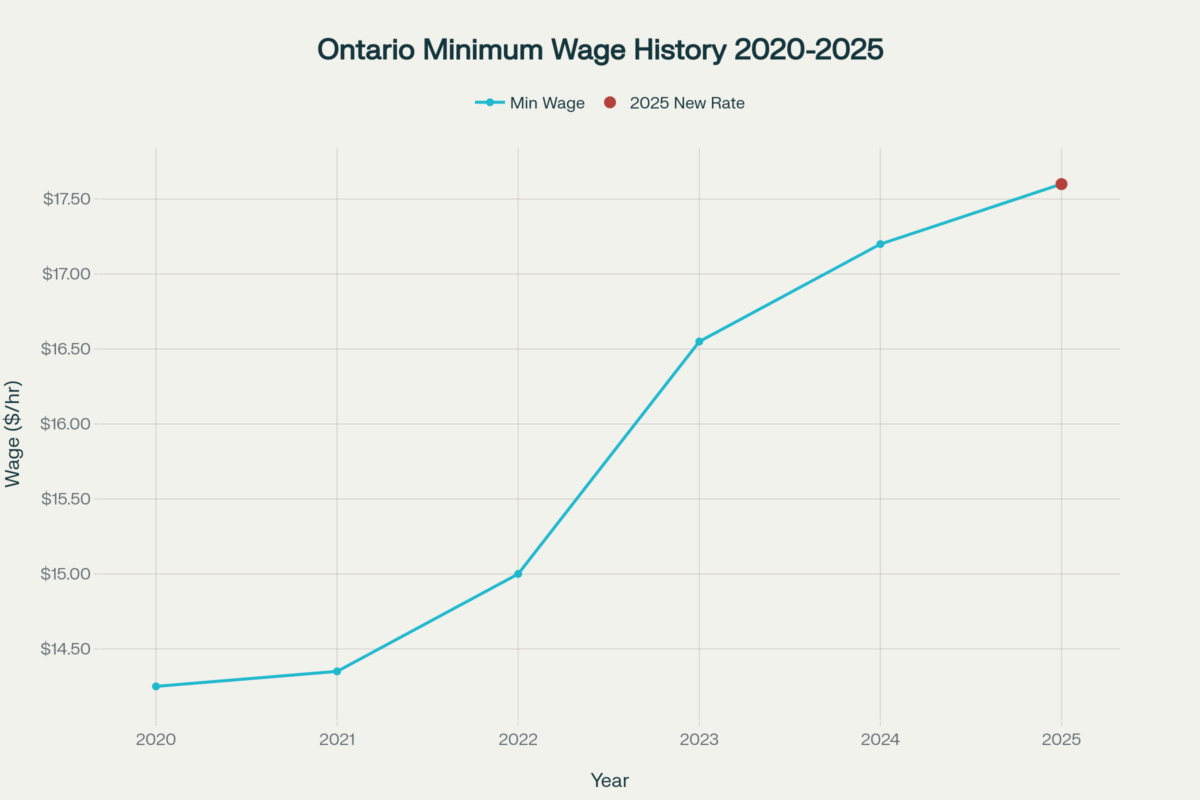
Ontario Minimum Wage Progression from 2020 to 2025
The chart above shows the steady progression from $14.25 in 2020 to $17.60 in 2025. Notable increases occurred in:
- 2022: $0.65 increase (4.5%) to $15.00
- 2023: $1.55 increase (10.3%) to $16.55
- 2024: $0.65 increase (3.9%) to $17.20
- 2025: $0.40 increase (2.3%) to $17.60
This progression reflects Ontario’s commitment to annual adjustments tied to inflation, ensuring wages keep pace with rising costs of living.
How Ontario Calculates Minimum Wage Increases
Since 2022, Ontario has used a formula-based approach to determine minimum wage increases, eliminating arbitrary political decisions and providing predictability for both workers and employers.

Flow diagram showing Ontario minimum wage calculation process using CPI
The Consumer Price Index (CPI) Formula
The province uses the Ontario Consumer Price Index (CPI) to calculate annual adjustments. Here’s how it works:
- Data Collection: Statistics Canada measures price changes for a basket of goods and services
- Annual Review: The government reviews CPI data each year
- Calculation: The percentage increase in CPI determines the minimum wage adjustment
- Announcement: New rates are announced by April 1st each year
- Implementation: Changes take effect on October 1st
For 2025: The 2.4% CPI increase for 2024 resulted in the current minimum wage adjustments.
What This Means for Workers
Financial Impact
Workers earning minimum wage will see their annual income increase by approximately $832 per year (based on a 40-hour work week). This translates to:
- Weekly increase: $16.00
- Monthly increase: $69.33
- Annual increase: $832.00
Broader Benefits
- Cost of Living Adjustment: Helps offset inflation and rising expenses
- Predictability: Workers can anticipate annual increases tied to economic indicators
- Improved Standard of Living: Additional income for essential expenses like housing, food, and transportation
What This Means for Employers
Immediate Impacts
- Increased Labor Costs: Direct increase in payroll expenses
- Related Costs: Higher Employment Insurance (EI) and Canada Pension Plan (CPP) contributions
- Budget Adjustments: Need to revise financial projections and pricing strategies
Long-term Considerations
- Improved Employee Retention: Competitive wages may reduce turnover
- Enhanced Productivity: Better-compensated workers often show increased job satisfaction
- Market Competitiveness: Staying aligned with provincial wage standards
Employer Compliance Checklist
To help employers prepare for the October 1, 2025 changes, here’s a comprehensive checklist with recommended timelines:
Pre-September Tasks
- Review current employee wage rates (by September 15)
- Identify employees earning below new minimum wage (by September 15)
- Calculate increased payroll costs (by September 15)
September Tasks
- Update payroll systems and software (by September 30)
- Adjust employee contracts and documentation (by September 30)
- Update timekeeping and record-keeping systems (by September 30)
- Notify employees of wage changes (by September 30)
- Update budget and financial projections (by September 30)
October 1 Tasks
- Review and update employee handbooks
- Ensure compliance with different worker categories
- Review overtime calculations
- Post updated Employment Standards Act poster
How Ontario Compares to Other Provinces
Ontario’s minimum wage increase positions the province competitively within Canada’s wage landscape.
Provincial Rankings (2025)
- Nunavut: $19.00
- Yukon: $17.94
- British Columbia: $17.85
- Ontario: $17.60
- Federal (Regulated): $17.75
Key Comparisons
- Above National Average: Ontario’s rate exceeds the national average of approximately $16.40
- Regional Competitiveness: $0.25 below British Columbia, $1.50 above Quebec
- Federal Alignment: $0.15 below the Federal Minimum Wage for regulated industries
This ranking demonstrates Ontario’s commitment to maintaining competitive wage standards while balancing business sustainability.
Frequently Asked Questions
When do the new rates take effect?
All new minimum wage rates take effect on October 1, 2025, at the start of the business day.
Do these rates apply to all workers?
The new rates apply to most workers covered by the Ontario Employment Standards Act. However, some workers may be exempt, including:
- Federally regulated employees (who follow federal minimum wage)
- Students in work-study programs
- Certain agricultural workers (specific exemptions apply)
How are overtime rates calculated?
Overtime rates are calculated as 1.5 times the employee’s regular hourly rate. With the new minimum wage:
- General workers: $26.40 per hour for overtime
- Students: $24.90 per hour for overtime
- Homeworkers: $29.03 per hour for overtime
What happens to employees paid above minimum wage?
Employees already earning above the new minimum wage rates are not automatically entitled to increases. However, many employers review their wage scales to maintain internal equity.
Can employers reduce hours to offset wage increases?
While legally possible, reducing hours to offset wage increases can negatively impact employee morale and productivity. Many successful businesses focus on improving efficiency and customer service to manage increased labor costs.
Impact on Different Industries
Retail and Food Service
These sectors, which employ many minimum wage workers, will see the most significant impact:
- Immediate cost increases for businesses with large minimum wage workforces
- Potential price adjustments to maintain profit margins
- Improved employee retention due to better compensation
Healthcare and Social Services
Many support workers in these sectors earn minimum wage:
- Enhanced recruitment potential with competitive wages
- Improved service quality through better staff retention
- Budget adjustments needed for non-profit organizations
Small Business Considerations
Small businesses may face unique challenges:
- Proportionally higher impact on tight margins
- Need for strategic planning to manage increased costs
- Opportunities for improved productivity and customer service
Preparing for Future Changes
Annual Review Process
Ontario’s commitment to annual reviews means employers should:
- Budget for annual increases based on CPI projections
- Develop flexible payroll systems that can accommodate regular adjustments
- Stay informed about economic indicators and government announcements
Long-term Planning
Smart businesses are already preparing for future changes by:
- Investing in employee training to improve productivity
- Implementing efficiency measures to offset wage increases
- Building wage increases into financial projections
Resources and Support
Government Resources
- Ontario Ministry of Labour: Information on employment standards and compliance
- Employment Standards Act: Complete legislation and guidelines
- CPI Data: Statistics Canada provides monthly consumer price index updates
Professional Support
- HR Consultants: Help with compliance and payroll system updates
- Legal Advisors: Assistance with employment law and contract updates
- Accounting Professionals: Support with financial impact analysis and budget adjustments
Conclusion
Ontario’s minimum wage increase to $17.60 per hour represents a balanced approach to supporting workers while maintaining business viability. The 2.4% increase reflects the province’s commitment to keeping wages aligned with the cost of living through transparent, predictable adjustments.
For workers, this increase provides meaningful financial relief and demonstrates the government’s recognition of their essential contributions to Ontario’s economy. For employers, while the immediate impact involves increased costs, the predictable nature of these adjustments allows for better planning and budget management.
The key to successful implementation lies in early preparation, clear communication, and strategic planning. By following the compliance checklist and understanding the broader economic context, both employers and employees can navigate these changes effectively.
As Ontario continues its annual review process, staying informed about CPI trends and government announcements will help all stakeholders prepare for future adjustments. The province’s transparent approach to minimum wage policy provides the certainty needed for long-term planning and sustainable business growth.
Remember that minimum wage represents the floor, not the ceiling, for compensation. Many employers find that paying above minimum wage helps attract better talent, reduce turnover, and improve overall business performance. The 2025 increase provides an opportunity to review compensation strategies and invest in workforce development for long-term success.
Related reading: Canada Minimum Wage — a closer look at this topic.
Quick answers from official sources
What is Ontario’s general minimum wage now?
$17.95 an hour, in effect since October 1, 2026, per Ontario’s guide to the Employment Standards Act.
When do Ontario minimum wage changes take effect?
Ontario says a changed rate is published on or before April 1 and comes into effect on October 1.
How does Ontario compare with the federal rate?
The federal minimum wage is $18.15 since April 1, 2026, per Canada.ca; Ontario’s general rate is $17.95.
Sources (checked October 27, 2026):