Canada Minimum Wage 2026: Provincial Rates & Guide

Canada’s minimum wage landscape in 2025 reflects significant regional variations and ongoing adjustments to help workers keep pace with the cost of living. This comprehensive guide covers everything you need to know about minimum wage rates across all provinces and territories, upcoming changes, and your rights as an employee or employer.
Quick answer: As of our October 27, 2026 check, the federal minimum wage is $18.15 an hour (since April 1, 2026). Nunavut has the highest territorial or provincial rate at $20.17 and Alberta the lowest at $15.00, while Ontario is $17.95 and British Columbia is $18.25, per each government’s official page.
Compare the current rate for every province and territory in our minimum wage by province.
Understanding Canada’s Minimum Wage System
Canada operates under a dual minimum wage system where both federal and provincial/territorial governments set minimum wage rates for different categories of workers. This system ensures that wages reflect regional economic conditions while maintaining baseline protections for all workers.
Federal vs Provincial Jurisdiction
Federal Minimum Wage: Currently $17.75 per hour (effective April 1, 2025), applies to employees in federally regulated industries including:
- Banking and financial services
- Airlines and airports
- Railways and interprovincial trucking
- Telecommunications
- Postal services
- Broadcasting
Provincial/Territorial Minimum Wages: Set by individual provinces and territories, ranging from $15.00 to $19.00 per hour in 2025.
Important Rule: If the provincial minimum wage is higher than the federal rate, employers must pay the higher amount.
2025 Minimum Wage Rates Across Canada


Canadian minimum wage rates by province and territory for 2025, showing the range from Nunavut’s $19.00/hour to Alberta and Saskatchewan’s $15.00/hour
Here’s a complete breakdown of minimum wage rates across all Canadian provinces and territories:
| Province/Territory | Current Rate | Effective Date | Next Increase |
|---|---|---|---|
| Nunavut | $19.00 | January 1, 2024 | TBD |
| Yukon | $17.94 | April 1, 2025 | April 1, 2026 |
| British Columbia | $17.85 | June 1, 2025 | June 1, 2026 |
| Federal (Federally Regulated) | $17.75 | April 1, 2025 | April 1, 2026 |
| Ontario | $17.20 | October 1, 2024 | October 1, 2025 ($17.60) |
| Northwest Territories | $16.70 | September 1, 2024 | September 1, 2025 |
| Quebec | $16.10 | May 1, 2025 | May 1, 2026 |
| Newfoundland and Labrador | $16.00 | April 1, 2025 | April 1, 2026 |
| Prince Edward Island | $16.00 | October 1, 2024 | October 1, 2025 ($16.50) |
| Manitoba | $15.80 | October 1, 2024 | October 1, 2025 ($16.00) |
| Nova Scotia | $15.70 | April 1, 2025 | October 1, 2025 ($16.50) |
| New Brunswick | $15.65 | April 1, 2025 | April 1, 2026 |
| Saskatchewan | $15.00 | October 1, 2024 | October 1, 2025 ($15.35) |
| Alberta | $15.00 | October 1, 2018 | TBD |
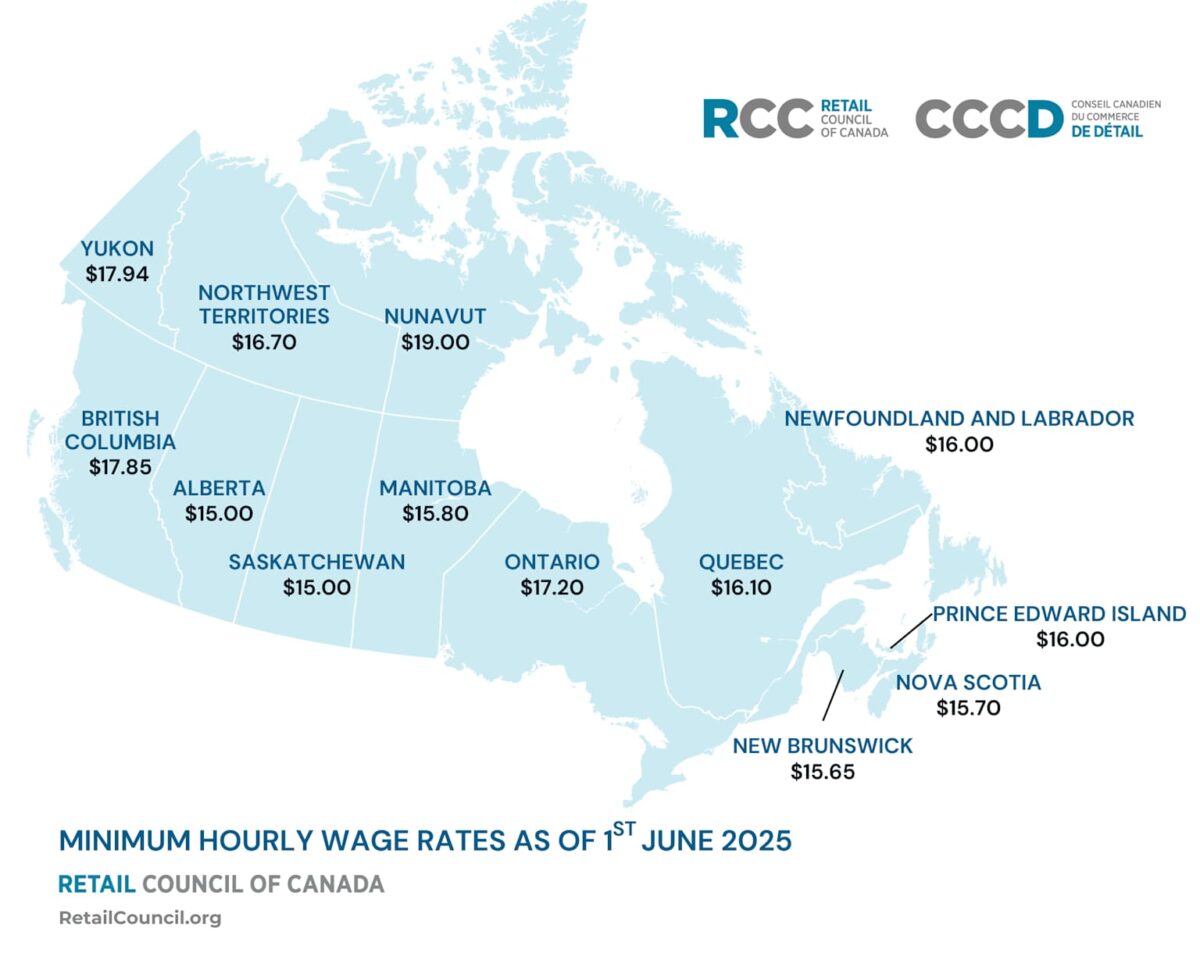
Map of Canada showing minimum hourly wage rates by province and territory as of June 1, 2025
Key Upcoming Changes in 2025
Major Increases Coming October 1, 2025
Five provinces will implement significant minimum wage increases on October 1, 2025:
| Province | Current Rate | New Rate | Increase | Percentage |
|---|---|---|---|---|
| Nova Scotia | $15.70 | $16.50 | $0.80 | 5.10% |
| Prince Edward Island | $16.00 | $16.50 | $0.50 | 3.13% |
| Ontario | $17.20 | $17.60 | $0.40 | 2.33% |
| Saskatchewan | $15.00 | $15.35 | $0.35 | 2.33% |
| Manitoba | $15.80 | $16.00 | $0.20 | 1.27% |
Recent 2025 Updates
- Federal Minimum Wage: Increased to $17.75 on April 1, 2025 (2.4% increase)
- British Columbia: Rose to $17.85 on June 1, 2025 (2.6% increase)
- Quebec: Increased to $16.10 on May 1, 2025
- Nova Scotia: Raised to $15.70 on April 1, 2025
Special Minimum Wage Categories
Student Minimum Wage
Ontario: $16.20 per hour (increasing to $16.60 on October 1, 2025)
- Applies to students under 18 working 28 hours or less per week during school
- Students working more than 28 hours receive the general minimum wage
Alberta: $13.00 per hour for students under 18
- Applies to first 28 hours worked per week when school is in session
- Hours beyond 28 are paid at the general minimum wage ($15.00)
Tipped Employees
Quebec: $12.90 per hour for employees receiving tips
- Applies to restaurant workers, bar staff, and others who customarily receive tips
- Most other provinces require tipped employees to receive the general minimum wage
Gig Workers (British Columbia)
British Columbia: $20.88 per hour for app-based workers
- Applies to ride-hailing and delivery service workers
- Calculated as 120% of the general minimum wage
- Covers “engaged time” (time from accepting to completing assignments)
Homeworkers (Ontario)
Ontario: $18.90 per hour (increasing to $19.35 on October 1, 2025)
- Applies to employees who work from their own homes
- Higher rate accounts for additional expenses and lack of workplace benefits
Employee Rights Guide: Minimum Wage in Canada 2025
💰 Your Basic Rights
✅ Right to Minimum Wage: You must be paid at least the minimum wage for every hour worked
✅ Right to Overtime Pay: You’re entitled to overtime pay (typically 1.5x regular rate) for hours over the standard work week
✅ Right to Accurate Pay: You must receive detailed pay stubs showing hours worked and deductions
✅ Right to Timely Payment: Your employer must pay you on scheduled pay days
✅ Right to Information: You have the right to know the minimum wage rate that applies to you
📊 Know Your Rates
- Federal Minimum Wage: $17.75/hour (for federally regulated employees)
- Provincial/Territorial Rates: Vary by location ($15.00 – $19.00/hour)
- Student Rates: Some provinces have lower rates for students under 18
- Tipped Employee Rates: Quebec has a lower rate for tipped workers ($12.90/hour)
🚨 What to Do If You’re Underpaid
- Keep Records: Document your hours worked and pay received
- Talk to Your Employer: Discuss the issue directly first
- File a Complaint: Contact your provincial labour standards office
- Seek Help: Contact employment lawyers or worker advocacy groups
- Know Protection: You cannot be fired for claiming your wage rights
📋 Common Situations
- Commission Workers: Must still earn minimum wage for all hours worked
- Piece Workers: Total pay must equal at least minimum wage
- Salaried Employees: If hourly equivalent is below minimum wage, you may be entitled to additional pay
- Interns: Most interns are entitled to minimum wage unless in specific exempted programs
📞 Where to Get Help
- Federal Employees: Labour Program – 1-800-641-4049
- Provincial Employees: Contact your provincial labour standards office
- Legal Aid: Many provinces offer free legal assistance for wage issues
- Worker Centres: Local organizations that provide support and advocacy
🔍 Red Flags to Watch For
- Being paid less than minimum wage for any hours worked
- Not receiving overtime pay when entitled
- Employers making illegal deductions from your pay
- Not receiving detailed pay stubs
- Being asked to work “off the clock” without pay
📈 Tips for Success
- Keep detailed records of your work hours
- Understand your provincial minimum wage laws
- Know when rate increases take effect
- Don’t be afraid to ask questions about your pay
- Join unions or worker organizations for additional support
Remember: These are general guidelines. Specific rules may vary by province/territory and industry.
📋 Employer Compliance Checklist
Pre-Employment Setup
- Verify which minimum wage applies (federal vs provincial/territorial)
- Confirm current minimum wage rate for your jurisdiction
- Update job postings with correct wage information
- Prepare employment contracts with accurate wage details
- Set up payroll systems with current rates
Payroll Management
- Ensure all employees receive at least minimum wage for every hour worked
- Calculate overtime pay correctly (typically 1.5x regular rate)
- Include commission and piece-rate workers in minimum wage calculations
- Account for deductions (meals, lodging) within legal limits
- Process payroll on time and provide detailed pay stubs
Rate Updates & Monitoring
- Track upcoming minimum wage increase dates
- Update payroll systems before rate changes take effect
- Notify employees of wage increases in advance
- Monitor federal minimum wage for federally regulated employees
- Stay informed about provincial/territorial rate changes
Record Keeping
- Maintain accurate time records for all employees
- Keep payroll records for required retention periods (typically 3-6 years)
- Document overtime hours and premium pay calculations
- Store employment contracts and wage agreements
- Maintain records of any wage-related deductions
Understanding Overtime Rules
Standard Overtime Thresholds
- Most Provinces: Overtime after 40-44 hours per week
- Federal: Overtime after 8 hours per day or 40 hours per week
- Overtime Rate: Typically 1.5x the regular hourly rate
Overtime Calculation Example
If you earn $17.20/hour (Ontario minimum wage):
- Regular hours (1-40): $17.20/hour
- Overtime hours (41+): $25.80/hour (1.5 × $17.20)
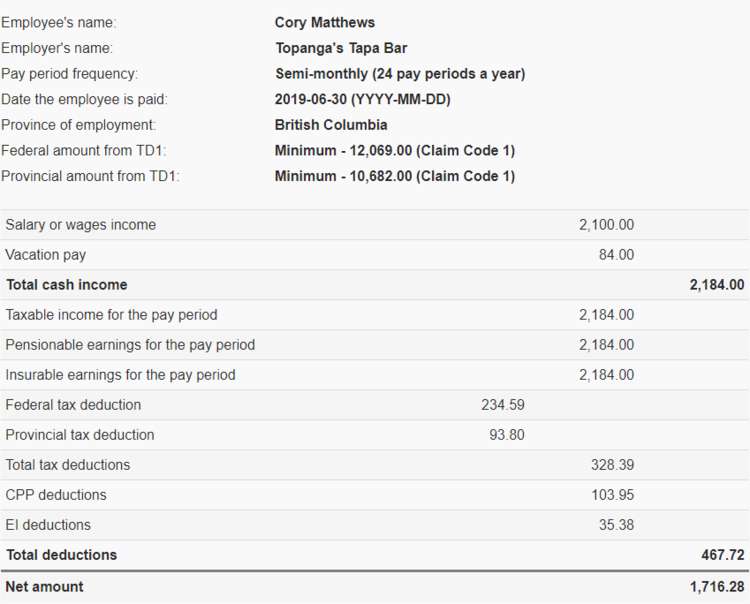
Example of a Canadian payroll summary showing wages, deductions, and net pay for an employee in British Columbia
Frequently Asked Questions
Q: How often are minimum wages updated?
u003cstrongu003eAu003c/strongu003e: Most provinces update minimum wages annually, typically on dates like April 1, October 1, or May 1. The federal minimum wage is reviewed every April 1u003ca href=u0022https://www.canada.ca/en/employment-social-development/news/2025/02/increasing-the-federal-minimum-wage-starting-april-1-2025.htmlu0022 target=u0022_blanku0022 rel=u0022noreferrer noopeneru0022u003eu003c/au003eu003ca href=u0022https://www.govdocs.com/canada-minimum-wage/u0022 target=u0022_blanku0022 rel=u0022noreferrer noopeneru0022u003eu003c/au003e.
Q: Do commission workers get minimum wage?
u003cstrongu003eAu003c/strongu003e: Yes, commission workers must still earn at least minimum wage for every hour worked. If commissions don’t meet this threshold, employers must top up the differenceu003ca href=u0022https://payroll.ca/minimum-wage-updatesu0022 target=u0022_blanku0022 rel=u0022noreferrer noopeneru0022u003eu003c/au003eu003ca href=u0022https://www.tiphaus.com/blog/canada-tipping-laws-explained/u0022 target=u0022_blanku0022 rel=u0022noreferrer noopeneru0022u003eu003c/au003e.
Q: Are interns entitled to minimum wage?
u003cstrongu003eAu003c/strongu003e: Most interns are entitled to minimum wage unless they’re in specific exempted educational programsu003ca href=u0022https://payroll.ca/minimum-wage-updatesu0022 target=u0022_blanku0022 rel=u0022noreferrer noopeneru0022u003eu003c/au003eu003ca href=u0022https://www.tiphaus.com/blog/canada-tipping-laws-explained/u0022 target=u0022_blanku0022 rel=u0022noreferrer noopeneru0022u003eu003c/au003e.
Q: Can employers make deductions that bring pay below minimum wage?
u003cstrongu003eAu003c/strongu003e: No, with very limited exceptions for things like meals and lodging (with strict limits), employers cannot make deductions that reduce pay below minimum wageu003ca href=u0022https://payroll.ca/minimum-wage-updatesu0022 target=u0022_blanku0022 rel=u0022noreferrer noopeneru0022u003eu003c/au003eu003ca href=u0022https://en.wikipedia.org/wiki/List_of_countries_by_minimum_wageu0022 target=u0022_blanku0022 rel=u0022noreferrer noopeneru0022u003eu003c/au003e.
Regional Highlights
Highest Minimum Wages
- Nunavut: $19.00 (reflects high cost of living in the North)
- Yukon: $17.94 (adjusted annually based on Whitehorse CPI)
- British Columbia: $17.85 (includes automatic annual adjustments)
Lowest Minimum Wages
- Alberta & Saskatchewan: $15.00 (Alberta unchanged since 2018)
- New Brunswick: $15.65
- Nova Scotia: $15.70 (increasing to $16.50 in October 2025)
Impact on Workers and Businesses
For Workers
- Increased Purchasing Power: Higher wages help offset inflation
- Regional Variations: Wages reflect local economic conditions
- Automatic Adjustments: Many provinces now tie increases to inflation
For Businesses
- Payroll Planning: Need to budget for scheduled increases
- Compliance Requirements: Must track multiple rate changes
- Competitive Hiring: Higher wages can improve recruitment and retention
Annual Salary Equivalents
Based on a 40-hour work week (2,080 hours annually):
| Hourly Rate | Annual Salary (Gross) |
|---|---|
| $15.00 | $31,200 |
| $16.00 | $33,280 |
| $17.20 | $35,776 |
| $17.85 | $37,128 |
| $19.00 | $39,520 |
Looking Ahead: Future Trends
Key Trends to Watch
- Inflation Adjustments: More provinces adopting automatic annual increases
- Living Wage Advocacy: Push for rates that reflect actual cost of living
- Gig Economy: Expanding protections for app-based workers
- Regional Variations: Continued differences reflecting local economic conditions
Upcoming Review Dates
- Federal: April 1, 2026
- Ontario: October 1, 2025 (confirmed increase to $17.60)
- British Columbia: June 1, 2026
- Quebec: May 1, 2026
Resources and Support
Government Resources
- Employment and Social Development Canada: canada.ca/employment
- Provincial Labour Standards: Contact your provincial government
- Canada Revenue Agency: Information on payroll taxes and deductions
Worker Support Organizations
- Local Labour Councils: Community-based worker advocacy
- Legal Aid: Free legal assistance for wage issues
- Worker Rights Centres: Support for employment-related problems
Conclusion
Canada’s minimum wage system in 2025 reflects a complex but comprehensive approach to protecting workers while accommodating regional economic differences. With rates ranging from $15.00 to $19.00 per hour, and several provinces implementing increases throughout the year, both workers and employers need to stay informed about current rates and upcoming changes.
The key to success is understanding which minimum wage applies to your situation, staying current with rate changes, and knowing your rights and obligations. Whether you’re an employee ensuring fair compensation or an employer maintaining compliance, this guide provides the foundation for navigating Canada’s minimum wage landscape in 2025.
Remember: Minimum wage rates and regulations can change, so always verify current information with official government sources for your specific province or territory.
Related reading: Discover Ontario Minimum Wage — a closer look at this topic.
Quick answers from official sources
What is the federal minimum wage?
$18.15 an hour since April 1, 2026, per Canada.ca; it was $17.75 from April 1, 2025.
How are federal minimum wage increases decided?
Canada.ca says increases are based on Canada’s Consumer Price Index for the previous calendar year, as published by Statistics Canada.
Which minimum wage applies if provincial pay is higher?
If the minimum wage of the province or territory where the employee usually works is higher than the federal rate, the employer is to pay the higher rate.
Sources (checked October 27, 2026):